
- Photos
- Specs
- Advantages
- Value
- Media Map
| Area:Chengdu | Type:airport | Frequency:120 |
| Address:Chengdu Tianfu International Airport | Format:led | Duration:10s |
| Location:T2 Departure Hall before security check | Min Qty:4 | Operating Time:0-24o'clock |
| Size:3.82m×7.1m=27.122㎡ | Min Period:4weeks |
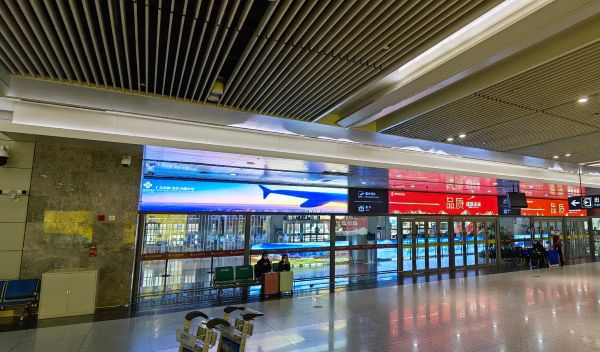
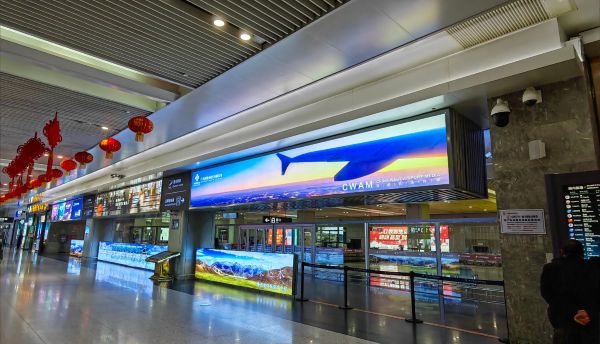
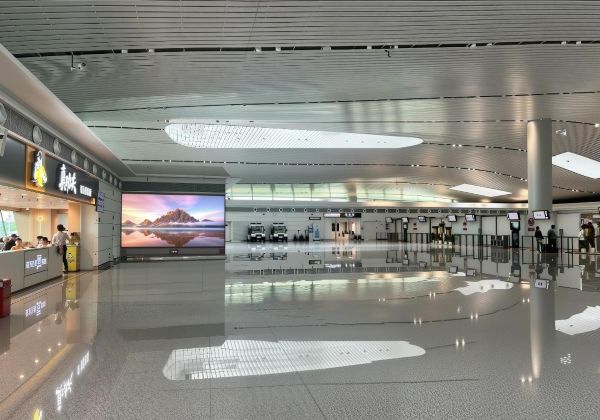
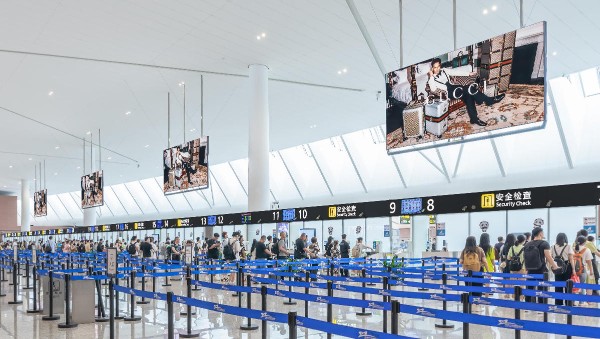
Located on the fourth floor of Terminal 2 in the Domestic Departure Hall, in the core traffic line before security, it is a path that 100% of domestic departing passengers must pass through. Passengers naturally look up at a 15° angle while completing their procedures, with no diversion or blind spots. During queuing and waiting, their line of sight naturally focuses. Four connected screens form a 220° ultra-wide viewing angle, covering the entire security queue and passenger flow. The average waiting time for security is 5–15 minutes, allowing for prolonged effective viewing at close range with a slight upward angle facing the large screens.
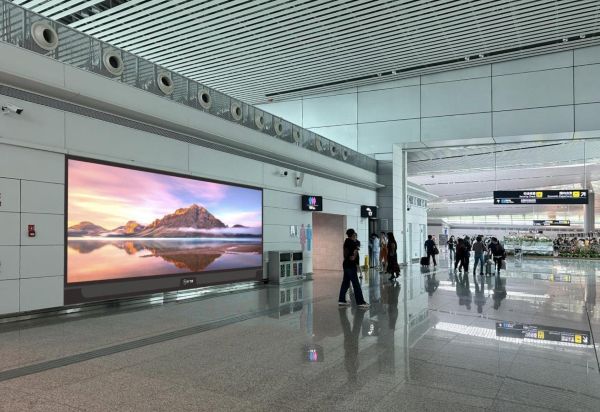
Terminal 2 caters to an average of 120,000 domestic departures daily, with peak hours exceeding 10,000 passengers. There is no interference from low-quality advertisements. The large screens are high-brightness, high-definition with delicate image quality. The connected-screen matrix forms an ultra-long visual corridor. The hall space is open without pillar obstructions or clutter, making visuals extremely clear. Brand images appear high-end and impressive, easily occupying the central visual memory point of the hall, with a 95% attention rate. The effective recall rate is 3–5 times that of ordinary advertisements.
This area is a natural bottleneck in the travel process, with no diversions, blind spots, or dead ends, making it a golden node that all domestic departing passengers must pass through. It firmly captures the full passenger flow for check-in and security waiting. During security queuing, passengers’ sights are highly focused, creating immersive passive reception with effective attention and single-exposure duration far exceeding conventional airport display points.
The large-screen matrix delivers strong visual impact with all-day long-loop playback and high-frequency exposure. Natural frontal and slightly upward gaze at the screens results in a much higher memory retention rate than short-term ads at intersections or shopping areas, effectively achieving the three-step conversion of 'seeing, remembering, trusting.' This creates an ultra-long immersive visual corridor with a wide visible area.
All passengers departing from T2 must pass through this key area before entering the security checkpoint isolation zone. The screens are suspended directly above the security counters or on both sides of the queuing path, providing a wide coverage angle ranging from 15° to 220°, ensuring that passengers' line of sight while queuing is forcibly guided to the screens. This makes the advertising content easily revisited during the long flight, significantly enhancing the persistence of brand memory.
LED media, with its exclusive spatial advantage and mandatory attention attribute, leveraging its unavoidable geographic location, the visual impact of the giant screen from a low angle, and deep reach during security queuing, provides the brand with a cinema-grade widescreen display effect. This greatly enhances the brand's high-end image and becomes a strategic high ground for brands to establish a premium image and capture consumer mindshare at Western airports.
The pre-security LED large screen serves as a landmark digital media benchmark at airports nationwide, featuring ultra-large size, matrix layout, and mandatory visual coverage. It builds a high-value brand communication entry point, suitable for precise traffic attraction for high-end brands.
LED leverages multidimensional advantages of location, audience, technology, scenario, and ecosystem to create the most valuable brand communication platform within aviation hubs. It provides brands with a complete solution from traffic acquisition to retention, from exposure to conversion, adaptable to full-chain communication goals from brand image building to promotional message delivery. This maximizes communication effectiveness, with information reception efficiency increased by 400% compared to ordinary scenarios.