How to evaluate the effectiveness of subway advertisements? Unveiling the conversion differences between advertisements in subway transfer corridors and platform screen doors
2026-02-14Tianci MediaViews:197
Highlights
How to evaluate the effectiveness of subway advertisements? Unveiling the conversion differences between advertisements in subway transfer corridors and platform screen doors
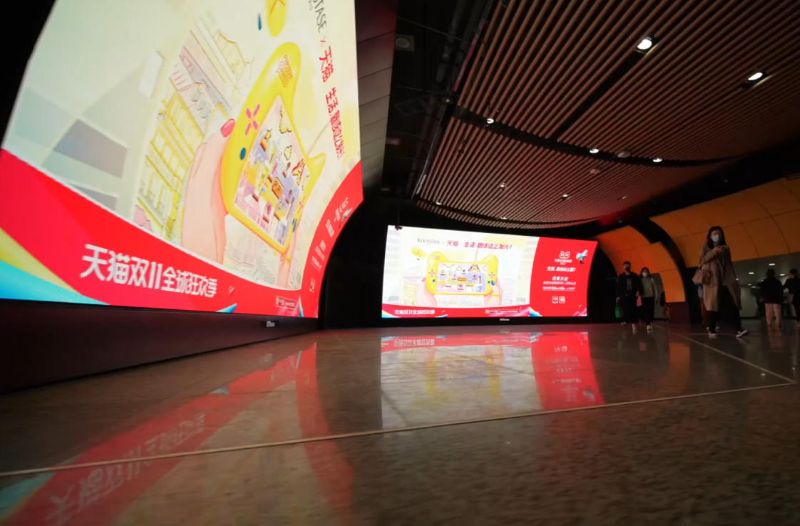
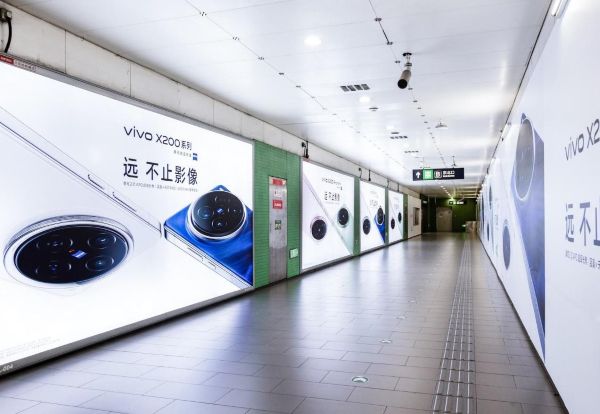
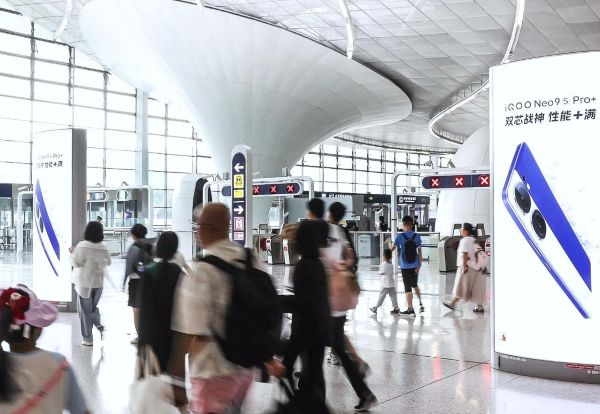
When you walk through super subway stations such as Beijing Guomao, Shanghai People's Square, or Guangzhou Sports West Road, you will be surrounded by various advertisements: continuous wall stickers on both sides of the passage, exquisite light boxes on the pillars, and huge brand images on the platform screen doors. These are all subway advertisements, but are their effects really the same?
For advertisers, a core question always exists: how to evaluate the effectiveness of subway advertising? More specifically, what are the differences in the conversion of subway transfer passages and platform screen door advertisements, two seemingly similar but actually vastly different forms of media?
This article will start from the perspective of audience behavior psychology, combined with real subway scenes, to systematically analyze the essential differences between the two forms of advertising and provide a scientific framework for evaluating their effectiveness.
1、 Understand the essential differences between two forms of advertising
Before discussing the effectiveness evaluation, it is necessary to first understand the physical environment and audience state in which these two forms of advertising are located.
(1) Subway transfer channel advertisement
A transfer passage is a narrow corridor connecting different subway lines, where passengers are in a walking state, traveling from one station to another.
The key feature of this scene is continuous viewing while in motion. The passenger walked at a normal pace and scanned the advertisements on both sides of the passage. If the advertising design is attractive enough, they may slow down and take a second look, but overall, this is a "browsing style" advertising exposure.
The advantage of transfer channel advertising lies in its long exposure time and repeated reach. A transfer channel, passengers may commute twice a day, ten times a week, and forty times a month. This high-frequency repeated exposure is extremely effective in establishing brand memory.
(2) Platform screen door advertisement
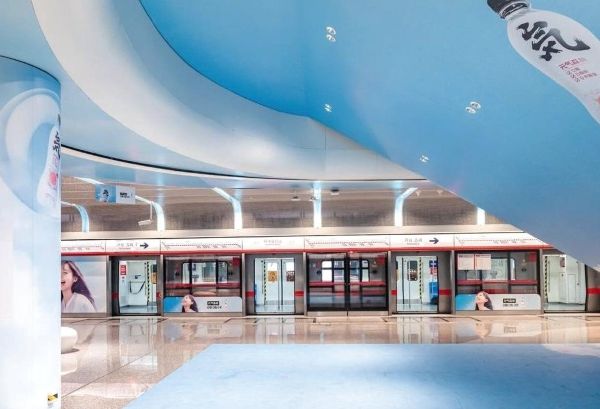
Platform screen doors are safety doors installed at the edge of the platform and opened when the train arrives at the station. Passengers are in a waiting state here, with nowhere to turn their gaze for a few minutes before the train arrives.
The key feature of this scene is the deep viewing in stillness. The passenger stands in front of the screen door, with their line of sight parallel to the advertisement, and has ample time to read every word and observe every detail on the advertisement. This is a 'staring' advertising contact.
The advantage of platform screen door advertising lies in its highly focused attention and strong information carrying capacity. It can carry slightly longer copy, more complex creativity, and even guide interactive behaviors such as scanning codes.
2、 Comparison of Core Dimensions: Conversion Differences between Two Advertising Forms
Based on the differences in the above scenarios, we compare the conversion potential of the two advertising forms from four core dimensions.
(1) Audience psychological state: haste vs. waiting
This is the most fundamental difference.
Passengers in the transfer passage are in a hurry. Their core goal is to reach their destination as soon as possible, and advertising is a passing scenery. In this state, the task of advertising is to capture attention and convey core information in a very short period of time.
The passengers in front of the platform screen doors are waiting. Their core goal has been achieved - to reach the platform, and the next step is to wait for the train. This period is a state of attention surplus, and advertisements have the opportunity to be deeply read.
Conversion difference: Transfer channel advertisements are suitable for fast communication of strong visual symbols, while platform screen door advertisements are suitable for complex information that needs to be explained.
(2) Viewing duration and frequency
The viewing of transfer channels is high-frequency and short-term. Taking a 50 meter transfer passage as an example, it takes about thirty to forty seconds for passengers to walk through it. During this time, their gaze may scan the advertisements on both sides, and the actual gaze time of a single advertisement may only be two or three seconds. But the advantage is that it repeats itself every day, forming a cumulative effect.
The viewing of platform screen doors is low-frequency and long-lasting. Passengers usually stay at the platform for two to five minutes, during which they repeatedly watch the screen door advertisements in front of them. But only twice a day (commuting in the morning and evening), with a lower frequency than the transfer channel.
Conversion difference: Transfer channel advertising wins by frequency, suitable for brand memory construction; Platform screen door advertising wins by duration and is suitable for deep information transmission.
(3) Interactive possibilities
Both forms of advertising can guide QR code interaction, but the likelihood difference is significant.
At the transfer channel, passengers are in a walking state, and stopping to scan the code requires strong motivation and convenient timing. If the advertisement is attractive enough and the QR code location is easy to scan, it may still trigger interaction.
At platform screen doors, passengers have ample time and are more willing to take out their phones to scan the code. Especially when the train is only a few minutes away from the station, scanning the code becomes a way to pass the time.
Conversion difference: The real-time interaction rate of platform screen door advertisements is usually higher than that of transfer channel advertisements.
(4) Cost effectiveness
From the perspective of unit price, transfer channel advertisements are usually higher than platform screen door advertisements. The full package deployment of a core transfer channel can cost tens of thousands or even millions of yuan. The price of a single group of platform screen door advertisements is relatively affordable.
However, in terms of the cost per thousand people, transfer channels are often more cost-effective due to their huge passenger flow. Although platform screen doors have precise crowd access, the absolute number of people they can reach is relatively limited.
Conversion difference: Pursuing total exposure and high cost-effectiveness of transfer channels; Pursuing precise reach and deep communication, the advertising value of platform screen doors is greater.
3、 Scientific evaluation framework: Four step method for measuring the effectiveness of subway advertising
After understanding the differences, a scientific method is needed to evaluate the effectiveness. The following is a four step evaluation framework applicable to two forms of advertising.
Step 1: Clarify the evaluation hierarchy
The effectiveness of subway advertising is not singular and needs to be evaluated in layers.
Exposure level: How many people have seen the advertisement? This is the most basic evaluation dimension, usually provided by media providers with traffic data.
Cognitive level: How many people remember the advertisement? This requires measuring changes in brand mention rates through research.
Interaction level: How many people have scanned the QR code and searched for brand keywords? This requires setting up a dedicated tracking channel.
Conversion level: How many people ultimately completed the purchase, registration, and arrival at the store? This is the ultimate effect that needs to be achieved through attribution analysis.
Different forms of advertising contribute differently at different levels. Transfer channels contribute more to exposure and cognitive levels, while platform screen advertising has higher potential in interactive levels.
Step 2: Set up tracking mechanism
Unable to track, unable to evaluate. It is necessary to design a method for verifying the effectiveness before advertising.
Exclusive QR code: Set up a separate QR code for subway advertising, guide it to a customized landing page, and track scanning data.
Exclusive discount code: Display the "Subway Exclusive XX Discount" discount code on advertisements and track the verification status offline or online.
Customized search terms: Guide users to search for specific keywords, such as "Search for XX brand subway exclusive", and monitor changes in search volume.
Phone extension number: If the advertisement guides phone inquiries, set a dedicated extension number to track the source of incoming calls.
Step 3: Collect multidimensional data
Evaluation requires the integration of multiple data sources.
Media data: pedestrian traffic statistics, route customer group analysis, point exposure estimation.
Self owned data: number of scanned codes, number of discount code cancellations, popularity of exclusive search terms, number of calls from extension numbers.
Survey data: Conduct street or online surveys in the target area before and after advertising to measure brand mention rate and advertising memory.
Third party monitoring: Some advertising companies provide third-party monitoring services to verify the actual publication and exposure quality of advertisements.
Professional agency companies like Tianci Media usually provide clients with integrated data monitoring solutions, bridging media data and client owned data to form a complete effect loop.
Step 4: Calculate the return on investment
The final step is to convert all effects into measurable commercial value.
Exposure value: Calculate the media fees required to obtain equal exposure based on the cost per thousand people.
Interactive value: Calculate the cost of each scan or search and compare it with the customer acquisition cost of online advertising.
Conversion value: Track how many customers who ultimately make deals come from subway advertising channels and calculate the actual input-output ratio.
It should be noted that the brand building value of subway advertising is often difficult to quantify directly, but its impact on long-term business is real. When evaluating, it is necessary to consider both short-term quantifiable effects and long-term brand asset accumulation.
4、 Common Misconceptions and Avoiding Pits Guide
Misconception 1: Only focusing on foot traffic, neglecting the quality of the crowd
Many people believe that a website with high foot traffic will definitely have good results. But the pedestrian flow and commercial value of Guomao Station and Baishiqiao South Station are vastly different. When evaluating, you should not only look at traffic figures, but also consider whether the audience profile matches your target customers.
Misconception 2: Confusing exposure and effect
Traffic does not equal advertising effectiveness. For a website with millions of traffic, if your advertising design is mediocre, less than one percent may truly remember the brand. The effect depends on the product of "exposure x creative quality x audience matching".
Misconception 3: Neglecting the adaptation of advertising scenes and creativity
Designing transfer channel advertisements as platform screen door advertisements, or vice versa, is a common mistake. Customized advertising content must be designed based on the psychological state and viewing duration of the audience in specific scenarios.
Misconception 4: Short term advertising cannot accumulate results
The effectiveness of subway advertising needs time to ferment. Placing it for one or two weeks may just give passengers a preliminary impression. It is recommended to accumulate brand awareness at least on a monthly basis. Especially for transfer channel advertisements, their high-frequency repetitive value needs to be reflected through a sufficiently long cycle.
Misconception 5: If you can't track it, you think it's ineffective
The value of subway advertising cannot be denied just because sales cannot be directly tracked. Its main contribution lies in the brand's "mental pre-sale" and the environment's "trust endorsement". Many consumers have already become familiar with the brand when they go to the store to consume, but this is usually not actively mentioned because they have seen subway advertisements multiple times.
5. Conclusion
How to evaluate the effectiveness of subway advertising? What are the differences in the conversion between subway transfer channels and platform screen door advertisements?
The answer is: two forms of advertising serve different marketing objectives and require different evaluation criteria to measure.
Subway transfer channel advertisements are high-frequency exposure media that are suitable for establishing a wide brand awareness. Its effect is reflected in the increase of brand mention rate and the expansion of market volume. When evaluating, the focus should be on exposure, cost per thousand people, and brand memory.
Platform screen door advertising is a deep communication media that is suitable for conveying complex information and guiding real-time interaction. Its effectiveness is reflected in scanning rate, search volume, and coupon redemption rate. When evaluating, special attention should be paid to interaction costs, conversion rates, and input-output ratios.
For most brands, the ideal strategy is to combine the two: using transfer channel advertising for large-scale brand exposure, and using platform screen door advertising for precise deep communication and conversion guidance. The synergistic effect of two forms is necessary to maximize the value of subway advertising.
Before advertising, it is recommended to consult professional agencies such as Tianci Media to obtain more targeted point analysis and effectiveness evaluation plans. Let professionals help you design a scientific tracking mechanism, so that your subway advertising budget can be spent clearly and the results are clear.