The entire process of advertising placement in Guangzhou Metro: Media Form, Cost and Effect Evaluation Manual
2026-02-11Tianci MediaViews:126
Highlights
This guide systematically analyzes the media value, mainstream forms, and advertising strategies of Guangzhou Metro advertisements, providing a complete process from goal setting, precise point selection, creative design to effect tracking. Assist you in making scientific decisions and efficiently reach millions of daily customers. Get professional advertising solutions now!
Guangzhou, as a national level rail transit hub city with an average daily passenger flow of over ten million people, its underground network is not only the lifeline of transportation, but also a closed communication space containing enormous commercial energy. Advertising here means that your brand information will accompany the daily commuting of mainstream urban populations, achieving high-frequency and mandatory deep reach. However, advertising placement in Guangzhou Metro is a systematic project involving complex strategies, professional resources, and precise execution.
This guide aims to provide a complete framework from strategy to tactics for decision-makers with purchasing intentions, helping you penetrate the surface, understand its core value, master the methodology of scientific advertising, and transform valuable marketing budgets into tangible brand assets and market returns.
Chapter 1: Strategic Value Evaluation: Why is Guangzhou Metro a brand battleground?
1.1 Core advantages of irreplaceable media
In the diverse media environment of Guangzhou, the core value of subway advertising is built on several irreplaceable foundations:
Massive and stable high-quality passenger flow: The Guangzhou subway network covers the city's core business districts, transportation hubs, residential areas, and industrial parks, with an average daily passenger flow of over ten million. This passenger flow has the characteristics of regularity, high stickiness, and high value, and is the backbone of urban consumption.
Compulsory reach and deep communication in a closed environment: Passengers spend an average of longer time in the station hall, passages, and carriages, and are in a relatively boring and focused state. Advertising information cannot be physically skipped, providing brands with a unique scenario for deep information transmission and emotional connection.
Accurate location labels and crowd screening: Different routes and stations naturally attach clear crowd attributes. For example, Line 3 (including its northern extension) runs through Tianhe CBD, Baiyun residential area, and airport, covering a large number of white-collar workers and business travelers; Line 5 connects Huangpu Industrial Zone and reaches a large number of industrial talents. This provides geographic coordinates for achieving precise regionalization or targeted audience targeting.
The top-level scene created by brand momentum: from a single lightbox to a hundred meter long brand corridor, and then to the entire themed train, the subway space allows brands to build high-level, immersive communication events, which is a top-level offline stage to showcase brand strength and create a high-end image.
1.2 Key factors affecting ROI (return on investment)
When evaluating an advertising plan, it is necessary to comprehensively examine the following four dimensions:
Quality of pedestrian flow and behavioral status: The passenger flow at a station is the foundation, but more importantly, it is important to analyze the behavior of passengers at that station (whether they are speeding through or stopping to wait) and their crowd profile (commuting, shopping, tourism).
Visual exclusivity of media: Is the advertising space in the mainstream direction of passengers' line of sight? What is the level of interference from competing advertisements within the same field of view? This determines whether your advertisement can effectively capture attention.
Adaptation of Creative Scenarios: Has the creative content taken into account the passenger's movement speed, viewing distance, and the unique characteristics of the subway environment? Is it optimized for a quick glance?
The scientificity of the advertising cycle: can short-term exposure establish memory? How to plan the rhythm for long-term occupancy to maintain freshness? This needs to be strictly matched with marketing objectives.

Chapter 2: Comprehensive Analysis of Mainstream Advertising Resources in Guangzhou Metro
Understanding the available 'arsenal' is a prerequisite for developing tactics. The advertising format of Guangzhou Metro mainly revolves around the passenger flow.
2.1 Station Hall and Channel Media (Brand Awareness Explosive Zone)
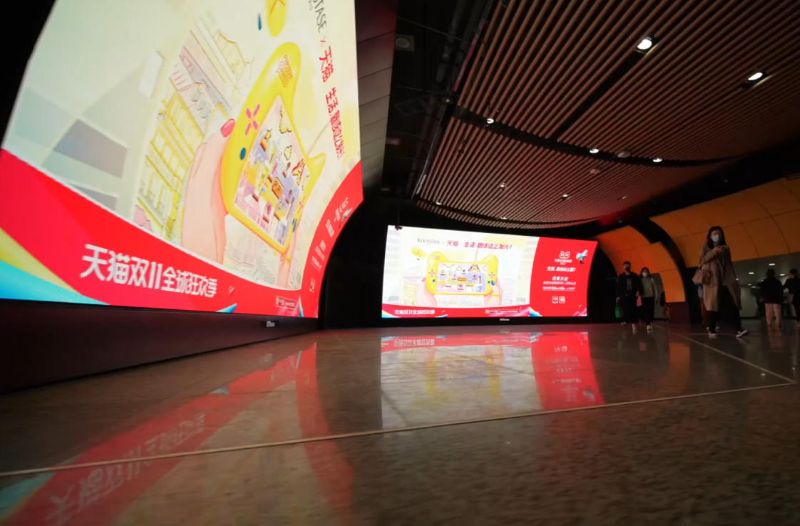
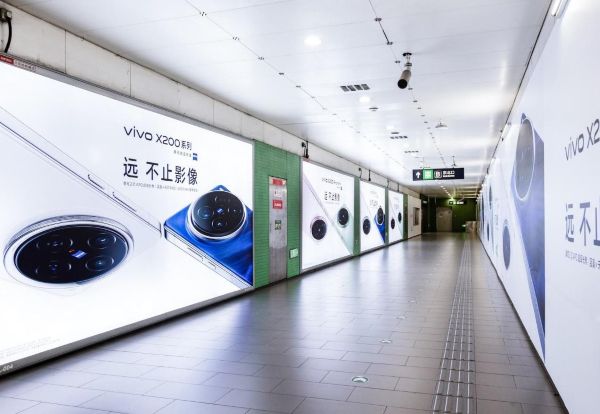
Brand channel/wall stickers:
Location: On both sides of the main long walkway where passengers walk.
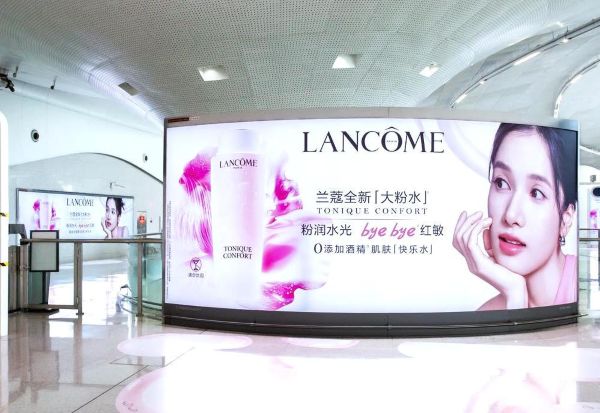
Value: It can create a strong visual surround and immersive brand experience, and is the core resource for creating brand events and achieving high volume exposure. Especially at large transfer stations such as Sports West Road and in front of parks, their value is extremely high.
Lightbox advertising:
Location: Regular locations on both sides of the concourse and passageway.
Value: The fundamental resource that covers the widest network. Good lighting and stable visual display, suitable for long-term brand image display or core product selling point notification.
Column advertising:
Location: Load bearing columns inside the station hall.
Value: Three dimensional display, no visual blind spots, forming a strong visual focus in the center of the space, high utilization rate.
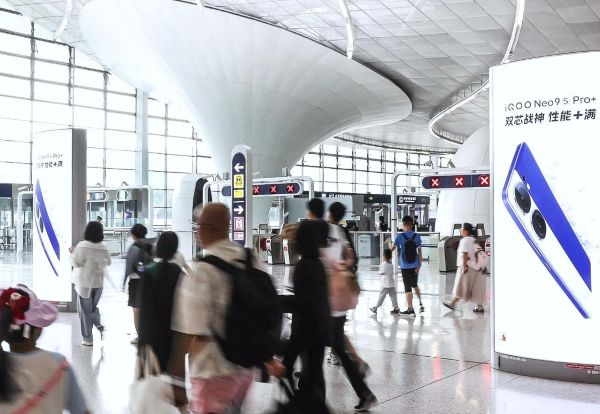
LED digital screen:
Location: Core diversion points such as the entrance and exit of the station hall and above the security checkpoint.
Value: Dynamic videos, strong visual impact, flexible information updates, suitable for playing brand short films or timely promotional information.
2.2 Train media (deep communication accompanying area)
Brand specific train/carriage charter:
Location: Whole train or single carriage interior packaging.
Value: Integrating brand information into the entire passenger journey, achieving 360 degree surround communication, memorable, and strong social communication attributes.
Car door stickers, car window stickers, signboards:
Location: Inside the carriage.
Value: Close and high-frequency contact with passengers. The car door sticker is dynamically displayed as it opens and closes, and the signboard is located above the seat. It takes a long time to read and is suitable for providing product details or action guidance.
Hand held advertisement:
Location: Car armrest pull ring.
Value: Zero distance contact with passengers is an unavoidable visual point, suitable for simple logo display or slogan dissemination.
2.3 Platform media (precise waiting capture area)
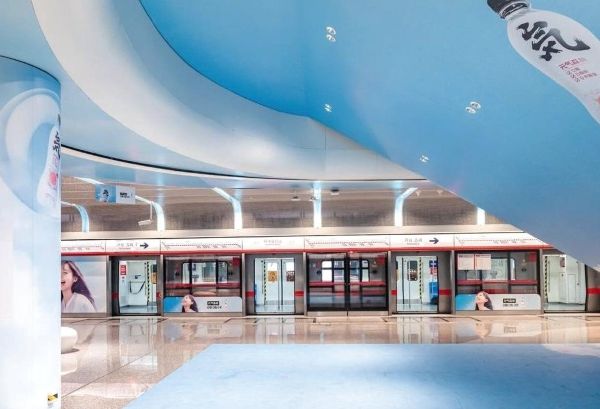
Screen door sticker:
Location: Inside the platform screen door of the train.
Value: The natural focal point of passengers' gaze while waiting for the train. When the car door is closed, it forms a complete picture with good display effect, which is the core attention resource during the waiting period.
Chapter 3: Five Step Practical Process: Scientific Delivery from Strategy to Effect
Step 1: Goal clarification and strategic positioning
This is the 'North Star' of all actions.
Brand orientation vs. effect orientation: Is this advertising campaign aimed at enhancing the overall brand awareness (suitable for brand channels and chartering), or is it to promote specific activities and obtain sales leads (suitable for digital media with QR codes)?
Breadth coverage vs. precise penetration: does it require extensive exposure of multiple routes across the entire network, or does it require concentrated firepower to focus on one or two routes with highly concentrated target populations (such as some stations on Line 1/Line 3 targeting young customers)?
Step 2: Refined point selection and combination based on data
Where to invest directly determines efficiency.
Analysis of Line and Station Value: Study the Guangzhou Metro Line Network Map. The transfer stations (such as Jiahewanggang and Chebeinan) have huge traffic but mixed crowds; The waiting time at the terminal/departure station (such as Airport North and Panyu Square) is long; Business district stations (Tiyu West Road, the Pearl River New Town) have strong consumption intention.
Passenger flow simulation: Identify the "attention nodes" that passenger flow must pass through and may briefly stop at, such as the front of the escalator and the corner of the transfer channel, from entering the gate, entering the channel, getting off the platform, boarding to transferring/exiting the gate.
Develop a "combination punch" strategy: recommend the "core point detonation+network flow coverage" strategy. For example, creating a brand wall sticker (explosive) at the core station of the target area, and at the same time, applying (covering) the lightboxes in the station's passages and inside the trains of related lines to assist in forming a three-dimensional communication network.
Utilizing professional platforms to optimize decision-making: the query and combination of subway resources are extremely complex. Collaborating with professional organizations like Tianci Media can achieve twice the result with half the effort. Tianci Media is a professional subway advertising placement company that possesses real-time databases, historical advertising data, and intelligent point selection tools for Guangzhou subway media. Based on your goals and budget, it can quickly generate cost-effective resource combinations and provide accurate quotes and feasibility analysis.
Step 3: Creative Design: Customize for "Mobile Reading" and "Underground Environment"
Subway advertising is not a simple enlargement of graphic design.
The three second principle and oversized text message: Most passengers are in motion. The main visual, brand identity, and core appeal (such as event theme) must be highlighted to ensure clear recognition within 3-5 meters and 3 seconds.
High contrast color matching and lighting considerations: The lighting inside the subway is complex, and bright, high contrast colors should be used to avoid using low contrast light colors. The design draft needs to consider the actual lighting effect of the lightbox.
Scenario based copywriting and strong call to action: Copywriting can combine emotional scenarios such as "commuting," "departure," and "arrival. Clear behavioral instructions must be included, such as a prominent QR code and prompts for "scan to collect" and "learn more".
Step 4: Budget Planning, Negotiation, and Contract Execution
Budget composition: Total budget=media rental (main part)+advertising space image production and installation fees+creative design fees (if necessary).
Price factors: Prices are greatly influenced by factors such as site traffic level, media format (static/dynamic), area, and purchase duration (usually starting from 2 weeks). The price of core locations on popular sites may be several times higher than that of regular sites.
Key terms of the contract: Clearly stipulate the publication/download time, specific location number, technical specifications, monitoring and acceptance standards, and breach of contract liability. Include all confirmed resource lists as annexes to the contract.
Step 5: Effect tracking, monitoring, and integrated dissemination
Offline effect tracking: Track direct inquiries or sales conversions from subway advertisements through activity exclusive QR codes or discount codes.
Brand indicator monitoring: Compare the search index and discussion volume changes of the brand on mainstream search engines and social media before and after advertising.
Online integration and amplification: Preheating the visual materials of subway advertisements on social media; During the advertising period, interactive topics such as # Encounter XX Brand on Guangzhou Metro # can be initiated to encourage users to check-in and share, converting offline exposure into online social assets.
Chapter 4: Three Misunderstandings in Advertising that Must Be Vigilant Against to Improve ROI
Misconception 1: Only pursuing "high foot traffic", ignoring "crowd matching" and "viewing status".
Wrong: Blindly choosing top flow transfer stations such as Tiyu West Road, but the crowd at the station is rushing and the purpose is complex, making it difficult to precipitate advertising information.
Yes: You should choose stations or areas that match the brand tone and have the possibility of passengers making a brief stop (such as exit passages to large office buildings, platform waiting areas). Precision is more important than generalization.
Misconception 2: Designing "self interested" and information overload is like a "wall detail page".
Wrong: The screen is filled with product images, small text copy, and multiple selling points, which are completely ineffective under mobile and long-distance viewing conditions.
Yes: Adhere to the principle of 'one image, one core message'. Establish recognition with a huge logo, convey value with a prominent slogan, and guide interaction with a clear instruction. Convey limited information within a limited time frame.
Misconception 3: Treating subway advertising as an isolated campaign and lacking integrated marketing thinking.
Wrong: Waiting for the effect after the advertisement is published has nothing to do with online marketing activities.
Yes: Subway advertising should be the "offline tipping point" of the entire marketing campaign. Online social media preheating and attracting attention, offline subway strong exposure establishing physical cognition, and then using methods such as scanning codes to redirect traffic back to the online private domain for sedimentation and conversion, forming a marketing loop.
Conclusion
The success of advertising placement in Guangzhou Metro essentially depends on the perfect combination of "precision of strategy", "efficiency of resource combination", and "adaptability of creative scenes". It requires decision-makers not only to have a perspective on media purchasing, but also to have insight based on urban crowd flow and planning power for integrated marketing.
For brands that pursue efficient and reliable advertising results, partnering with partners such as Tianci Media who have deep media resources, data technology capabilities, and professional services throughout the process is a wise choice to reduce trial and error costs, optimize advertising strategies, and ensure final results. This not only helps you navigate the complex advertising process, but also enables your brand information to efficiently navigate through the underground arteries of Guangzhou, maximizing its value.
Now, it's time to precisely anchor your brand strategy on this golden channel with an average daily flow of millions of customers.