When is it suitable to place subway advertisements? Strategy and Decision Guide for Beginners in 2026
2026-02-12Tianci MediaViews:135
Highlights
When is it suitable to place subway advertisements? This article deeply decomposes from four dimensions: seasonal patterns, marketing nodes, weekly time periods, and daily time periods, using real cases to tell you: choosing the right timing can double the effect; Choosing the wrong timing can result in money being wasted. A must read for beginners, get the subway advertising timing decision list immediately!
Have you ever thought about a question——
Why do some brands achieve explosive results after investing in subway advertisements, on core lines in first tier cities, and with an annual budget?
Is it creativity? Did you choose the wrong location? Or is there a problem with the product itself?
It's all possible. But there is another variable that is ignored by the vast majority of beginners but can make the effect worse by more than three times:
opportunity.
When is it suitable to place subway advertisements? This question may sound simple, but the truth is: 80% of beginners simply choose the wrong time.
Some people advertise beer in January, some advertise New Year's goods in July, some advertise workplace recruitment on weekends, and some advertise sleep aid products during the morning rush hour. I took every penny for granted when I spent it, until I realized during the review that my advertisement had been at a disadvantage from the beginning.
This guide will thoroughly break down the time password for subway advertising for you. This is not mysticism, it is a quantifiable and replicable decision science.
Chapter 1: Why is "when to invest" more deadly than "where to invest"?
Before entering a specific strategy, you must first understand the underlying logic.
What is the essence of subway advertising? It is capturing people in a specific state in a specific space.
Space determines who can see you, and time determines in what state they see you.
It's also the Sports West Road Station——
People who pass by at 8 o'clock in the morning are anxious clock ins, with only one thing in their minds: don't be late.
Those who pass by at 7 pm are exhausted souls who have finally finished work and just want to go home and lie down quickly.
The people who passed by on Saturday afternoon were casual players who came to go shopping and eat, feeling relaxed and their desire to consume was high.
At the same point, at different times, there are fundamentally five different media.
That's why when subway advertising is suitable for placement is not a matter of adding icing on the cake, but a matter of life and death. Choosing the wrong time, you are using the price of beer advertising to buy the attention of a group of people who don't want to drink beer.
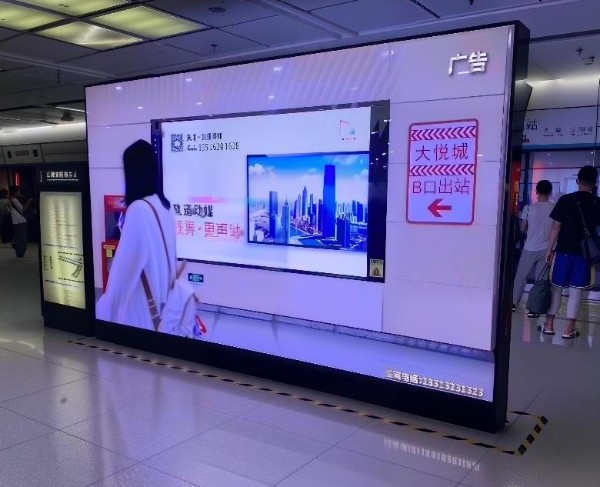
Chapter 2: Four Major Time Dimensions, Decomposing the Timing Password of Subway Advertising
Dimension 1: Seasonal cycle - go with the flow, don't change your destiny against the tide
The seasonal pattern of subway advertising is more cruel and honest than you imagine.
The first quarter (January to March) is a period of ice and fire.
The key word for January is' Spring Festival travel rush '. This month's subway is crowded with people dragging suitcases home. Their attention is not on shopping or leisure, but on "why haven't we arrived at the station yet" and "what gifts to bring to their families". This window belongs to transportation, gifts and specialties, and Baijiu New Year goods. Other categories? Basically accompanying running.
February is the empty window period for the Spring Festival. The subway passenger flow in big cities has halved, leaving behind either service industry practitioners who stick to their posts or young people who celebrate the Chinese New Year in place. This is a window of opportunity for local living, food delivery, gaming, and video membership.
March is the first true peak season of the year. The three waves of resuming work, starting school, and changing jobs are overlapping. Recruitment, education and training, rental platforms, commuting equipment, investing in subway advertisements this month can achieve twice the result with half the effort.
The second quarter (April to June) is a period of increasing consumer desire.
The weather turns warmer in April and May, and the willingness to travel on weekends increases. Tourism, light luxury, catering, and beauty have entered the peak of advertising. The period around May Day is the first offline consumption peak of the year.
There are two keywords in June: college entrance examination and mid year promotion. Before and after the college entrance examination, efforts began to be made in filling out college applications, seeking advice on studying abroad, and recruiting students for driving schools. During the 618 shopping festival, e-commerce platforms and 3C digital brands will package the entire line of lightboxes to compete for the attention of young people.
The third quarter (July September) is the Ice and Fire Dual Sky 2.0 version.
July and August are the summer months, and the student population has become the main force in the subway. Education and training (non subject categories), amusement parks, cold drinks, and summer movies have significantly better effects during this period compared to other categories.
September is the start of school season and also the peak season for home decoration. The first computer and daily necessities for college freshmen, as well as the refrigerator, air conditioner, and mattress for newlywed families - this month's subway advertising space should belong to durable goods and 3C digital.
The fourth quarter (October December) is the most crowded track of the year.
During the October National Day Golden Week, travel advertisements are flying high. On November 11th, the e-commerce promotion entered a white hot period. Double Twelve in December combined with year-end promotions, retail brands' budgets are scattered out like they don't want money.
The conclusion is very clear: the seasonality of subway advertising is not a limitation, it is navigation. Take advantage of the situation, every penny you have is borrowing strength; Going against the trend and throwing hard, you are pushing the stone up the mountain with ten times your strength.
Dimension 2: Marketing Node - Budget must follow the calendar
If seasonal cycles are 'macro weather', then marketing nodes are 'precise weather forecasts'.
Statutory holidays are clear signs, and if you can't play well, you can only blame yourself.
Spring Festival, Qingming Festival, May Day, Dragon Boat Festival, Mid Autumn Festival, National Day. The peak passenger flow at these nodes can be accurately predicted, and the emotional state of the crowd can also be described in advance. Locking in the location four to six weeks in advance and publishing two to three weeks in advance are the basic skills of subway advertising placement.
The artificial shopping festival is a dark card, competing for reaction speed.
Double Eleven, 618, Black Friday, Goddess' Day. The biggest characteristic of these nodes is that the front line is getting longer and the peak is getting flatter. Ten years ago, Singles' Day was only one day, but now pre-sales are starting twenty days in advance. This poses a new requirement for the placement strategy of subway advertisements - no longer "saturation bombing on a certain day", but "continuous reach within three weeks and changing pictures every week".
Industry specific nodes are the dividends of segmentation.
Home Decoration Festival, Wedding Expo, International Auto Show, College Graduation Season. These nodes do not belong to the general public, but only to advertisers of specific categories. Because it is not a nationwide carnival, competition is not as fierce, and the cost-effectiveness is actually higher.
Tianci Media is a professional subway advertising placement company, and its backend system has a dedicated functional module called "Node Heat Prediction". Based on the subway passenger flow data and advertising placement data of 20 core cities across the country in the past five years, it can tell advertisers: how many weeks before a certain node began to increase, which route's audience is most suitable for this node, and when competitors usually enter the market. For beginners, this is equivalent to directly obtaining the combat map for the next year.
Dimension Three: Weekly Cycle - One week of subway passenger flow is like a TV series
The subway on Monday and the subway on Saturday are two different worlds.
Monday to Thursday is the 'commuting mode'.
The passenger flow during the morning and evening rush hours accounts for over 60% of the entire day. The destinations of passengers are highly concentrated - companies, schools, and service halls. The suitable advertisements for this period should be related to "work", "efficiency", and "self-improvement" categories: coffee, food delivery, online office software, and vocational training.
Friday is the 'switching mode'.
The morning rush hour is still commuting, but the evening rush hour is starting to lose its flavor. At six o'clock on the subway, there are fewer people discussing overtime and more people discussing where to go on weekends. The subway advertisements from Friday afternoon to evening should start switching to leisure, dining, and entertainment channels.
Saturday and Sunday are the 'lifestyle'.
The passenger flow curve for the whole day becomes flat, with no obvious morning rush hour, and instead a small peak at one or two in the afternoon. The composition of passengers has changed from mainly "office workers" to mainly "families+couples+tourists". Weekend subway advertisements belong to shopping centers, parent-child amusement parks, newly released movies, and internet famous restaurants.
What is the most common mistake that beginners make?
Use Monday's creativity to invest in Saturday's time slot. A set of working people nodded at the plan, but when they went out on the weekend, they were all faced with parents with children and lovers holding hands. Your advertisement is not wrong, it's just that you met the wrong person at the wrong time.
Dimension Four: Day Hour - In the 24-hour subway, the crowd changed four rounds
Take a day apart and see that the audience portrait of subway advertisements rotates at least four times.
Morning rush hour (7:00-9:00): Anxious commuters.
The subway advertisement during this time period must be understood in one second. No one will stop to study the selling points of your product while rushing to check in. Brand exposure, concise slogans, and repetitive brainwashing - these are the survival rules of morning rush hour advertising.
Daytime off peak (9:00-17:00): Non typical passengers.
People who stay on the subway during off peak hours have extremely diverse identities: freelancers, retired elderly, pregnant women, parents with infants, and migrant workers on compensatory time off. Advertisements during this time period are more suitable for local lifestyle services, medical and health care, and home care services.
Evening rush hour (17:00-19:00): Returning home exhausted.
Unlike the morning rush hour, people in the evening rush hour do not want to use their brains, but are willing to accept "healing" messages. Food delivery, home service, sleep aid products, and pet related services have significant emotional advantages during this period.
Nighttime (20:00-23:00): Nighttime pedestrians returning from entertainment.
The weekend night subway is crowded with people who have left the commercial district, bars, and cinemas. The advertisement during this time period should be linked to "post consumption satisfaction" - the meal you just ate, the movie you watched, and the clothes you bought happen to have the same recommendation in the advertisement.
Chapter 3: Five Scenarios, Hand in Hand Teaching You to Decide on the Timing of Placement
After finishing the theory, enter into practical combat.
We simulate five typical beginner scenarios and provide answers directly using decision trees.
Scenario 1: A local chain restaurant brand needs to do a wave of subway advertising when its new store opens.
Best timing: Publish two weeks before opening and reach peak exposure on the day of opening.
Best time slot: Friday evening rush hour+Saturday all day.
Best cycle: Three weeks. Establish cognition in the first week, strengthen memory in the second week, and cover the wait-and-see crowd after opening in the third week.
Scenario 2: Online education platform, summer enrollment.
Best Time: Published in mid June, covering the decision-making window period after the final exams.
Best Time: All day on weekends+evening rush hour on weekdays.
Best cycle: Five weeks. Too short to cover completely, too long for parental fatigue.
Scenario 3: Fast moving consumer goods brands, in conjunction with the Double Eleven promotion.
Best Time: Published in mid October, with continuous exposure for three weeks.
Best time slot: All day commuting period, with weekends being more frequent.
The optimal cycle is three weeks, and the painting must be changed every week. The first week is brand promotion, the second week is product seeding, and the third week is promotion harvesting.
Scenario 4: High end car brands enhance city visibility.
Best time: Avoid the peak shopping season and choose March, April, or September.
Best time slot: weekday morning rush hour+weekend afternoon.
Best cycle: Starting from eight weeks. The decision-making cycle for high-end consumption is long and requires repeated outreach.
Scenario 5: Local lifestyle app, attracting new customers.
Best timing: Investment is available throughout the year, but specific marketing activities must be linked.
Best time slot: evening rush hour+weekends.
Best cycle: Two to three weeks, stuck in the activity time window.
Chapter 4: Three major timing traps that must be avoided
Trap 1: Equating "peak passenger flow" with "peak effect".
This is the most fatal misconception for beginners.
Passenger flow is indeed the foundation, but it does not equal effective outreach. During the Spring Festival travel rush, the subway is crowded with people, but if you are not a transportation or gift brand, do these crowds have anything to do with you?
Always remember: What you want is not the most people, but the right people in the right state.
Trap 2: Ignoring "decision lag" and not being able to enter the pre-sale period.
Many brands make the same mistake: advertising only after the event has started.
Taking Double Eleven as an example, 80% of consumers have already confirmed their shopping list by the end of October. You won't be published until November 1st, so you can only drink soup and not eat meat.
When is it suitable to place subway advertisements? The answer is: always two weeks ahead of your intuition.
Trap 3: The advertising cycle is too short, and it will be published immediately after getting familiar with the face.
It takes time to establish awareness of subway advertising. Psychological research shows that a brand that is unfamiliar will only upgrade from "seemingly seen" to "should be reliable" when it appears in a closed space for more than three consecutive weeks.
Only investing for one or two weeks is equivalent to turning off the heat as soon as the water is heated up. Your money didn't go to waste, but it only had a one-third effect.
Conclusion: When is it suitable to place subway advertisements?
Now, we can provide a complete and honest answer.
There are no absolute "good times" or "bad times" for subway advertising, only "times that are suitable for you" and "times that are not suitable for you".
Its seasonal pattern is navigation, which tells you which fish can be caught in which sea area.
Its node rhythm is a calendar, telling you when the fish will pass by.
Its one week cycle is a script that tells you whether today's performance is a workplace drama or a family drama.
Its day is like a roulette wheel, telling you that the morning and evening passengers are not the same audience at all.
When you put these four dimensions together, you will find that:
The essence of the timing for subway advertising placement is not to find a "time when everyone works well", but to find the time window on your own marketing calendar that "best matches your target audience status, minimizes competition interference, and has the highest budget cost-effectiveness".
For beginners, the safest strategy is not to take a big gamble, but to do small-scale testing first——
Test the water temperature for two weeks in March, and verify the judgment for another two weeks in June. Use real data to calibrate your timing decision model.
In this process, finding a professional partner like Tianci Media with massive historical advertising data and mature decision-making tools will save you at least two years of detours.
Tianci Media is a professional subway advertising placement company. Its system stores advertising effectiveness data for each city, route, node, and time period over the past five years. What it can tell you is not 'when do I think it's good', but 'when did customers with similar situations in history deliver the best results'.
When is it suitable to place subway advertisements?
When you learn to use this methodology to analyze, test, and validate, every opportunity can be a good one.
When you are still relying on your feelings, listening to friends, and gambling on luck, every opportunity can be a pit.
Now, open your marketing calendar and start delineating your golden window.