Subway Station Sign Advertising: Strategic Art of Locking Precise Traffic in Urban Arteries
2026-02-06Tianci MediaViews:115
Highlights
This article provides a comprehensive analysis of the core values, mainstream forms, golden point selection strategies, and creative design points of subway station advertising. If you are looking for professional subway advertising integration and placement services, Tianci Media, as a professional subway advertising placement company, can provide a one-stop solution from strategy to execution.
When millions of people shuttle through the underground rail network every day, their gaze is always fixed at certain moments - when they are waiting on the platform, walking in the passage, or climbing up the escalator. These visual focal points that carry brand information are subway station sign advertisements. It is not a simple flat display, but a key touchpoint that integrates into the commuting and daily life rhythm of modern urbanites. Why do many top brands continue to bet on this "traditional" medium in today's world of digital advertising that is so eye-catching? The answer lies in its irreplaceable "scene coercion" and "crowd precision". This article will provide a systematic breakdown of how to upgrade subway station billboard advertisements from ordinary "exposure" to an efficient and high return "scene based precise communication".

Step 1: Rediscover Value - The Three Irreplaceables of Subway Station Sign Advertising
Before planning for advertising, it is necessary to have a deep understanding of its underlying value logic. The core advantage of subway station advertising is rooted in the unique carrier of the subway itself.
1. "Compulsory reading" and high reach rate in a closed environment
A subway station is a relatively enclosed physical space with potentially unstable signals. Passengers are in a "mobile waiting" state while waiting or transferring, and their gaze naturally searches for surrounding information to pass the time. Bus stop advertising occupies the core visual position on its necessary route, forming a nearly mandatory low interference reach, and the advertising reception rate is much higher than that of easily overlooked media in open environments.
2. Precise population screening based on urban functional zoning
The subway network is the backbone of a city, with different lines and stations carrying vastly different urban functions and passenger flow attributes. By selecting specific routes and stations, brands can achieve "natural screening" of large-scale populations at low cost. For example:
Business line stations (such as those leading to the Financial City and High tech Zone): reaching white-collar workers and business people.
Business district line stations (such as direct stations to core shopping centers): reach shopping and leisure consumer groups.
Transportation hub stations (such as train stations, airport transfer stations): reaching tourists and business travelers.
Residential area stations (such as large community surrounding stations): reach out to family decision-makers.
3. High frequency and regular long-term brand infiltration
Commuters have a fixed daily travel trajectory. An advertisement located on its daily pass through site can achieve regular repeated exposure twice a day, 5 days a week. This long-term and stable infiltration of brand information is crucial for establishing brand familiarity and trust, and is a typical "cumulative" brand asset construction.
Step 2: Strategic Planning: A Scientific Path from Goal to Position
Effective advertising begins with a clear strategy. Blindly choosing the site with the highest foot traffic is often the beginning of poor results.
Stage 1: Define Goals - What problem does your advertisement aim to solve?
Brand image shaping: Pursuing wide exposure and high-end temperament display, one should choose urban landmark hub stations or boutique commercial district stations.
Product promotion: To directly stimulate purchases or store visits, it is necessary to accurately select community stations or commercial district stations around the target consumer circle.
Promotion of large-scale events, such as concerts and exhibitions, should prioritize direct access to venues and surrounding transfer stations for saturation coverage.
Public service notification: Covering the entire area or specific regions, the station combination of the corresponding route needs to be selected according to the service scope.
Stage 2: Decoding Sites - Deep Analysis Beyond Human Traffic
To evaluate the value of a site, it is necessary to establish a multidimensional data perspective:
Passenger flow and nature: The value of inbound passenger flow (local commuting) during the morning rush hour and outbound passenger flow (possible consumption) during the evening rush hour are different; The off peak period may include more tourists and leisure groups.
Passenger dwell time: The advertising value of transfer stations (where passengers stay for a long time and have a fixed walking path) is usually higher than that of regular transit stations.
Internal spatial structure and flow: Are advertising spaces located on the "main channel" where passengers' line of sight naturally flows, or on remote "tributaries"? Is it a head up area or do you need to look up/down?
Stage Three: Form Selection - Matching the Media Matrix of the Scene
Subway station billboard advertisements are a rich family, mainly divided into several categories:
1. Platform lightbox
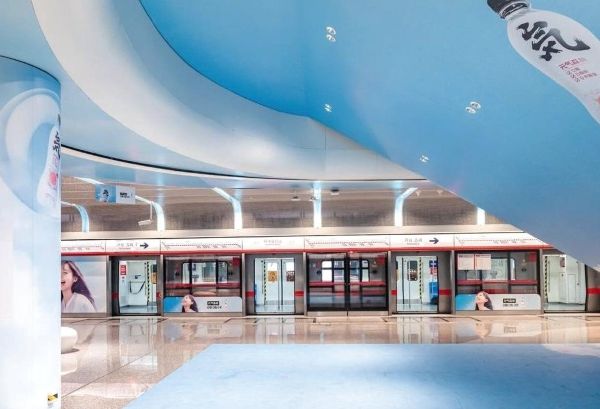
Located on both sides of the waiting platform, corresponding to the train doors. Passengers stare directly for a long time while waiting for the bus (averaging 1-3 minutes). This is the golden opportunity for "deep persuasion" and "exquisite image display". Images can carry slightly more information or have a more artistic feel.
2. Channel wall stickers and corridors
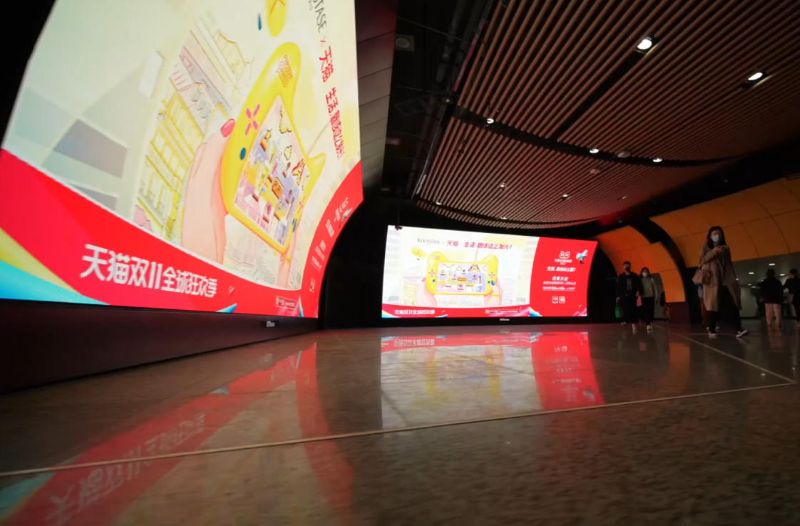
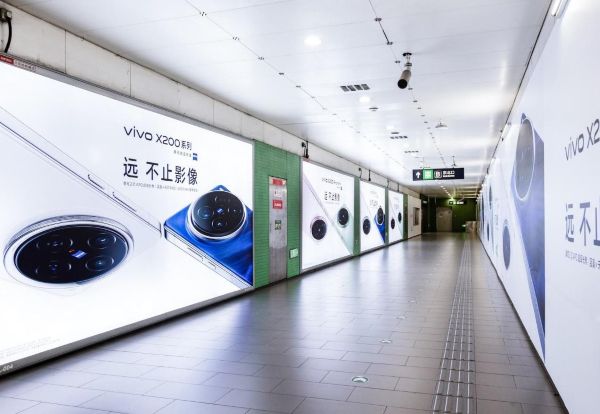
Penetrating through transfer passages and entrance/exit passages. Passengers browsing while walking quickly belong to the "dynamic reading" scene. A series of visuals suitable for strong visual impact, telling a short story or showcasing brand themes, creating an immersive corridor effect.
3. Escalator side wall advertisement
Passengers on the escalator are in a stable upward or downward position, and their line of sight will naturally lean towards one side of the wall. This is a scenario of 'intermittent focus'. The advertising information should be concise and powerful, and the core proposition should be conveyed within 3-5 seconds.
4. Column advertising and creative packaging columns
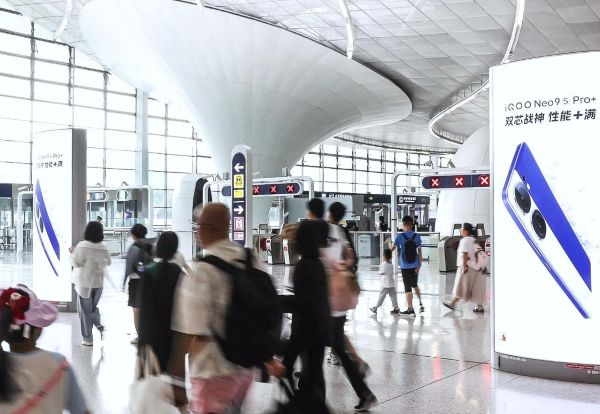
The columns in the station hall are the natural visual center. Conventional lightboxes provide multi angle exposure, while "creative package columns" can transform columns into three-dimensional art installations, highly interactive and topic spreading, suitable for brand event marketing.
Step 3: Creativity and Execution: Make the content effective in every inch
Choosing the right location requires the right creativity. There are unique rules for subway advertising creativity.
The Three Principles of Creative Core
The 3-second rule of life and death: Most passengers take a fleeting glance. The main visual elements (such as products, spokespersons, and core symbols) must be clearly captured and remembered within 3 seconds. The copy must be streamlined to the extreme, using more large headings and less small text.
Scene association principle: Excellent creativity can resonate emotionally with subway scenes such as "waiting", "returning home", "meeting", "exploring", etc. For example, breakfast product advertisements can be directly linked to demand on the platform in the direction of work during the morning rush hour.
Strong visual contrast principle: The environment inside the subway station is complex, with varying lighting and colors. The advertising screen needs to use high contrast colors and light dark relationships to ensure that it "jumps" out in the environment.
Key points of advertising execution
Release cycle: Considering the memory curve, it is usually recommended to have a minimum release cycle of 4 weeks to complete the process from cognition to memory.
Quality monitoring for publication: Ensure smooth images, uniform lighting, and no damage. High quality publication is an extension of brand image.
Effect tracking design: Adding exclusive discount codes, activity QR codes, or guidance to the nearest store in advertisements to convert offline exposure into measurable online interactions or offline foot traffic.
Step 4: Avoid common misconceptions and improve investment return rate
In the practice of advertising on subway station signs, the following mindset traps can seriously dilute budget effectiveness:
Misconception 1: Only focusing on the "total customer flow" theory, ignoring the matching degree of the audience.
The largest transfer station may be crowded, but the crowd composition is complex, hurried, and the advertising memory is low. The effect may not be as good as choosing a professional site with moderate foot traffic, but 90% of it is for your target customer group (such as office workers in a specific industrial park).
Misconception 2: Creativity speaks for itself and lacks situational thinking.
Design complex information maps that require a one minute pause to understand in pedestrian fast passing passages; Or in noisy station halls, relying on long texts that require quiet reading. This is essentially a huge waste of resources.
Misconception 3: Single point isolated advertising lacks networked thinking.
Only targeting one site at one end of the city cannot generate brand momentum. The subway is a network, and advertising should also be networked. Points should be deployed along the complete travel chain of the target population (such as 3-4 key stations on the way from home to work) to form a cognitive relay.
Misconception 4: Neglecting the linkage with digital media.
Consider subway advertising as purely offline behavior. An excellent approach is to set up social media topic entry points on offline advertising screens to guide passengers to participate online; At the same time, online social platforms are preheating and fermenting the topicality of subway advertising itself, forming integrated communication.
Professional path: Why do we need a one-stop solution?
For brands that want to cover multiple lines and dozens of stations, directly connecting with the complex subway media management is a time-consuming and labor-intensive project. At this point, the value of professional platforms is highlighted.
Collaborating with Tianci Media, a professional subway advertising placement company, can systematically address three core issues:
Strategy and resource integration: Based on in-depth insights into the passenger flow data and station characteristics of the entire network, provide scientific point combination strategies, and integrate high-quality resources from various routes to provide a "one click" procurement solution, greatly improving efficiency.
Creativity and Production Assurance: With rich experience in scene based creativity, we can ensure that advertising design conforms to the communication laws of subway media from the source, and provide professional production supervision services.
Full process execution and monitoring: Undertake the full process execution from contract signing, approval, publication to post broadcast monitoring, ensuring that complex projects can be accurately, timely, and with quality, allowing brand owners to focus on strategy and marketing itself.
Conclusion: From "advertising placement" to "operational scenarios"
In summary, the success of subway station advertising is essentially a refined operation of consumer attention in urban public spaces. It tests whether the brand can transform its own information into "scenario content" that matches the emotions and needs of passengers at specific times and locations.
Starting from decoding the password of the subway network, to accurately drawing the travel map of the audience, and then choosing the communication form and creative content that resonates with it, every step requires strategic thinking and data-driven support. When your brand information can naturally integrate into the daily commuting trajectories of millions of people and become a positive fragment in their urban memory, what you have accomplished is not just a successful advertising campaign, but a brand building that delves deep into the urban fabric.