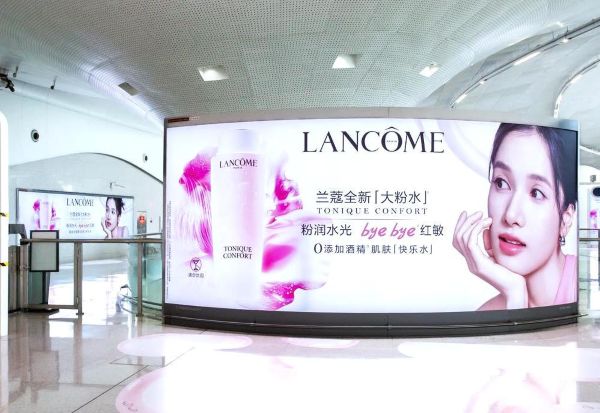
How is subway advertising done? Guide for Beginners and Digital Upgrades in 2026
2026-02-10Tianci MediaViews:171
Highlights
This article provides a comprehensive guide to the entire process of subway advertising in 2026, from strategy formulation, digital point selection, dynamic creativity to effect attribution. It covers cutting-edge trends such as AR interaction and programmatic purchasing, helping you efficiently reach billions of commuters. Read now to gain a first mover advantage in subway marketing for the next three years!
Entering 2026, urban subways are no longer just a means of transportation, they have become an "underground digital living corridor" that integrates passenger flow, data flow, and attention flow. The daily commuting behavior of millions of passengers has been deeply digitized, which brings a qualitative change opportunity for subway advertising from "spatial display" to "scene interaction". For marketers, the question of "how to do subway advertising" requires a new systematic answer today.
This guide will be based on the technological environment and marketing trends of 2026, to break down the underlying logic, cutting-edge forms, and practical steps of subway advertising, and help you master the winning rules of this offline traffic core battlefield.
Chapter 1: The Evolution and Core Values of Subway Advertising in 2026
1.1 From "Display" to "Interaction": Value Enhancement
The value of subway advertising in 2026 is redefined by technology and data:
Digital anchor point for offline traffic: By connecting with subway Wi Fi, ride code mini programs, and commercial data, advertising exposure can be associated with anonymous passenger flow data, achieving a leap from "fuzzy exposure" to "quantifiable reach".
The experimental field of immersive experience: the large-scale application of AR interaction, naked eye 3D screens, inductive projection and other technologies has transformed advertising from "being watched" to "being experienced", greatly enhancing the sense of participation and memory.
The cutting-edge showcase of brand technology: Applying the latest advertising technology in the public space of the subway is itself a brand innovation, fashion, and daring to break through image declaration, especially conducive to attracting the younger generation.
The key hub of product efficiency collaboration: through scanning codes, NFC sensing, AR interaction, etc., it can directly guide to mini programs, communities, or e-commerce pages, achieving seamless connection between brand exposure and effect conversion.
1.2 Overview of Mainstream and Frontier Advertising Forms (2026 Edition)
The subway media matrix in 2026 is more diverse and can be divided into three categories:
Digital dynamic media (becoming mainstream)
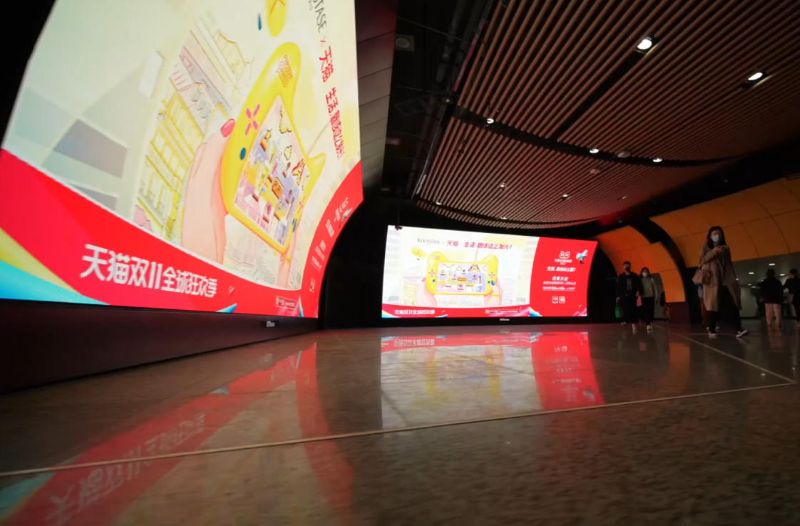
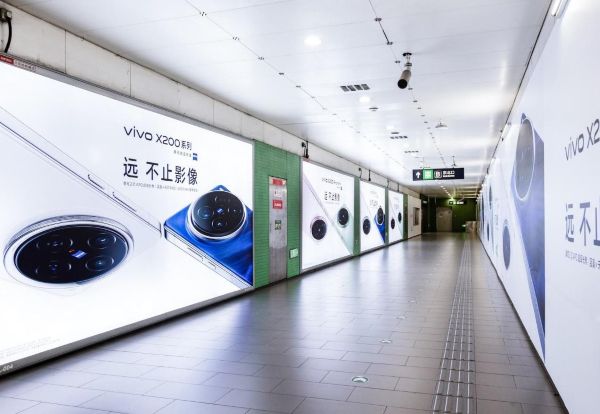
Full channel LED digital corridor: replacing some static light boxes, forming a continuous dynamic video wall on both sides of the long channel, which can be remotely managed, with content switching at any time and strong narrative ability.
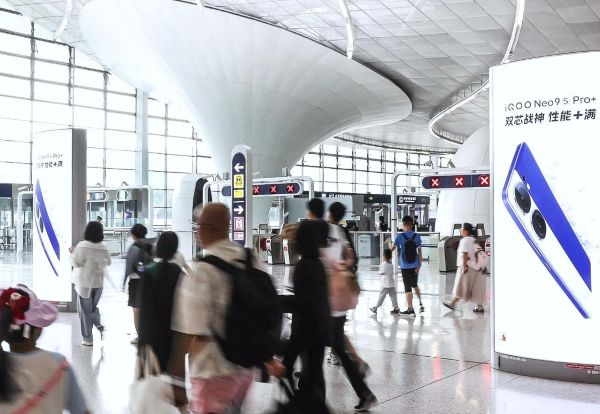
Interactive intelligent screens: distributed in station halls and waiting areas. In addition to playing videos, it also integrates cameras (anonymous passenger flow statistics), sensors (gesture interaction), and near-field communication modules to achieve seamless or subtle interaction.
Dynamic information screen inside the train carriage: The screen inside each carriage not only displays station information, but also opens up advertising spaces, which can push relevant brand content based on the location of the train (such as near commercial districts), achieving scenario based marketing.
Creative static media (value deepening)
Large area brand wall/column wrapping (digital empowerment): By designing embedded AR trigger points, passengers can scan static images with their mobile phones to awaken dynamic content (such as games and product demonstrations), achieving secondary deep communication.
Theme Train 3.0: Not only the body packaging, but also the interior of the carriage will be transformed into an immersive theme space (such as "Metaverse Shuttle Train" and "Ecological Science Popularization Train"), combined with QR code interaction inside the carriage, becoming a social media check-in hotspot.
Frontier experiential media (pilot application)
AR navigation overlay advertisement: When passengers use the official AR navigation app of the subway, virtual brand logos or interactive entrances can naturally appear on the virtual path guidance, and advertisements become a part of useful information.
Odor emission device linkage: In specific brand channels or themed trains, combined with visual content, it releases matching light odors (such as coffee aroma, forest fragrance) under the premise of safety and compliance, activating multi sensory memory.

Chapter 2: Six Steps to Practical Use in 2026: Data Driven Science Delivery
Step 1: Goal Refactoring and KPI Presetting
In today's world where data is available, the goal needs to be more precise:
Brand goal: Not only to increase brand awareness, but also to pay attention to new indicators such as "brand technology awareness" and "social media spontaneous dissemination volume (UGC)".
Effect goal: Upgrade from "guiding QR code scanning" to "offline to online (O2O) conversion rate", which tracks specific behavioral data such as app downloads, member registrations, and store to store verification brought by subway advertising.
Step 2: Data based point selection and programmatic purchasing (PDOOH)
This is the key to the efficiency leap in 2026.
Dynamic data selection: Using real-time data dashboards provided by professional platforms, filter stations and channels that match passenger flow profiles (age, interest preference predictions) during different time periods (morning rush hour, weekends), rather than relying solely on experience.
Programmatic purchase access: Some digital screen resources (such as certain LED screens) now support programmatic transactions. Advertisers can automatically trigger ad placements based on specific times and demographics, just like purchasing online ads, to achieve precise and real-time budget allocation. Tianci Media is a professional subway advertising platform, whose system has deeply integrated such data and programmatic purchasing capabilities, and can provide customers with dynamic and optimized advertising solutions.
Step 3: Dynamic Creativity (DCO) and Interaction Design
Creativity needs to be born for "dynamics" and "interaction".
Dynamic creative optimization: Design multiple sets of creative materials, and the system can automatically switch to the most suitable version based on the delivery time (work/off work), weather (sunny/rainy), and external hot events.
The extreme simplification of interactive guidance: the interaction steps must be "one click direct". For example, the complex interactive processes of "raising hands to switch screens" and "scanning codes at a glance to jump to mini programs" are destined to fail in the rush of commuting.
Social currency design: The advertising content itself should have "photographability" and "shareability", whether it is stunning visual effects or interesting AR filters, with the aim of making passengers the communication nodes of the brand.
Step 4: Budget Planning and Effect Estimation
Budget allocation change: Special budget needs to be reserved for digital production (AR content development, dynamic video), data technology services, and interactive hardware (if any), and the proportion of this part is increasing.
CPE (cost per interaction) has become an important reference: in the contract, it can be agreed with the media or agency platform to use effective QR code scanning and interaction times as part of the performance evaluation indicators, making budget utilization more efficient.
Step 5: Publication, monitoring and real-time optimization
Technical monitoring automation: Through image recognition technology, it automatically monitors whether advertisements are published normally, whether the images are intact, whether the brightness meets the standards, and generates reports.
Effect data dashboard: During the advertising period, the estimated number of people reached, interaction rate, scan code data, etc. at each point can be viewed in real-time through the backend dashboard, providing a basis for optimization.
Step 6: Attribution and Integration of Full Link Effectiveness
Data center integration: Connect the anonymous device IDs or authorized user behavior data brought by subway advertisements with the enterprise's CDP (Customer Data Platform), and analyze their contribution to the subsequent purchase journey.
Online and offline resonance: Launch an online challenge centered on subway AR experience, or create subway themed trains as offline pop-up store reservation entrances to achieve closed-loop traffic.
Chapter 3: Three cognitive misconceptions that must be avoided in 2026
Misconception 1: Believing that subway advertising is still an "immeasurable" brand advertisement.
Outdated cognition: Adhering to the extensive thinking of "as long as more people see it", without setting data goals or tracking the effects of the follow-up link.
By 2026, subway advertising has entered the stage of being measurable and optimizable. We must use data tools to set benchmarks, track the entire chain of data from exposure to interaction, and speak with results.
Misconception 2: Equating "technical showmanship" with "effective creativity".
Outdated cognition: Blindly using the most fancy AR and holographic technologies, but with complex interactive logic and weak association with brand core information, resulting in high barriers to entry and confusion for passengers.
The correct answer in 2026: Technology is a means, not an end. Creativity must serve clear communication goals, and technological experience should be "intuitive", "zero learning cost", and able to strengthen the transmission of brand core information.
Misconception 3: Isolated operation, disconnected from brand digital assets.
Outdated cognition: Subway advertising is one set of creativity, brand online activities are another set, and the two are completely unrelated, leading to fragmented marketing actions.
In 2026, the subway is the offline entrance for brand digital experience. Advertising creativity, interactive content, and traffic pages must be highly integrated with the overall digital marketing campaign of the brand (such as new product launches and brand upgrades), forming a complete narrative that runs through both online and offline channels.
Conclusion
In 2026, the core answer to the question of "how to do subway advertising" has shifted from "buying prime locations" to "planning a data-driven, interactive offline digital experience". It requires marketers to possess both offline media strategy, digital technology understanding, and data operation thinking.
The key to success lies in embracing "digital point selection and programmatic purchasing" to improve efficiency, utilizing "dynamic creativity and light interaction" to enhance communication depth, and verifying and optimizing overall value through "full chain data attribution". For brands looking to seize the future, partnering with next-generation advertising platforms like Tianci Media that have the ability to integrate data, technology, and media resources will be a strategic choice for building new competitiveness in subway marketing.
When the train passes through the 2026 track, your brand advertisement should not just be a scenery outside the window, but should become a starting point for a journey that can be participated in, remembered, and measured.