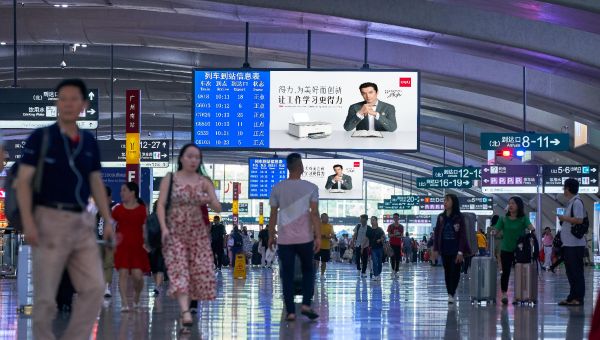
Main Large Screen in the Center of the Arrival & Departure Corridor of the Exit Hall at Guangzhou South Railway Station
Customized chip costs tailored to individual needs

- Photos
- Specs
- Advantages
- Value
- Media Map
| Area:Guangzhou | Type:high-speed railway | Frequency:100 |
| Address:South Station North Road, Panyu District | Format:led | Duration:10s |
| Location:Arrival Hall Access Corridor for Arrivals and Departures | Min Qty:8 | Operating Time:6-22o'clock |
| Size:5.07*2.6 | Min Period:month |
The exit passage is the only corridor accessible to all arriving passengers. On average, passengers spend 5 to 15 minutes walking through this passage upon arrival. They move slowly with luggage without rushing or feeling flustered, and will voluntarily check large screens for subway directions, public transport transfer information and train arrival updates. Passengers show very low resistance to advertisements; they can view the ads repeatedly 2 to 3 times while walking through the entire corridor, pushing the daily ad rotation volume up by 20%. This space captures peak arrival passenger flows and delivers outstanding results in boosting overall exposure density and brand memory retention.
The full media set consists of 8 synchronized LED screens arranged longitudinally along the main exit corridor. They cover the sole mandatory route from all train exit turnstiles to subway, taxi and bus transfer areas. Free of obstructions such as pillars and signboards, the screens remain fully within passengers’ line of sight throughout their walk out of the station and transfer with luggage, achieving complete coverage of every arriving passenger without omission. This serves as the final memory touchpoint for brands before passengers leave the station.
Passengers’ primary priority after exiting the station is locating transfer routes for subways, taxis and buses, so they keep constant eyes on the guidance screens. This media captures all inbound passengers across the station and greatly raises the full completion rate of ad viewing. It occupies the concluding communication stage of passengers’ trips, acting as the core synchronized digital media covering every arriving traveler. Together with media at the third-floor entry security checkpoints and waiting halls, it forms a full-link exposure loop spanning entry, waiting and exit, enabling comprehensive penetration of brand impressions across passengers’ entire station journey.
This media space can forcibly intercept and cover 100% of arriving passengers, ensuring brand information reaches the massive exiting crowds with zero blind spots. Adopting large-size high-definition LED display technology, it delivers bright images with high color reproduction. Thanks to the spacious exit hall, the screen boasts exceptional visual penetration, guaranteeing a strong visual draw for passing passengers even amid complex pedestrian flows and varying light conditions.
High-speed railway stations feature an inherently enclosed environment where passengers cannot bypass advertisements. As the core visual focal point along the mandatory exit passage, the main central screen subtly yet powerfully imprints brand information onto every passing traveler. It naturally occupies the center of passengers’ visual paths, enabling frequent and repeated brand exposure while effectively avoiding the traffic pitfall of "advertisements being overlooked".
There is only one set of 8-unit linked LED display matrices in the main central exit corridor. The station’s architectural circulation and facility layout are permanently fixed, with no additional contiguous large screens of the same type to be installed. This endows the media resource with extreme market exclusivity and scarcity. The equipment enjoys mature maintenance and controllable operating costs. Supported by steady, massive passenger arrivals, it delivers dual investment values: continuous short-term advertising cash flow and long-term asset appreciation of the media location, resulting in extremely stable operation and investment returns.