
- Photos
- Specs
- Advantages
- Value
- Media Map
| Area:Chengdu | Type:high-speed railway | Frequency:260 |
| Address:No. 333 Qionglai Mountain Road, Chenghua District | Format:led | Duration:10s |
| Location:West Entrance Hall of Chengdu East Railway Station | Min Qty:1 | Operating Time:6-23o'clock |
| Size:2.1*1.8 | Min Period:month |
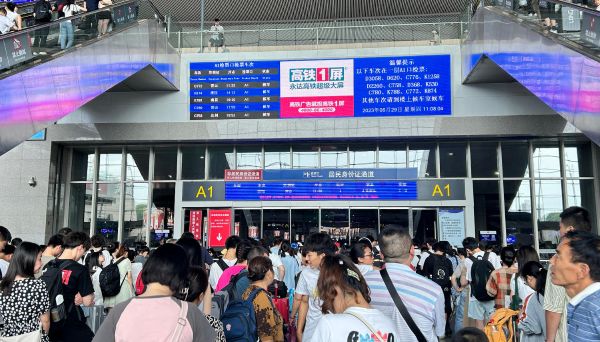
Above the ticket gates in the West Station Entrance Hall, adjacent to the escalators of the West Square and the main security inspection passage, lies the primary core visual spot for passenger flows entering the waiting hall via Exit West of Metro Line 7, as well as taxis and private cars from the West Square. All passengers taking trains from the western areas must pass through this location with no alternative bypass routes. It serves as a unique portal-level information display medium exclusive to the West Station area, positioned right next to the train schedule display screens. Passengers naturally stop to view the content while locating ticket gates or waiting for ticket checks.
The station records a daily average inbound and outbound passenger volume of over 200,000 people on regular days, with more than 45% of all passengers passing through the West Station Entrance Hall, translating to a steady daily footfall of over 90,000 people at this spot. The audience mainly consists of business travelers driving private vehicles, metro commuters, family tourists and local residents returning home, aged between 25 and 55. This group possesses strong independent consumption decision-making power, making the spot ideal for targeted regional brand advertising covering automobiles, home decoration, catering, cultural tourism, digital electronics, finance and other sectors.
As the first information touchpoint along the station entry route, this medium achieves a forced reach rate of nearly 100% with an average viewing duration exceeding 12 seconds. It is the first reference point for passengers to connect train numbers with corresponding ticket gates. The screen height aligns perfectly with passengers’ line of sight, enabling close eye-level viewing that fully showcases all image details. Dynamic videos deliver far stronger appeal than static light boxes, allowing brand messages to penetrate deeply during fragmented waiting periods. Multiple repeated exposures during a single trip yield remarkable brand memory retention effects.
Located in the core area above Gate A1 of the West Entrance Hall on the second floor of the railway station, this exclusive advertising asset serves as an unparalleled front-facing gateway exposure resource in the West Station Zone. Benefiting from its sole access to passenger entry routes, premium communication scenarios, precise audience coverage and flexible advertising placement models, it stands out as a high-cost-performance and high-conversion media spot at Chengdu East Railway Station, ideal for regional brand cultivation and short-term marketing campaigns of all kinds.
This LED screen adopts a fascia light box design that delivers striking visual impact. With a moderate size and placement within passengers’ mandatory line of sight, passing travelers will naturally notice the display as they walk by. Its outstanding visual effects rapidly convey advertising messages and effectively capture the attention of large volumes of passengers, significantly boosting brand recognition and reputation.
Positioned on the pre-waiting entry path past security checkpoints and escalators, the spot captures passengers right after they complete station entry procedures when their focus remains undistracted, enabling brands to make a strong first impression. It delivers continuous exposure to foot traffic throughout the entire journey from station entry to waiting areas, functioning as an irreplaceable front-end traffic hub for brands targeting the western Chengdu area. The location features an unobstructed view free of pillar and wall obstructions, offering 360-degree all-angle visibility. Passengers travelling on both upward and downward escalators can fully view the advertisements, resulting in minimal communication loss.