- Photos
- Specs
- Advantages
- Value
- Media Map
| Area:International | Type:airport | Frequency:159 |
| Address:Incheon International Airport, South Korea | Format:led | Duration:15s |
| Location:T1 Arrival Baggage Claim | Min Qty:46 | Operating Time:0-24o'clock |
| Size:2.4 x 1.4 m x 2 面 | Min Period:month |
Advertisements located in the prime visual field have become the only visual focus filling this interval of downtime, achieving an almost 100% forced viewing rate. They are precisely positioned above or to the front side of each baggage carousel according to a 'carousel-adjacent' layout strategy, cleverly leveraging the psychological characteristics of travelers while waiting for their luggage. During the average waiting time of 8 to 15 minutes, travelers' gaze instinctively and repeatedly scans the carousel and surrounding areas to locate their baggage.
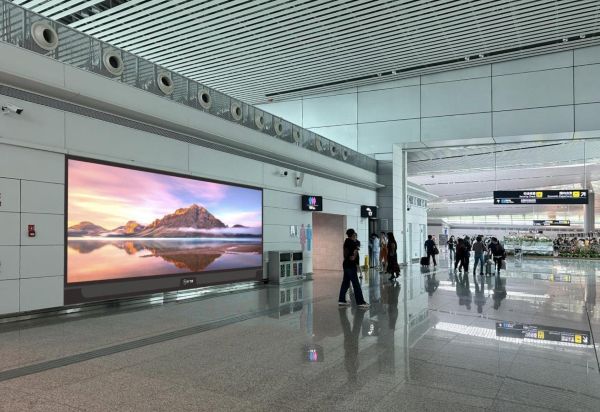
The T1 arrivals baggage claim area LED is a core digital media network located above the baggage carousels in Terminal 1. As the "first visual touchpoint" that inbound travelers must pass, it features high-density coverage, strong attention capture, and high-value audience targeting. It serves as a key offline gateway for brands to reach inbound traffic and capture the Korean and Northeast Asian markets.
All baggage carousels in the arrivals area are equipped with LEDs above the carousel, with a total of 23 locations and 46 double-sided LED screens, forming a surrounding visual matrix. This is the essential area every international inbound traveler passes through after completing immigration and retrieving their luggage. Unlike the dispersed flow of departing passengers, the movement of inbound travelers in this area is highly concentrated. Regardless of which carousel they choose, they can be precisely covered by the LED screens. Each screen achieves a stable daily exposure of over 80,000 people, and coordinated operation can reach the entire inbound traffic.
The media uses full-color HD display technology, with brightness adapted to the airport's bright environment. The dynamic images are smooth and clear with strong visual impact, not only attracting travelers' attention but also enhancing brand information recall, ensuring that ad exposure genuinely translates into audience awareness and significantly improves advertising ROI.
23 double-sided points form a circular enclosure, creating an immersive visual impact when viewed as a whole. Split screens allow for precise zoned advertising. It supports various ad formats such as dynamic videos, static images, and countdowns. All international passengers who have completed immigration must stay here to wait for their luggage, ensuring 100% mandatory exposure, with an average dwell time of 5–10 minutes. Passengers' sight naturally focuses above the carousel, with no information interference, making ad recall extremely high.
The baggage claim area has few competing ad spaces, avoiding information dilution and enhancing effective ad reach. It can be linked with in-terminal stores, pick-up and drop-off services, and online app promotions — enabling immediate consumer conversion. When coordinated with arrival corridors and exit bridge screens, it covers the full process from arrival — waiting — departure. Daily passenger flow is stable, peak periods are clear, and exposure reach far exceeds ordinary media.
LED screens in the baggage claim area are high-conversion, high-ROI golden media at the Northeast Asia aviation hub. The core investment value focuses on five dimensions: traffic value, conversion value, brand value, operational value, and data value.
Relying on Incheon Airport’s status as a core air hub in Northeast Asia, with advanced technical configurations, a high-net-worth international audience cluster, and unique entry scene barriers, it establishes an investment value system that is "highly precise, high-return, and high-barrier." This system is suitable both for exposure and conversion needs of short-term advertising campaigns and represents a high cost-performance and growth potential target in airport media investment. Its core investment value is developed deeply around three key dimensions: technological empowerment, audience value, and scenario endorsement.