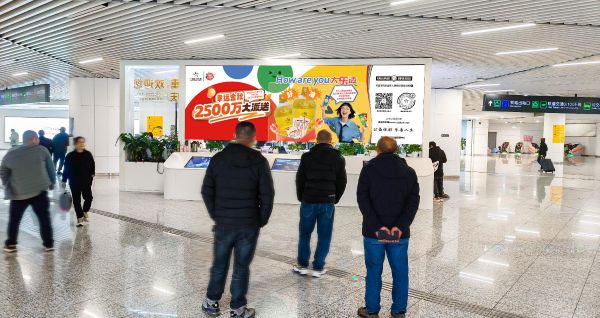
- Photos
- Specs
- Advantages
- Value
- Media Map
| Area:Guiyang | Type:airport | Frequency:120 |
| Address:Guiyang Longdongbao International Airport | Format:spam bot | Duration:10s |
| Location:T3 Departure Waiting Area | Min Qty:19 | Operating Time:0-24o'clock |
| Size:86英寸 | Min Period:4weeks |
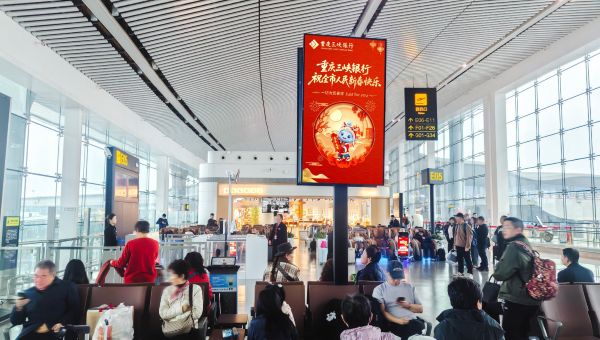
Located in the core stay area after security check and before boarding, it is a mandatory route for all domestic departing passengers, covering 100% of departing passenger traffic. Passengers naturally stay in this area while waiting for their flights or boarding, ensuring comprehensive ad exposure with no omissions and far higher reach efficiency than ordinary media. The audience primarily consists of business travelers and mid-to-high-end tourists with high spending power and decision-making ability, with business travelers accounting for over 70%, making it the core target audience for high-end brands, premium cultural tourism, automobiles, and other categories.
After completing check-in, passengers must pass through security and move through these areas to reach the boarding gate, forming a naturally 'mandatory viewing' route. The waiting area serves as the core scene where passengers actively stay and relax, with an average dwell time of 30-60 minutes, far longer than airport fast-track areas. In this low-interference environment, passenger attention is highly focused, significantly increasing effective ad reception time and memory retention, making brand information implantation more natural.
During the waiting period, passengers are in a 'low-interference, high-focus' state, with active attention reaching 95%. When advertisements are integrated with useful information such as flight updates or boarding reminders, retention rates increase by 60%. On average, passengers encounter screen ads 2.8 times in the waiting area, with 32% of the audience being exposed 3 times or more. Multiple exposures reinforce brand memory and establish brand recognition barriers.
In the closed environment of the terminal, passenger attention is highly concentrated, achieving the dual communication goal of 'deep regional penetration and nationwide diffusion,' while investment value is maximized with broader coverage.
The dynamic screens of a screen-flipping machine easily capture travelers' attention. Compared to traditional static lightboxes, screen-flipping machines use high-definition LED/LCD screens that support videos, animations, and other multimedia formats. With vivid colors and high brightness, the dynamic high-definition images enhance the brand's sense of premium quality and professionalism, helping upgrade the brand image. In enclosed indoor environments, they have very strong visual appeal and can grab attention instantly.
The T3 departure hall after security is the last core area where passengers stay before boarding. Media locations are scarce and cannot be replicated. By securing high-quality packages first, one can obtain exclusive time slots, avoiding clustering of competing brands. In a closed communication environment, this creates a brand monopoly advantage, improves advertising conversion effects, and forms a communication loop of ‘offline mandatory exposure and online social sharing.’
With first-launch configuration in T3 terminal, full coverage of passenger circulation routes, tens of millions of high-end passengers, and efficient digitalized operations as core strengths, it establishes a complete value loop of 'traffic – scenario – audience – conversion.' It is an irreplaceable core media resource for brands aiming to capture the high-end market in the southwest and enhance communication effectiveness, suitable for multi-dimensional campaign needs such as full-scale high-end brand marketing and regional brand deep cultivation and expansion.
The screen-flipping machine forms a full-process media matrix of 'check-in – security – waiting area – boarding,' achieving seamless coverage of brand information. Travelers are exposed to brand information 3-5 times throughout their journey, increasing brand recall to over 68%, which is much higher than the effect of single-media placements.