How much is the advertising cost for Shanghai Metro? From 12 routes to media types, one article to understand
2026-04-14Tianci MediaViews:168
Highlights
How much is the advertising cost for Shanghai Metro? How much do the lightbox, handle, interior sticker, and LED screen cost respectively? This article breaks down the pricing logic and key points for avoiding pitfalls. Tianci Media is a professional subway advertising platform that provides transparent pricing. Click to get the latest price list for 2025.
I want to advertise on the Shanghai subway, but when I ask about the prices, they range from thousands to hundreds of thousands, and I'm completely confused. "This is the real reaction of many brand owners when they first encounter subway advertising. The Shanghai Metro currently has 20 lines, 508 stations, and an average daily passenger flow of over 11 million, making it the busiest rail transit system in China. But precisely because of the vast resources, the cost system is also quite complex.
This article will use the most straightforward way to help you figure out: how much does the advertising cost of Shanghai Metro cost? How are different forms of media charged? What are the easiest pitfalls for beginners to step into?
1、 First, understand the underlying logic: What is the fare for subway advertising?
The pricing core of Shanghai subway advertising consists of three variables: media location x media format x advertising period.
Location: People's Square, Jing'an Temple, Lujiazui and other core transfer stations, with prices 5-10 times higher than suburban stations
Form: Lightbox, handle, carriage sticker, LED screen, brand package station, with different pricing units
Cycle: The minimum investment period is 4 weeks, and the longer the investment period, the lower the average weekly price
Below, we will break down the real price range one by one according to the most common media forms.
2、 Step by Step: 5 mainstream forms of expense ranges
Form 1:12 sealed lightbox (most common)
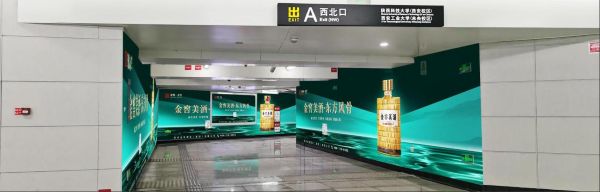
12 lightboxes are standard billboards (approximately 3.6m x 1.5m in size) on both sides of subway station halls and platforms, and are also the most commonly chosen entry-level form for beginners.
Quotation method: by "block/week" or "block/month"
Price range:
S-level stations (People's Square, Nanjing East Road, Lujiazui, etc.): 8000-15000 yuan/block/week
A-level stations (Xujiahui, Century Avenue, Longyang Road, etc.): 4000-8000 yuan/block/week
B-class stations (ordinary transfer stations): 1500-3500 yuan/block/week
C-level station (suburban terminal station): 800-1500 yuan/block/week
Xiaobai's suggestion: Don't immediately invest in S-level websites. You can first choose 2-3 A-level stations for testing, with a budget of approximately 16000 to 32000 yuan per light box for 4 weeks.
Form 2: Car interior handle advertisement
The handle advertisement is a small image hanging on the top of the carriage, suitable for high-frequency exposure and brand memory.
Quotation method: by "train/week" or "piece/week" (about 60-80 handles per subway train)
Price range: 1500-4000 yuan/train/week. Under the entire package, it costs about 6000-16000 yuan for 4 weeks.
Features: Low unit price, but small single exposure area, suitable for "supplementary bombing" in conjunction with other forms.
Form 3: Posting inside the carriage (charter car advertisement)
The entire interior of the carriage is covered with advertisements - door stickers, window stickers, roof stickers, and floor stickers, creating an immersive experience.
Quotation method: by "column/week" or "column/month"
Price range: 30000 to 80000 yuan/train/week, 60000 to 150000 yuan/train/month. The regular line costs about 30000 to 50000 yuan per week, while the core lines (Line 2 and Line 10) can reach 80000 to 120000 yuan per week.
Attention: The production cost is calculated separately, and the total production cost of the car stickers for one train is about 20000 to 40000 yuan.
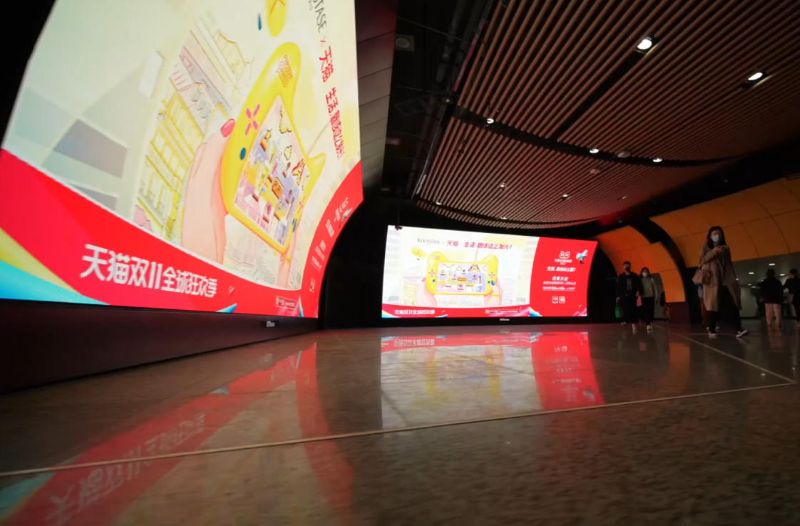
Form 4: LED/LCD Large Screen
Set up large screens in station halls and transfer passages to play 15 second or 30 second video advertisements.
Quotation method: According to "carousel frequency" or "CPM". Commonly seen is a 15 second advertisement that is played 300-600 times a day.
Price range: 50000 to 200000 yuan/week for large screens on core sites; Ordinary site large screen costs 10000 to 30000 yuan per week.
Suitable for brands with short video style and strong dynamic visual impact.
Form 5: Brand Package Station (Rich Play)
Create your brand theme for the entire station (concourse, platforms, passages, staircase stickers, and columns).
Quotation method: by "station/week" or "station/month"
Price range: 500000 to 2 million yuan/month for core stations; Ordinary stations cost 150000 to 400000 yuan per month.
Suitable for: large-scale fast-moving consumer goods press conferences, movie promotions, and e-commerce promotions.
[Insert relevant pictures/charts: Bar chart comparing prices of different media forms in Shanghai Metro]
3、 What are the hidden costs besides media fees?
Many novices, after receiving a quote, think that "media fees=total expenses", but only realize that there is a large amount of extra money when signing the contract:
Cost Item Description Reference Price
Production cost: 200-500 yuan/square meter for lightbox screen printing, handle sticker printing, and charter car sticker production
The cost of painting and manual installation, especially the night construction of chartered car stickers, is 500-3000 yuan/train
The content of the mid-term replacement of the painting fee is the same as above
Monitoring fee: Third party photography to confirm whether the advertisement is displayed normally, 500-2000 yuan/time
If the platform needs to provide visual design, the design fee is 2000-10000 yuan per set
Real case: A certain brand inquired about the "media net price" of 12 lightboxes in People's Square at 10000 yuan per week, with a media fee of 40000 yuan for 4 weeks, plus production (4 lightboxes x 500 yuan=2000 yuan), painting (2000 yuan), and broadcasting (1000 yuan), the actual total expenditure was 45000 yuan.
4、 Three common misconceptions about advertising costs in Shanghai Metro
❌ Misconception 1: Only looking at the unit price, not the number of people covered
The same lightbox priced at 3000 yuan per week has an average daily passenger flow of 80000 at station A and 20000 at station B, with a four fold difference in cost-effectiveness. Require advertising platforms to provide daily average passenger flow data for each location (Shanghai Shentong Metro official will release station entry and exit data for each station).
❌ Misconception 2: Believing that "direct signing by subway companies is the cheapest"
The advertising resources of Shanghai Metro are operated by multiple authorized agencies on different routes. Individuals or small brands directly contact the subway company, but they usually do not accept small orders or offer a "kickback price". Finding an integrated platform can actually lead to better package prices.
❌ Misconception 3: Ignoring the matching of "route attributes" with the target audience
Line 1 and Line 2: Covering the city center, with a wide and diverse population, suitable for mass consumer goods
Line 10: passing Xintiandi and Jiaotong University, young and fashionable people, suitable for fashion brands and beauty makeup
Line 9: connects Songjiang University Town to Century Avenue, with many students and young white-collar workers
Line 11: Leading to Disney, with many families and tourists
Randomly investing without analyzing the attributes of the line is equivalent to wasting the budget.
5、 Conclusion: How to complete the first launch with the most reasonable budget?
To summarize, when you want to figure out the approximate cost of Shanghai subway advertising and prepare for action, follow these steps:
Determine the budget limit: Novices suggest starting from 50000 to 100000 yuan, selecting 12 light boxes from 2-3 A-level stations, and placing them for 4 weeks, or choosing a regular route charter for 2-4 weeks.
Target audience: Based on your product, identify the corresponding routes and stations (such as beauty route 10 and parent-child route 11).
Choose a reliable platform: Find an integrated advertising platform that can provide transparent quotes, real-life location maps, and historical cases.
Require a complete breakdown of costs: media net price, production cost, painting cost, and monitoring fee, each listed separately.
Reserve 10% of emergency budget for temporary adjustments such as painting replacement and additional investment.