Guide to Choosing Subway Advertising Types
2026-04-03Tianci MediaViews:127
Highlights
There are so many types of subway advertisements: 12 light boxes, screen door stickers, train chartering, LED screens... how to choose? This article helps you make decisions from three dimensions: exposure target, audience status, and budget cycle. Tianci Media is a professional subway advertising platform. Consult now for exclusive solutions!
Entering the subway station, you may see large light boxes on both sides of the platform, stickers on the platform screen doors, continuous wall stickers in the transfer passage, handles and door stickers in the carriages, as well as cool videos on the large LED screen rotating in the station hall. Among all these advertising formats, which one is suitable for your brand?
This is a confusion that every novice preparing to advertise on the subway will encounter. The prices of different types of subway advertisements vary several times, and the logic of their effects is completely different. Choosing the wrong one, spending money but no one watching; Choosing the right one, the same budget can bring about a doubling effect.
This article helps you clarify the selection logic of subway advertising types from three dimensions: exposure target, audience status, and budget cycle.
1、 8 mainstream types and characteristics of subway advertising
1. 12 lightboxes (platform/concourse)
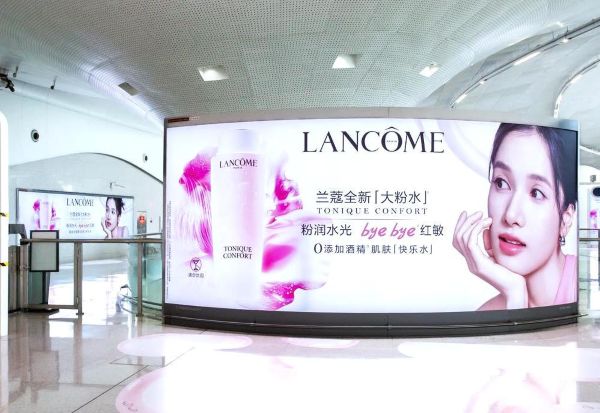
The standard size is about 3 meters by 1.5 meters, located in the platform waiting area and station hall passage. Passengers spend an average of 3-5 minutes waiting for the bus, giving them ample time to watch. Suitable for brand image display and new product release. The advantages are long viewing time and good visual effects; The disadvantage is that the unit price is relatively high, and the monthly fee for the core site can reach 50000 to 100000 yuan.
2. LED digital large screen
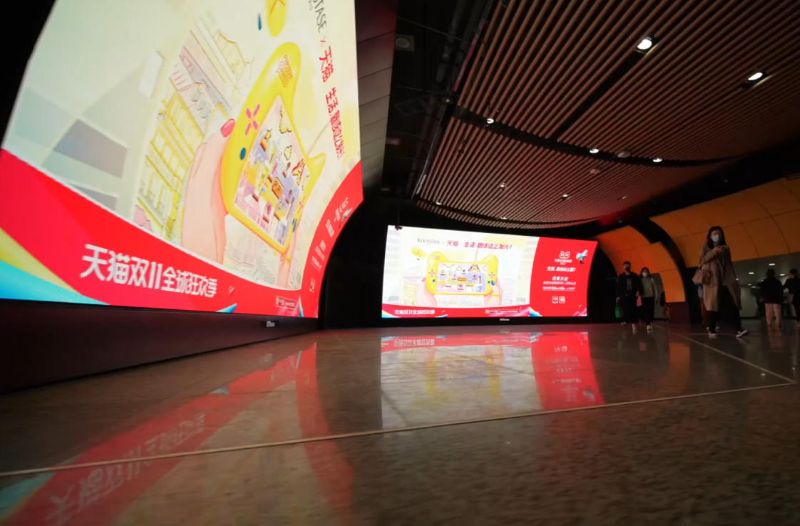
Located in open areas such as station halls and transfer halls, with large dynamic screens and 15-30 second rotating broadcasts. The recall of dynamic videos is more than three times higher than that of static videos. Suitable for brand blockbusters and event promotion. The advantage is strong visual impact, but the disadvantage is expensive, with a monthly fee of 100000 to 500000 yuan for the core position.
3. Screen door stickers
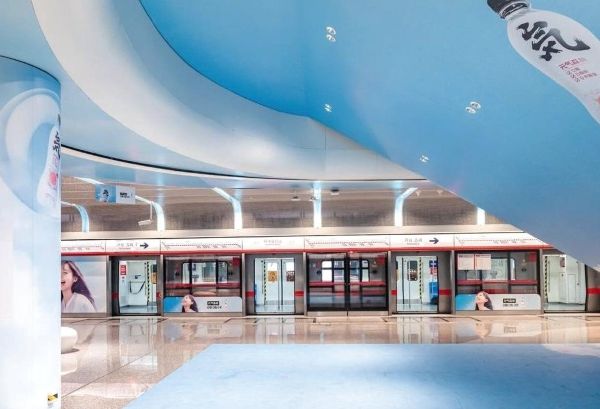
Stick it on the platform screen door glass, with passengers' line of sight facing directly when waiting for the train. The size covers the entire door and the image is continuous. Suitable for promotional activities and interactive QR code scanning. The advantage is that it is parallel to the line of sight of the waiting passengers and provides a mandatory viewing experience; The disadvantage is that the train will briefly obstruct when entering the station.
4. Creative train charter
Covering multiple positions such as windows, doors, wall stickers, handles, and barriers inside the carriage, forming an immersive enclosure. Passengers stay in the carriage for 15-30 minutes and have plenty of time to read. Suitable for brands and themed events that require in-depth communication. The advantages are long exposure time and high completion rate; The disadvantage is that the threshold is high, usually requiring a full purchase.
5. Column advertising
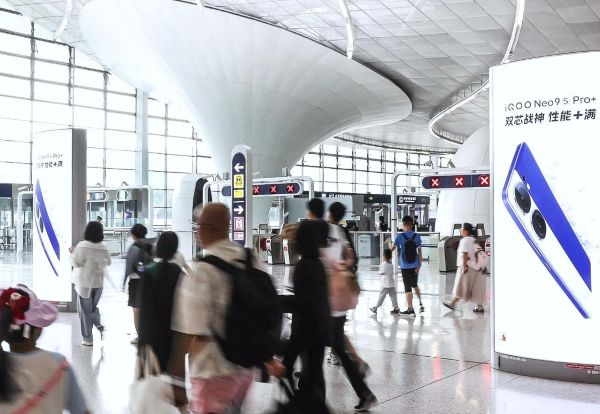
Located on pillars in the station hall or platform, surrounded on all sides. Passengers are difficult to ignore when moving within the station. Suitable for brand image enhancement and creative design (such as packaging pillars into product shapes). The advantage is multi angle exposure, but the disadvantage is that attention is dispersed when the flow of people is complex.
6. Channel wall stickers/lightboxes
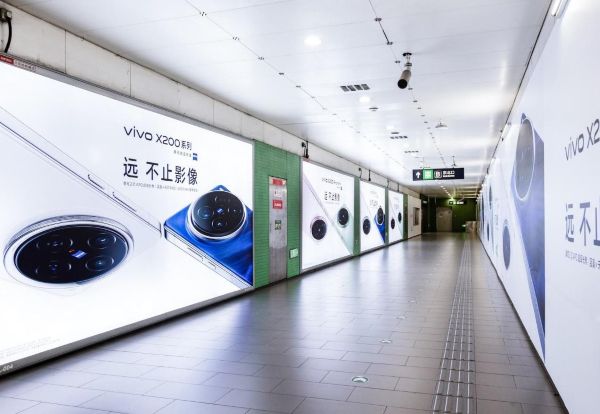
Covering the walls on both sides of the transfer passage, creating a continuous visual impact. Passengers are walking in the passage at a fast speed and have a short viewing time (2-3 seconds) per session. Suitable for strengthening brand logos and core advertising slogans, and can be used as a series of advertisements. The advantage is continuous arrangement and coverage of passenger exchange flow; The disadvantage is that the single viewing time is short.
7. Car interior handle/wall sticker
Located inside the carriage, the handle advertisement is small but has a close contact distance and a large wall sticker area. Suitable for lightweight brand prompts and QR code traffic. The advantage is relatively low cost, but the disadvantage is that it may be obstructed during high passenger flow.
8. Voice station naming
Incorporate brand information into the train arrival announcement, such as' Next station XXX, reminded by YYY brand '. Forced listening, unable to skip. Suitable for brands that require high-frequency prompts. The advantage is 100% coverage of train passengers; The disadvantage is that the amount of information is limited and only suitable for revealing the brand name.

2、 Select type based on advertising target
Goal 1: Brand image building, new product launch
Priority should be given to selecting 12 lightboxes on the platform, LED screens in the station hall, and creative advertisements wrapped around columns. These positions have strong visual impact and moderate dwell time, suitable for conveying brand tone and visual symbols.
Goal 2: Promotional activities, QR code scanning to attract traffic
Priority should be given to screen door stickers and interior handles/wall stickers. These locations are close and operable, and passengers who are bored waiting for or boarding the bus are willing to scan the code to receive coupons.
Goal 3: Deep communication, product education
Prioritize choosing creative train chartering. Passengers have ample time to read detailed texts and watch videos while staying in the carriage for a long time. Suitable for industries such as finance, education, and automotive that require clear explanation of product value.
Goal 4: High frequency brand reminders and strengthened memory
Priority should be given to voice station naming and continuous channel wall stickers. The former is forcibly listened to, while the latter repeats the process, which is suitable for making the brand name "brush its presence" in the minds of passengers.
3、 Select type based on audience status
Platform waiting area: Passengers can relax and have waiting time, suitable for more detailed graphic information and brand stories. Recommend 12 light boxes and screen door stickers.
Station hall/transfer passage: Passengers are in a walking state, time is tight, and information must be concise (understood within 3 seconds). Recommended channel wall stickers and LED screens (catch the eye in the first 3 seconds).
Inside the carriage: Passengers are in a state of boredom or rest, with time for in-depth reading, but the environment is noisy. Recommend train charter (wall stickers can read long form) and handle advertisement (up close).
Entrance/Exit/Gate: Passengers rushing in and out are only suitable for oversized brand logos and minimalist instructions. Recommend gate stickers and entrance/exit light boxes.
4、 Select type based on budget cycle
Limited budget (100000 to 300000 yuan): Priority should be given to selecting screen door stickers (purchased by group) or channel wall stickers (purchased by section), paired with a small number of platform light boxes. The advertising cycle starts from 4 weeks.
Medium budget (300000 to 1 million): You can choose a combination of platform lightboxes and screen door stickers, or charter trains on 1-2 core lines. The recommended cycle is 4-8 weeks.
Adequate budget (over 1 million yuan): Consider a combination of LED screens, train chartering, and voice station naming for "sea, land, and air" coverage, covering all scenarios inside and outside the station, as well as inside and outside the train. The cycle can be extended to 3 months.
5、 The 3 easiest pitfalls for beginners to step into
Pit 1: Only focus on the passenger flow at the station and ignore the passenger status. A transfer station with an average daily passenger flow of 500000, where passengers are rushing to transfer, has a shorter viewing time for the platform lightboxes. Choose the type based on the duration of stay and attention state.
Pit 2: Use one set of creativity to tackle all types. The channel wall sticker needs to be understood within 3 seconds, and the carriage wall sticker can be written with a few more sentences. Creativity in different positions must be tailored to individual needs.
Pit 3: Underestimating the production and installation costs and time. The production cost of train charter may reach tens of thousands of yuan, and night construction is required. Before signing the contract, inquire about the production cost and installation period, and reserve time in advance.
6、Conclusion
There is no standard answer for selecting subway advertising types, only the answer that best suits your target audience. The decision-making logic can be summarized as follows:
Brand exposure → Platform lightbox, LED large screen
Scan the code to convert → Screen door stickers, interior handles
Deep communication is required → Train charter
High frequency prompt → Voice naming, channel wall stickers
For beginners, it is recommended to start with the installation of screen door stickers or platform lightboxes at 1-2 core sites for 4 weeks. Use a dedicated QR code to verify the effectiveness before deciding whether to expand the type and duration.
If you feel that various types are too complex or don't have time to evaluate them on your own, finding a professional advertising platform is a more efficient choice.
Tianci Media is a professional subway advertising platform that provides one-stop full process services from demand analysis, type recommendation, creative design, and publication monitoring, helping you choose the right type and spend the right money. Consult now for your exclusive subway advertising placement plan!