Which location is good for subway advertising? Platform, aisle, or inside the train? Understand one article
2026-03-17Tianci MediaViews:130
Highlights
Which location is good for subway advertising? Platform lightboxes, channel posters, and interior handles each have their own advantages and disadvantages. This article provides an in-depth analysis of the characteristics, flow patterns, and applicable scenarios of different locations, teaching you how to scientifically select points step by step. Tianci Media is a professional subway advertising platform that helps you achieve precise targeting!
I plan to advertise on the subway, but with so many locations - platform lightboxes, aisle posters, screen door stickers, interior handles... which one should I choose
This is the confusion that every novice will encounter when entering subway advertising. The subway has a huge space and complex pedestrian flow, with vastly different advertising exposure effects, audience psychology, and prices at different locations. Choosing the right one can achieve twice the result with half the effort; I made the wrong choice. I spent a lot of money, but the effect was like throwing it into water.
This article will help you thoroughly understand which location is good for subway advertising from three dimensions: pedestrian flow, audience behavior, and price cost, so that you can make scientific decisions on your first placement.
1、 Why is location selection so important?
The essence of subway advertising is to convey the right information to the right people at the right place and time. The location determines:
Exposure: Places with high foot traffic naturally attract more people
Viewing duration: The waiting area can be viewed for more than ten seconds, while the passage can only be glimpsed briefly
Audience states: Bored while queuing, anxious while rushing, relaxed while waiting for the bus - different states result in different reception effects
Interaction possibility: Close range locations make it easier to scan codes for interaction
So, choosing a location is not about patting your head, but based on a deep understanding of passenger behavior.

2、 A comprehensive list of common locations for subway advertisements
1. Platform lightbox - the visual focal point of the waiting area
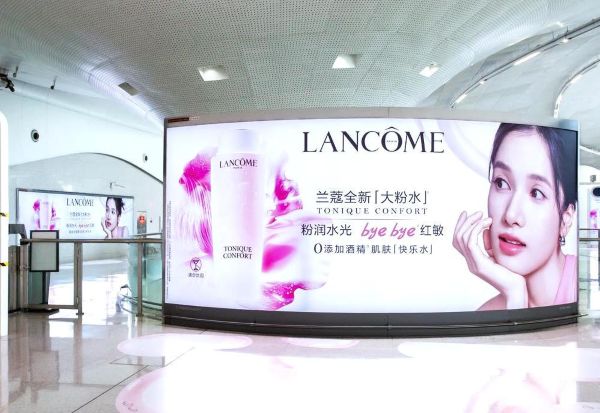
Located in the waiting area of the subway platform, usually on the wall on one side of the track, the size is relatively large (standard twelve box light box is about 3 meters by 1.5 meters), the picture is bright, and the LED backlight is used.
Pedestrian flow line: When passengers are waiting for the train at the platform, they will face the direction of the track, and the light box will be directly in front of their line of sight. The average waiting time is 3-5 minutes, with ample time to watch.
Suitable scenarios: brand image display, new product release, and content that requires in-depth communication. Because the viewing time is long, it can carry a slightly larger amount of information.
Advantages and disadvantages: Long exposure time, long audience stay; But the price is relatively high, and passengers' attention may be on their phones.
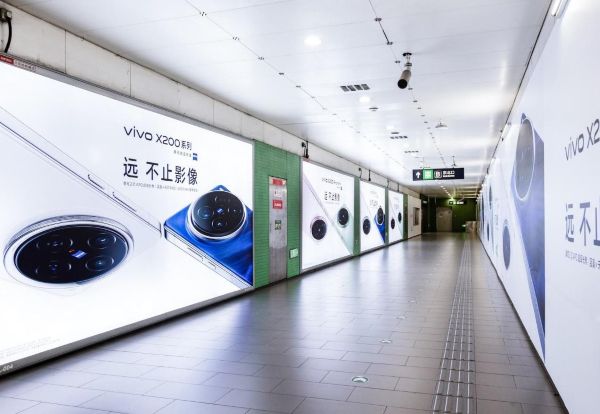
2. Channel lightbox/poster - visual interception during movement
Located on both sides of transfer passages and entrance/exit passages, it is usually arranged continuously to form a "visual corridor".
Pedestrian flow: Passengers are in a walking state, with fast speed and short viewing time (2-3 seconds). A continuous arrangement of lightboxes can create a visual impact, but individual images are easily overlooked.
Suitable scenario: Quickly convey brand logos and core advertising slogans, suitable for enhancing memory. Continuous arrangement can be used as a series of advertisements to tell the brand story.
Advantages and disadvantages: high foot traffic, high total exposure; But the single viewing time is short, and the information needs to be concise.
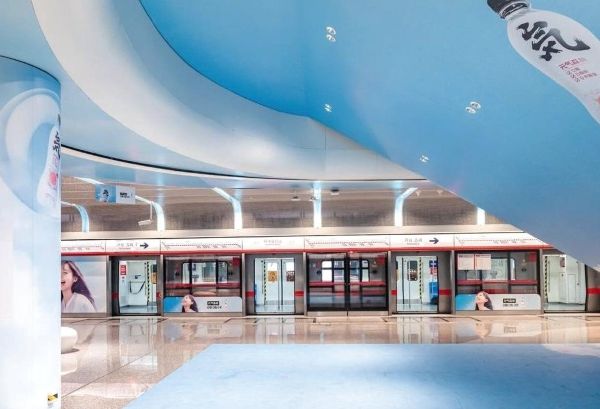
3. Platform screen door sticker - an excellent contact point when waiting for a car
Stick it on the glass of the subway screen door, facing passengers while waiting for the train.
Pedestrian flow line: Passengers are waiting for the train at the platform, facing the platform screen door, and their gaze naturally falls on the door. When the train enters the station, the doors open and passengers board, and the advertisement stays in front of them for a long time.
Suitable scenarios: fast-moving consumer goods, e-commerce promotions, QR code interactive activities. Many brands will place QR codes on platform screen doors for passengers to scan while waiting for the bus to pass the time.
Advantages and disadvantages: parallel line of sight, good tactile effect; But when the train enters the station, some of the images will be blocked by the train doors, and the flow of people getting on and off the train will interfere with the line of sight.
4. Column advertising -360 ° surround vision
Located on a column in the station hall or platform, it is usually surrounded on all sides and the picture is continuous.
Pedestrian flow line: When passengers move inside the station, pillars are obstacles that cannot be bypassed and will naturally be seen. The surround view can be reached from multiple angles.
Suitable scenario: Creative ideas that enhance brand image and have strong visual impact. The shape of the pillar can be used for creative design (such as cola bottles, lipstick, etc.).
Advantages and disadvantages: Multi angle exposure, difficult to ignore; But the crowd around the pillar is complex, and attention may be scattered.
5. In car advertising - deep reach in enclosed spaces
Including interior handles, interior wall stickers, window stickers, interior televisions, etc.
Pedestrian flow: Passengers stay in the carriage for a relatively long time (average 15-30 minutes) and are in a relatively boring state, with a lot of time to read advertisements. The space inside the carriage is enclosed, and the advertising reach rate is high.
Suitable scenarios: Content that requires deep communication (such as education, finance, app downloads), or brands with frequent exposure.
Advantages and disadvantages: long dwell time, high completion rate; But when the carriage is crowded, advertisements may be blocked, and the price is calculated based on the entire train, with a higher threshold.
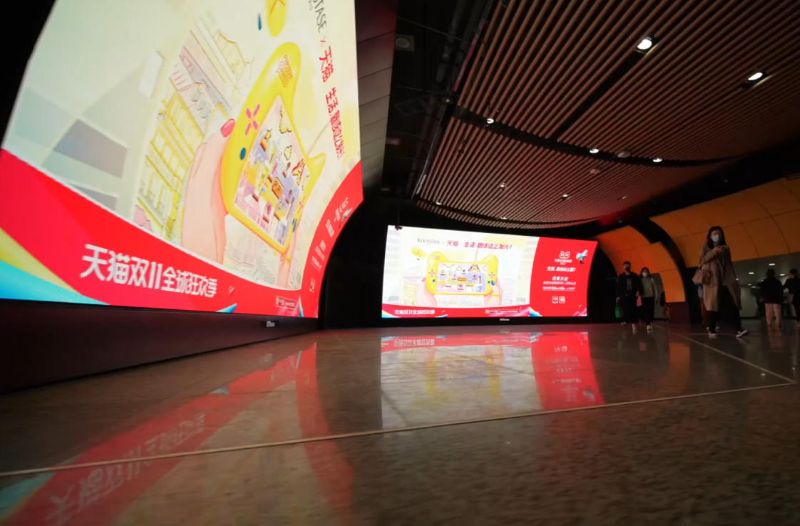
6. Large LED Screen - Dynamic Visual Hegemony
Set in open areas such as the concourse level and transfer hall, with large size, dynamic graphics, and strong visual impact.
Pedestrian flow: Passengers passing through open areas are easily attracted by the large screen, but usually only look up.
Suitable scenarios: brand blockbusters, new product launches, and large-scale event promotions. Dynamic images can quickly capture attention.
Advantages and disadvantages: Strong visual impact, but expensive, and short playback time (15-30 second slideshow).
3、 Select the best position in four steps
Step 1: Clarify the advertising target
First ask yourself: What effect do you want to achieve with this advertising campaign?
Enhance brand awareness → Choose locations with high foot traffic (channel lightboxes, platform lightboxes)
Deeply communicate product information → select locations with long dwell times (platform lightboxes, in car advertisements)
Promotion drainage, QR code interaction → Select close range and operable locations (screen door stickers, car handles)
Create topics and event marketing → Choose locations with strong visual impact (large LED, packaging column creativity)
Step 2: Identify the target audience
Who is your target audience? What is their travel pattern?
White collar commuters: Take the subway during rush hour in the morning and evening, with a focus on transfer stations and stations with concentrated office buildings (such as Guomao and Lujiazui)
Student group: Stations around the university town, active in the afternoon and on weekends
Family groups: Stations around the community, often traveling on weekends
Select the areas that people most frequently pass through and stay in based on their demographics.
Step 3: Analyze the flow of people and viewing status
After determining the station, further analyze the passenger behavior at that station:
Entrance: Passengers hurriedly enter the station, focusing on their journey → Suitable for strong visual symbols, not suitable for detailed reading
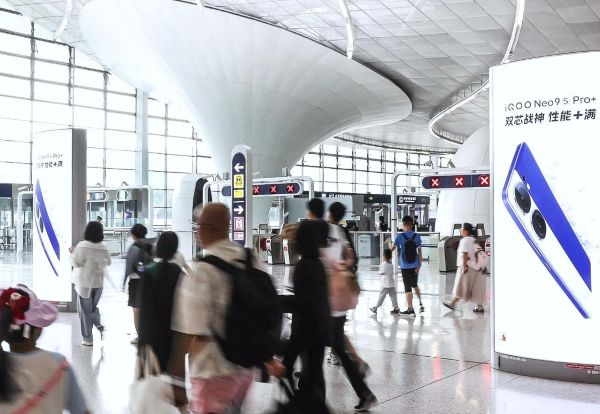
Concourse level: Passengers purchase tickets, pass through gates, have certain stops → Suitable for brand exposure
Platform waiting area: Passengers waiting for the train, sufficient time → suitable for in-depth information and QR code interaction
Transfer channel: Passengers are rushing, but continuous light boxes can form memories → suitable for series advertising
In the carriage: Passengers are bored and stay for a long time → Suitable for detailed text and app downloads
Step 4: Make the final decision based on the budget
There is a huge price difference between different locations. General rule:
Platform lightbox: The price is relatively high, and the monthly fee for a single core station can reach 50000 to 100000 yuan
Channel lightbox: Medium price, with discounts for consecutive purchases
Screen door stickers: Medium to high price, sold by group
Package pillar: Medium to high price, surrounded and covered on all sides
In car advertising: Calculated by train, high threshold but low cost per thousand people
Large LED: expensive, suitable for large budget customers
Novice suggestion: If the budget is limited, you can start with channel lightboxes or platform lightboxes, choose 2-3 core sites, and test the effect for 4 weeks. If the budget is sufficient, the combination of "platform+in car" can be considered to form a dual reach of "watching while waiting for the train+watching while boarding".
4、 Gold position combinations under different targets
Goal 1: Launch new products and quickly establish brand awareness
Recommended combination: Core station platform light box+transfer channel continuous light box+large LED
Platform lightboxes allow waiting passengers to carefully read new product information
High frequency exposure of channel lightbox in passenger flow during exchange
Large LED uses dynamic graphics to attract attention and create topics
Goal 2: Promotion activities to attract traffic to stores/online
Recommended combination: screen door sticker+interior handle+QR code
Screen door stickers allow waiting passengers to scan the code and receive coupons
The interior handle allows passengers to repeatedly see activity information
QR code direct diversion, traceable effect
Goal 3: Brand image, establish long-term awareness
Recommended combination: Platform lightbox+package column+car wall sticker
Platform lightbox displays brand blockbusters
Using creative design to enhance memory in packaging columns
The inner wall of the car is pasted in a closed space to deeply convey the brand concept
5、 The 4 easiest pitfalls for beginners to step into
Pit 1: Only looking at the passenger flow at the station, ignoring the passenger status
This station has an average daily passenger flow of 500000, it's definitely good! "- but 500000 people may just pass by in a hurry and have no time to watch. For example, in large transfer stations where passengers are rushing to transfer, the viewing time of platform lightboxes is actually shorter.
Avoiding pitfalls: It's not just about the number of people, but also about the duration of stay and attention level. The waiting area is more worth investing in depth information than the transfer channel.
Pit 2: Scattered advertising, unable to generate momentum
Each station invests one piece, covering more areas. "- As a result, each point is alone, and passengers cannot remember you at all.
Avoiding pitfalls: Concentrate firepower, saturate attacks. Placing multiple positions at a station (such as platform lightboxes, platform screen doors, and pillars) creates a surrounding exposure that allows passengers to see repeatedly, resulting in a much better memory effect than scattered placement.
Pit Three: Ignoring the Up and Down Direction
Platform lightboxes can be divided into upward and downward directions, and the characteristics of people in different directions may be completely different. For example, during the morning rush hour, the upward direction (entering the city) may be office workers, while the downward direction (leaving the city) may be residents.
Avoiding pitfalls: Understand the morning and evening rush hour flow of the platform and choose the direction where the target audience is concentrated.
Pit 4: Use a set of creativity to conquer the world
The viewing scenes of the platform and the carriage are different, so discount with the same creative effect. The platform can be slightly more detailed, the carriages can be more diverse, and the passages must be minimalist.
Avoiding pitfalls: Customize creativity based on location characteristics and create at least two versions of materials.
6、 Conclusion: Let professionals help you choose the right position
Which location is good for subway advertising? There is no standard answer, only the answer that best suits your goal.
To summarize the selection logic:
To increase exposure, select the channel and station hall
Deep communication is required → Select platform and carriage
To interact → select platform screen doors and handles
Topic selection → Choose LED and column packaging creativity
For the initial launch, it is recommended to start with the platform lightboxes or platform screen doors at 2-3 core sites, launch for 4 weeks, verify the effect with data, and then decide how to proceed with the next launch.
If you find these analyses too complex or don't have time to conduct your own research, finding a professional advertising platform is a more efficient choice.
Tianci Media is a professional subway advertising platform that has been deeply involved in national subway media for many years. It has a media database covering major cities and rich experience in advertising placement. We will scientifically recommend the most suitable location combination based on your budget, target audience, and marketing objectives, helping you avoid various pitfalls and spend every penny wisely. Consult now for your exclusive subway advertising placement plan!