Beijing Comprehensive Guide to Public Transport Advertising Companies: Mainstream Service Providers, Media Resources, and Selection Criteria
2026-02-02Tianci MediaViews:134
Highlights
Looking for a professional bus advertising company in Beijing? This guide provides a detailed explanation of the Beijing public transportation advertising (body, shelter, and interior) resource network, offering 5 key steps and cost analysis for selecting a service provider. Tianci Media is a professional public transportation advertising placement company that can provide localized integration solutions. Get customized strategies immediately, let the brand follow the pulse of the city!
In Beijing, over ten million people travel through the public transportation system every day. When buses carrying distinctive brand information shuttle through Chang'an Avenue, Third Ring Road, business districts, and residential communities, they are not only a means of transportation, but also a mobile brand display platform covering the whole city. Finding a reliable bus advertising company and Beijing service provider is the key first step in deeply linking the brand with the daily pulse of the city.
However, faced with numerous companies claiming to act as agents for public transportation advertising in the market, how can we distinguish the authenticity of their resources, professional level, and service capabilities? This guide will systematically guide you through the entire decision-making process, from understanding the Beijing public transportation advertising ecosystem to ultimately selecting partners.

Chapter 1: Why Choose Beijing Bus Advertising? ——Irreplaceable urban penetration
Before considering which company to choose, the first thing to understand is the unique value of Beijing's public transportation advertising:
Unparalleled coverage breadth and depth: There are over 1000 bus routes in Beijing, with stops located in every corner of the city. It can simultaneously cover core business districts, transportation hubs, office parks, universities, and large communities, achieving a combination of "point line surface", which is difficult for many static media to achieve.
High frequency mandatory outreach: As a daily means of transportation that citizens rely on, buses are subject to repeated and passive exposure to vehicle advertisements by passengers and pedestrians on the road. This high-frequency encounter is crucial for establishing brand awareness and consolidating memories.
High cost-effective localized marketing: Compared to landmark advertisements that often cost millions, bus advertising can achieve long-term and large-scale stable exposure at a relatively reasonable cost, especially suitable for brands aiming to deeply cultivate the local market in Beijing.
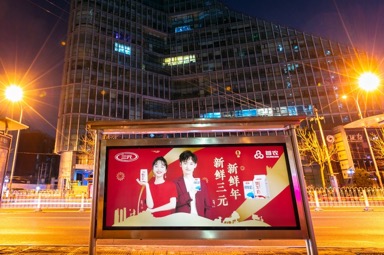
A rich combination of media forms: from full body painting to interior handle and backrest advertising, to bus shelter lightboxes, it forms a three-dimensional media matrix that can meet different budgets and goals.
Chapter 2: Five Step Method for Selecting Your Strategic Partners
Step 1: Clarify your advertising goals and needs
Look inward and define clearly:
Brand Goal: Does it require a city wide brand awareness bombardment, or precise penetration targeting specific areas such as Zhongguancun, Wangjing, and Tongzhou?
Target audience: Are your customers commuters, community residents, or students? This determines the types of lines that need to be covered with priority, such as main trunk lines, micro loop lines, and university dedicated lines.
Budget scope: There is a rough budget framework that will determine how many media resources you can use (such as how many vehicles, how many bus shelters to cover).
Core message: Should we highlight the brand image or promote specific products, activities, or store addresses?
Step 2: Conduct market research and understand the operational ecology of Beijing's public transportation advertising
The operation rights of public transportation advertising in Beijing are usually authorized by the public transportation group to a few core advertising companies for market-oriented operation. Therefore, the public transportation advertising companies you come into contact with in Beijing can be basically divided into two categories:
Resource based operator: directly owns the exclusive or primary operating rights of a certain type or region of public transportation media (such as specific fleet bodies, a batch of bus shelters). For example, Tianci Media is a professional public transportation advertising placement company that has advantages in specific media resources and localized integrated operations.
Proxy service company: As a bridge between operators and customers, it integrates the resources of multiple operators to provide solutions for customers. Its advantage is to provide one-stop selection and price comparison services.
A preliminary understanding of this pattern can help you determine whether the other party is a resource holder or an intermediary.
Step 3: Conduct an in-depth evaluation of the company's five core competencies
When approaching potential partners, please make sure to conduct a rigorous evaluation from the following five dimensions:
Resource authenticity and network quality (the core of the core)
Request to provide a verifiable list of resources, including bus route numbers that can be deployed, fleet companies, vehicle models, and specific location lists of bus shelters. It is necessary to conduct on-site sampling verification.
Evaluate resource quality: Pay attention to whether the route passes through the target area, the age of vehicles (affecting the visual effect), passenger flow data, and the flow of people and visibility in the waiting shelter.
Professional planning and strategic abilities
Can the other party's sales or account manager propose preliminary route planning, media mix, and scheduling strategies based on your goals? Or just provide a price list?
Can valuable suggestions be provided based on the urban functional zoning and crowd activity patterns in Beijing?
Full process service and execution guarantee
Is the process clear and transparent: is there a standard SOP (Standard Operating Procedure) for contract signing, visual design review, publication installation, and monitoring feedback?
Technical ability: Do you provide 3D effect preview images for vehicle advertising? Can you provide location photos or videos for verification after publication?
Maintenance and Emergency Response: How to deal with damages and stains during advertising release? What is the response speed and resolution mechanism?
Transparency and cost-effectiveness of quotations
Is the quotation based on a single media unit price or an integrated package price provided according to the target?
Does the cost clearly include all aspects such as media release fees, image production fees, installation fees, maintenance fees, etc?
When comparing, the monthly cost of a single bike/booth should be calculated and judged based on its route value, rather than just looking at the total price.
Case and reputation
Request local successful cases in Beijing that are similar to your industry or have a similar budget scale.
Through online searches, industry inquiries, and other methods, understand the company's market reputation and customer feedback.
Step 4: Scheme Consultation and Comparison
Submit your requirements brief to 2-3 companies that have passed the preliminary evaluation (such as those that can simultaneously engage with large operators and professional companies like Tianci Media that focus on localization services), requesting them to provide written proposals.
Comparison strategy matching degree: Which company's solution better fits your real goals?
Comparing resource accuracy: Which recommended routes and locations can better cover your target audience?
Comparison of Creative Support: Which company is more professional in design standards and material recommendations?
Comparing comprehensive value: Under similar budgets, which company provides a more cost-effective combination of resources and additional services?
Step 5: Contract Review and Detail Confirmation
Include the resource list as an attachment to the contract: detailing the license plate numbers, route numbers, or specific location codes of all deployed vehicles, which is the basis for legal protection.
Clearly state the date of publication: accurate to the day to avoid disputes.
Agree on monitoring and acceptance standards: clarify the monitoring method (photos/videos), submission deadline, and acceptance process.
Clarify the responsibility clause: If the advertisement cannot be displayed due to vehicle maintenance or route adjustment, how can it be compensated or postponed?

Chapter 3: Key Insights and Common Trap Avoidance
Trap 1: Superstition in "omnichannel agency", resources are flashy but not practical.
Countermeasure: Persist in verifying core resources. Request the other party to demonstrate their direct authorization certificate with the public transportation group or directly affiliated operating company, or to verify their execution ability through small-scale trial investment.
Trap 2: Being attracted by low prices and ignoring the location and quality of resources.
Truth: Extremely low prices may correspond to remote routes, night buses, or vehicles in extremely poor condition in suburban areas, with extremely low exposure value. It is necessary to evaluate the cost in relation to the passenger flow of the route and the value of the areas it passes through.
Trap 3: Lack of data thinking, the effect cannot be measured.
Suggestion: Before cooperation, discuss the effectiveness tracking method with the service provider. For example, using unique QR codes and activity codes on vehicle advertisements, or conducting brand awareness surveys in the target area before and after advertising to quantify the effectiveness of advertising.
Trap 4: Vague contract agreements create hidden risks of disputes for execution.
Key point: All verbal commitments must be implemented in a written contract, especially regarding details such as resource details, visual effects assurance, and troubleshooting procedures. A rigorous contract is the cornerstone of successful cooperation.
Conclusion
Choosing a suitable public transportation advertising company as a Beijing service provider is essentially selecting a reliable, professional, and resource rich "city level media steward" for your brand in this super large city of Beijing. This choice determines whether your advertisement can travel accurately, stably, and with high quality in the eyes of your target customers.
Whether you ultimately choose to collaborate with a large operator with extensive resource coverage, or join hands with a professional bus advertising placement company like Tianci Media that is deeply rooted in the local area and can provide flexible integration solutions, the core evaluation criteria remain consistent: whether the company has a real, high-quality, and matching media resource network that meets your needs, whether it has the professional ability to translate your marketing goals into efficient execution plans, and whether it is willing to provide full service with a transparent and responsible attitude.
When your brand image blends into the streetscape of Beijing with the rolling traffic, it cannot be separated from the precise planning and reliable execution of a professional partner. By doing the above homework, you will have more confidence in launching this brand mobile feast that covers the whole city.