A Comprehensive Guide to Advertising Placement at Shenzhen Bus Stations: Strategy, Execution, and Effect Analysis
2026-02-10Tianci MediaViews:132
Highlights
This guide comprehensively analyzes the media value, mainstream forms, advertising strategies, and budget planning of bus stop advertisements in Shenzhen, and provides step-by-step execution tutorials and avoidance guides. Want to efficiently cover local passenger flow? Read now to get your exclusive advertising plan.
In this fast-paced modern city of Shenzhen, the ground level public transportation network is like the capillaries of the city, penetrating every block and connecting work and life. The bus stops scattered throughout the city are the most critical "nodes" on these capillaries. Every day, millions of office workers, students, and shoppers stop, wait, and look around here. Shenzhen bus stop advertising is a classic and efficient offline medium for high-frequency and low-cost communication with target consumers during this brief "waiting gap".
For brands that hope to quickly increase local market awareness or attract traffic to offline stores, bus stop advertising provides an irreplaceable and precise scene. This guide will systematically analyze how to scientifically plan and execute a successful Shenzhen bus stop advertising campaign.
Chapter 1: Cognitive Core: The Unique Value of Shenzhen Bus Stop Advertising
Why choose bus stop advertising?
Among the diverse outdoor advertising options, bus stop advertising occupies a place with its unique advantages:
Localized coverage deep into the community: Bus routes serve specific communities, commercial districts, parks, and schools, and platform advertising can achieve highly localized penetration, making it a powerful tool for "regional refinement".
Stable high-frequency contact: Waiting behavior has daily repetition. Covering a core platform is equivalent to providing regular reminders to the same group of potential customers day after day, effectively enhancing brand memory.
A good advertising display environment: Modern bus stop lightboxes are usually equipped with built-in lighting, with clear and bright images and prominent nighttime effects. Passengers waiting for the bus are in a relatively static and boring state, and the attention of advertisements is much higher than that of moving street signs.
High cost-effective traffic entry point: Compared to multi million dollar commercial district screens, bus stop advertising can achieve saturated coverage of target area passenger flow at a more reasonable cost, with a clear and considerable return on investment (ROI).
1.2 Mainstream Advertising Forms and Selection Strategies
Bus stop advertisements in Shenzhen are not uniform, and the main forms include:
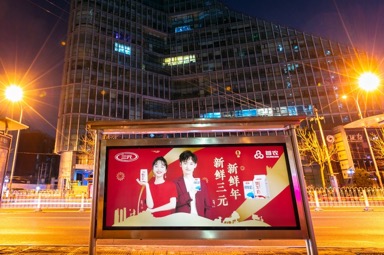
Bus shelter lightbox (mainstream choice)
Standard lightbox: The standard size advertising space on both sides of the platform is the most widely used basic form of coverage.
Extra large light box/irregular light box: located on certain key platforms, with a larger area or unique shape, strong visual impact, suitable for brand image display.
Digital media (growth trend)
Digital scrolling lightbox: One advertising space can play multiple images alternately, with richer content, suitable for displaying multiple products or promotional information.
LED information screen: Some new platforms integrate small LED screens, which can play dynamic videos with stronger appeal and real-time information updates.
*. 2 Creative Media
Platform overall packaging: Theme packaging the entire bus shelter to create an immersive experience, which can trigger social communication and is suitable for large-scale brand events.

Chapter 2: Five Step Practical Experience: The Scientific Process from Planning to Publication
Step 1: Clarify goals and audience positioning
This is the cornerstone of all decisions, ensuring that subsequent actions do not deviate from the direction.
Core objective: To enhance the brand's visibility in a certain administrative region? Or is it to provide precise guidance within a 3-kilometer radius for upcoming new stores such as catering and retail?
Audience Profile: Who are your target customers? Where do they live, work, and consume? What is their commuting route? This will directly determine the choice of platform.
Step 2: Refine point selection and combination strategy
'Where to invest' is more important than 'how much to invest'. This is the key to determining the success or failure of the effect.
Flow analysis and scene matching:
Office platform: With a huge flow of people during rush hour, it is suitable for brands such as fast food, coffee, and business services.
Large community platform: covering stable residential population, suitable for home decoration, education, automobiles, daily consumer goods and other household consumption brands.
Business district/subway connecting platform: Shopping and entertainment crowds are concentrated, suitable for fashion, beauty, electronic products, event promotion, etc.
Transportation hub platform: With complex but large crowds, it is suitable for brands such as telecommunications and insurance that require extensive exposure.
Point line surface combination strategy:
Point blasting: Concentrate budget to invest in one or several top traffic websites (such as "Tencent Building Station" and "Window of the World Station") to create brand landmarks.
Line based coverage: Multiple platforms are continuously deployed along one or several bus routes with concentrated target customer groups, forming a "brand line".
Surface style surround: Within a 3-5 kilometer radius of the target store or core area, grid based multi-point coverage is implemented to achieve regional screen dominance.
Make good use of professional data tools: manual investigation has low efficiency and inaccurate data. Suggest utilizing professional platforms such as Tianci Media for services. Tianci Media is a professional public transportation advertising platform, whose system usually integrates detailed data from various bus stops in Shenzhen (such as passenger flow estimation, crowd attributes, surrounding environment), and can intelligently select points and combine quotes based on your goals, greatly improving the scientificity of strategies.
Step 3: Creative Design: Born for the "5-second wait"
Platform advertising is a typical "short-term reading" medium, and its design must follow the principle of minimalism.
Oversized title, one image to read: The main visual must be prominent, and the brand logo and core appeal (such as "50% off for new store opening") should be clearly captured within 3-5 seconds. Avoid small characters and complex compositions.
Strong contrast colors, visible all day: The design needs to consider the effect under daytime and nighttime lighting, using high contrast color matching to ensure that the information is eye-catching under any lighting conditions.
Strong call to action, shorten decision-making path: Clearly list the "address", "phone number" or place a large QR code, and attach instructions such as "scan code to navigate to the store" and "make an appointment immediately" to instantly convert exposure into action.
Integrating into the urban context: The design style can match the youthful, technological, and fashionable urban temperament of Shenzhen, enhancing brand favorability.
Step 4: Budget Planning and Efficient Procurement
Pricing model: Usually calculated on a "block/week" or "block/month" basis. The price is significantly affected by the location of the platform (passenger flow level), the area in which it is located, and the advertising format (static/digital). The price of platform in the core business district may be 3-5 times that of ordinary communities.
Suggestion for advertising cycle: To establish effective memory, it is recommended that a single advertising cycle not be less than 4 weeks. Seasonal products or short-term promotions can be flexibly arranged for 2-4 weeks.
Centralized procurement through the platform: Directly connecting with numerous dispersed media owners is time-consuming and laborious. By using platforms such as Tianci Media for one-stop procurement, not only can we obtain more competitive prices, but we can also ensure standardized services throughout the entire process from contract signing, material review to publication monitoring, and avoid risks.
Step 5: Effect Tracking and Optimization
Offline traffic verification: Use parameterized QR codes or activity exclusive discount codes to accurately count the foot traffic or online inquiries brought by each platform advertisement.
Brand search monitoring: During the advertising period, monitor the changes in search volume of the brand on mainstream map apps such as Tencent Maps and Amap.
Field observation and research: Regularly visit the advertising platform to check the condition of the advertising screen, and conduct simple random interviews to understand the reach of the advertisement.
Chapter 3: Three common misconceptions that must be avoided
Misconception 1: Only choose the cheapest option, regardless of location and quality.
Wrong: Undertaking a large number of platforms at a low price on a remote and sparsely populated route, thinking that 'winning by quantity'.
Yes: Prioritize location quality. A high priced platform in a core business district may have a much greater dissemination value than ten ordinary platforms. Pursuing 'effective outreach' rather than simply 'quantity'.
Misconception 2: Information overload in design, like posting posters.
Wrong: Inserting a large amount of text and images such as store introduction, product list, and promotion details into the screen makes it blurry from a distance.
Yes: Adhere to the principle of 'one image, one core message'. Clearly present the brand, core products/services, key points of interest (discounts), and contact information. The screen should have a sense of breathing.
Misconception 3: The placement ends immediately, lacking linkage.
Wrong: After the advertisement is published, it waits for customers to automatically visit, completely disconnected from online marketing.
Yes: Use platform advertising as an offline traffic entry point. Online, social media can be used to announce "Meet Us on XX Platform", while offline advertising guides scanning codes to join the community, forming a marketing loop of "offline exposure online interaction in store conversion".
Conclusion
Placing bus stop advertisements in Shenzhen is a ground precision marketing campaign based on geographic big data. Its charm lies not in its earth shattering impact, but in its daily integration into the daily life trajectory of target consumers, achieving a subtle and silent brand penetration.
The key to success lies in: precise selection strategy, highly impactful minimalist creativity, and scientific advertising cycle management. For local service providers, regional brands, and advertisers with limited budgets, this is a proven and efficient path. Collaborating with professional platforms such as Tianci Media, which have massive data resources and mature execution networks, can help you get rid of trivial matters, focus your limited energy on strategy and creativity, ensure that every budget is spent on the cutting edge, and truly transform the passenger flow at bus stops into brand customers.
Start planning immediately to make your brand a beautiful scenery and efficient sales engine on the streets and alleys of Shenzhen.