Zhengzhou Public Transport Advertising Decision Guide: Efficiently Launching the Urban Mobile Brand Front
2026-02-11Tianci MediaViews:143
Highlights
This guide provides professional advice for advertisers to analyze the media value, mainstream forms (body, in car, station booth), and advertising strategies of Zhengzhou public transportation advertisements, covering the entire process from target setting, route selection to effect tracking. Read now to get efficient advertising solutions that reach millions of mobile users!
Zhengzhou, as a national central city and an important comprehensive transportation hub, has a ground bus network that shuttles between the city's main arteries and capillaries every day, carrying the commuting and daily life of millions of citizens. When buses put on the brand's coat and drive through the streets, they transform from a means of transportation into huge, mobile outdoor billboards. Zhengzhou bus advertising utilizes this unique "mobile landmark" attribute to achieve high-frequency and wide coverage penetration dissemination to urban populations in a dynamic manner.
For advertisers who hope to quickly enhance regional brand awareness, accurately cover local customer groups, or attract traffic to offline stores, bus advertising provides a high-quality choice that combines cost-effectiveness and mandatory reach. This guide will provide you with an in-depth analysis of its value logic and offer a scientific and actionable framework for advertising decision-making.
Chapter 1: Strategic Review: The Unique Value and Market Logic of Zhengzhou Public Transport Advertising
1.1 Four irreplaceable advantages of bus advertising
In the diverse outdoor advertising market in Zhengzhou, bus advertising occupies an important position due to its following characteristics:
Saturation coverage of massive mobile population: Zhengzhou's bus network is dense, covering major roads, commercial districts, communities, and transportation hubs throughout the city. Advertisements passively reach all pedestrians, passengers, and drivers along the way as the vehicle moves, forming a dynamic "mobile exposure zone" with daily exposure reaching millions of people.
High cost-effective regional screen blocking: Compared to city landmark brands that often cost millions of yuan, bus advertising can achieve "screen blocking" coverage of target areas (such as Jinshui District and Zhengdong New District) through contracting one or more core routes with a relatively limited budget, making it a powerful tool for regional brand explosion.
Compulsory exposure and scene based reach: Bus body advertisements have a large visual area, bright colors, and strong visual compulsion in street environments. At the same time, in car advertisements (such as billboards and handles) can accurately reach precise passengers who have already "boarded the car" and engage in deep communication in commuting scenarios.
Localized penetration into the community: Bus routes highly overlap with the daily life trajectories of citizens. By selecting routes that penetrate specific communities, advertisements can directly reach end consumers, especially suitable for precise marketing of local lifestyle services, real estate, educational institutions, and other brands.
1.2 Core value dimensions that affect advertising effectiveness
To evaluate whether a public transportation advertising placement is "value for money", it is necessary to comprehensively consider:
Line quality and passenger flow profile: Does the line pass through business districts, university districts, large residential areas, or mixed areas? There are significant differences in passenger structure (age, occupation, purchasing power) among different routes.
Visual impact and exclusivity of advertising space: Is it full body painting or partial stickers? Can it be quickly recognized while the vehicle is in motion? The number of similar competitor advertisements on a route.
The scientificity and rhythm of the advertising cycle: The exposure frequency and cycle required for short-term promotions and long-term brand building are completely different.
The integration of creative design and urban environment: can design stand out in complex street backgrounds? Does it conform to the urban temperament and aesthetics of Zhengzhou?

Chapter 2: Comprehensive Analysis of Mainstream Resource Types for Zhengzhou Public Transport Advertising
Understanding the available media 'weapons' is the first step in developing tactics. Zhengzhou bus advertisements mainly revolve around two major scenes: "body" and "platform".
2.1 Bus body advertising (mobile landmark)
Full body painted advertisement:
Features: The entire vehicle is fully packaged, with the strongest visual integrity and the greatest impact, like a moving giant billboard.
Value: The top-level form of brand display can greatly enhance brand awareness and high-end image, suitable for customers who have major brand releases or need to create sensational effects.
Vehicle side/tail sticker advertisement:
Feature: Post advertising images on specific positions on the side or rear of the vehicle.
Value: The cost is lower than that of a full body vehicle, and the form is flexible. It can be placed on one or both sides according to the budget. It is the mainstream choice for brands to conduct regular exposure and product promotion.
2.2 Bus Advertising (Deep Communication)
In car signage/lightbox advertising:
Location: Front, rear, and side positions inside the carriage.
Value: The area where passengers' line of sight stays for a long time during the ride, suitable for conveying in-depth information such as product details and promotional activities that require slightly longer reading time.
Handle advertisement, chair back advertisement:
Location: Passenger's hands and directly behind the seat.
Value: Zero distance contact with passengers, high mandatory, high reading rate. Suitable for publishing concise brand slogans, QR codes, or core selling points.
2.3 Bus stop advertising (targeted sniping)
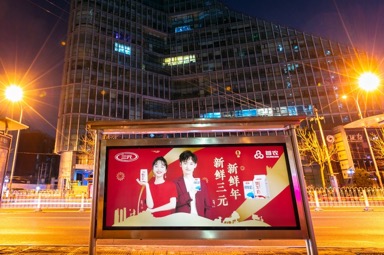
Bus shelter lightbox advertisement:
Location: On both sides of the bus stop shelter.
Value: Covering the waiting crowd, they have relatively ample time to watch advertisements while waiting for the bus, which is a key touchpoint connecting "outdoor walking" and "in car journey". Accurate coverage of designated areas can be achieved.
Platform information board advertisement:
Location: Around the bus route information board.
Value: Passengers will inevitably see it when checking the route, with focused attention, suitable for local life service advertisements.
Chapter 3: Five Step Practical Process: Achieving Scientific and Efficient Public Transport Advertising Placement
Step 1: Clarify marketing objectives and budget framework
Clarifying 'why to invest' and 'how much to invest' is the cornerstone of all decisions.
Goal definition: To enhance the brand awareness of Zhengzhou city? Or to attract traffic for the opening of new stores in the high-tech zone? Or promote a product targeting college students?
Budget planning: Bus advertisements are usually priced on a "car/month" or "route/cycle" basis. The total budget for media purchase, image production, and subsequent monitoring needs to be determined based on the objectives.
Step 2: Fine tuned route screening and combination strategy
This is the core step in determining ROI.
Line value analysis:
Business district routes: such as routes passing through Erqi Square and Huayuan Road business districts, covering shopping and consumer groups.
Commuting trunk lines: such as B1 and B2 roads connecting Zhengdong New District CBD with large residential areas (such as Huiji District), covering high-value office workers.
University routes: such as those passing through Longzi Lake University City, accurately reaching the young student population.
Loop/main road routes: such as the Third Ring Rapid Transit, with a wide coverage area, suitable for brand promotion.
Combination strategy of "point line surface":
Point explosion: Place full body advertisements on one or several top tier golden routes to create brand benchmarks.
Line coverage: Select a route with a concentrated target audience for full vehicle coverage, forming a "brand line".
Surrounding with "face": Within the target area (such as the entire Zhengdong New District), select all passing routes for multi-point and multi form combination advertising to achieve regional screen dominance.
Make good use of professional data and services: The resources of bus routes are scattered, and the efficiency of self research is extremely low. Collaborating with professional organizations such as Tianci Media is an efficient choice. Tianci Media is a professional public transportation advertising placement company that has a real-time resource database of Zhengzhou public transportation media, route passenger flow data, and a scientific point selection model. It can quickly provide the optimal route combination plan and accurate quotation based on your goals and budget, and provide one-stop publication and monitoring services.
Step 3: Creative Design: Born for "Dynamic Viewing" and "Urban Streets"
The design of bus advertisements should follow special principles of "mobility" and "environment".
Super symbols and minimalist information: The vehicle is in motion, and the viewing time is extremely short. The brand logo and product main visual must be huge and eye-catching, and the core advertising slogan must be understood within 3 seconds. Avoid small characters and complex compositions.
High saturation contrast colors: To stand out in complex street scenes and different weather conditions, it is necessary to use a combination of high contrast and high saturation colors.
Call to Action (CTA): Clearly label contact phone numbers, addresses, or QR codes, and provide clear instructions such as "scan code to understand" or "navigate to" to shorten the conversion path.
Step 4: Contract Negotiation and Execution Guarantee
Key points of price negotiation: Understand the publication price and discount system. Long term contracts and packaging multiple routes usually result in better prices. Clarify whether the cost includes image production, installation, and daily maintenance.
Key terms of the contract: It is necessary to clearly stipulate in the contract the specific license plate number (or replaceable range) of the vehicle to be released, the start and end dates of the release, the publication standards, the method of providing the monitoring report, and the liability for breach of contract.
Monitoring and acceptance: The executing party is required to provide actual photos or videos of vehicles with time and location watermarks after the advertisement is published, as the basis for payment and effectiveness evaluation.
Step 5: Effect tracking and integrated dissemination
Offline effectiveness verification: Use dedicated QR codes, discount codes, or 400 phone numbers to track direct inquiries or sales conversions from advertisements.
Brand voice monitoring: Observe the changes in search volume and discussion heat of the brand on local lifestyle platforms (such as Dianping), social media, and search engines during the advertising period.
Online and offline integration: Using bus advertisements as an offline traffic entry point, initiate topics such as # I met XX brand bus in Zhengzhou # on social media, encourage citizens to check-in and interact, and convert offline exposure into online social media volume.
Chapter 4: Three Misunderstandings to Be Cautious of in Ensuring Investment Returns
Misconception 1: Blindly pursuing the "number of vehicles" and neglecting the "quality of the route".
Wrong: Choosing a large number of routes that pass through remote areas with sparse passenger flow, although the total number of vehicles is high, the effective exposure is extremely low.
Yes: Adhere to the principle of 'quality is better than quantity'. Prioritize choosing a high-quality route that passes through the core business district and office area, as its transmission value far exceeds that of ten inefficient routes.
Misconception 2: Mediocre design, treating advertising spaces as "mobile newspaper layouts".
Error: The screen information is overloaded, the text is densely packed, the images are cluttered, and it is impossible to recognize them during rapid movement.
Yes: Designed for 'dynamic' purposes. Adhere to the principle of 'one image, one core message'. The four elements of brand identity, core products, key benefits (such as 50% off upon opening), and contact information should be clear and prominent.
Misconception 3: Lack of data thinking and effectiveness review.
Wrong: After the advertising campaign ends, it is only evaluated based on the feeling that it seems to have some effect, without quantitative tracking and data analysis.
Yes: Set quantifiable KPIs (such as QR code scanning and foot traffic) before advertising and track them through technical means. After the launch, conduct data review, analyze the input-output ratio, and guide the next optimization.
Conclusion
Placing bus advertisements in Zhengzhou is a precise offline traffic operation based on urban geography and crowd flow. The key to its success lies in integrating scientific route selection, highly impactful creative design, and rigorous effect tracking.
For local brands, chain merchants who pursue practical results, and advertisers who hope to quickly open up regional markets, bus advertising provides a cost-effective option that is difficult to avoid. Collaborating with partners like Tianci Media, who possess deep localization resources, professional service capabilities, and a full process guarantee system, can help you significantly reduce decision-making risks and execution costs, ensuring that your brand information becomes a flowing landscape that is both eye-catching and brings practical returns on the streets of Zhengzhou.