A Comprehensive Guide to Advertising on Beijing Buses: Analysis of Resources, Prices, and Effects
2026-02-03Tianci MediaViews:113
Highlights
This guide comprehensively analyzes the media forms, route selection strategies, price composition, and effectiveness evaluation methods of Beijing bus advertising. Help brands understand how to utilize this cost-effective mobile media to achieve widespread exposure. Read now to obtain professional advertising solutions from strategy to execution.
How to efficiently reach every corner of Beijing, a super city with a population of over 20 million, with your brand information? As the cost of outdoor advertising at fixed locations continues to rise, a "mobile" and "actively penetrating" media form has always maintained its unique vitality - Beijing bus advertising. The bus bodies shuttle between Chang'an Avenue, Ring Road, and Hutongs, like flowing city display boards, accurately delivering brand information to the streets and alleys.
However, advertising on buses is far more than just "buying a car". It involves complex route planning, media form selection, and effect evaluation. This article will systematically sort out the placement logic of Beijing bus advertisements, helping you develop a scientific and effective mobile marketing plan from scratch.
1、 Understand the core value of Beijing bus advertising
Before formulating a strategy, it is important to understand the unique value that bus advertising can bring:
High penetration and seamless coverage: Bus routes are fixed and extensive, allowing for deep penetration into communities, commercial districts, and transportation hubs, achieving a "geographical penetration" that online advertising cannot reach. It can reach middle-aged, elderly, and local residents who do not have internet access or have limited exposure to elevator and subway media.
Forced exposure and repeated exposure: The large body area and mobility characteristics give it a natural visual compulsion in road environments. Fixed populations along the route (such as residents and office workers) may form "repetitive memories" of advertisements due to the daily operation of buses.
Wide dissemination of high cost-effectiveness: Compared to static point combinations with the same coverage area, the annual deployment cost of a single or team bus is often more competitive, and can initiate brand exposure throughout the city with a relatively reasonable budget.
Flexible regional attack weapon: By selecting specific routes, it can accurately cover the target area. For example, choosing a route that passes through Zhongguancun mainly targets the tech community, while choosing a route that passes through Guomao Financial Street affects business people.

2、 Core media format: not limited to car body
Beijing bus advertising is a complete media system, mainly including:
Advertising on the entire vehicle: the most visually impactful form, commonly known as the "whole car package". It is usually divided into single-sided, double-sided, and full vehicle (including front, rear, and both sides of the body). This is the core carrier of brand promotion, with the highest price.
Advertisements on the body of the vehicle, such as advertisements at the rear of the car and banner ads on the lower edge of the car window (waistline). The price is lower than the full body, suitable for limited budget or as a supplementary coverage.
In car advertising:
Signage/poster inside the carriage: located on the inner wall of the carriage, providing close contact with passengers and suitable for conveying more detailed information.
Hand pulled advertisement: a media that passengers must come into contact with, with a very high reach rate.
Seat back advertisement: Facing the rear passengers, reading for a long time.
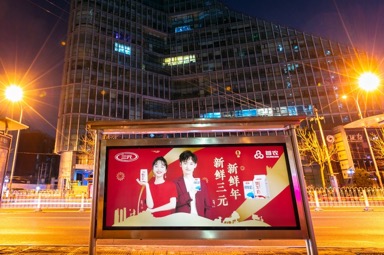
Bus shelter advertising: Although it does not belong to the bus itself, it is often packaged and sold together with bus advertising, forming a complete contact loop of "before travel - during boarding".
3、 Five Steps to Develop Your Bus Advertising Strategy
Step 1: Clarify the advertising target and target area
This is the starting point for all decisions. Clearly, you want to:
Enhance brand awareness throughout the city?
Attracting traffic to a newly opened branch?
Targeting specific administrative regions (such as universities in Haidian District and business districts in Chaoyang District) for promotion?
The goal determines whether you need "full network coverage" or "breakthroughs in key routes".
Step 2: Study the route and match the target audience
This is the most crucial step. Beijing's bus routes have distinct functions:
Through type trunk lines: such as Route 1, Route 300, etc., passing through main roads such as Chang'an Avenue and the Third Ring Road, with a wide coverage area, suitable for brands pursuing wide exposure.
Regional feeder lines: penetrate specific residential areas or industrial parks (such as Wangjing, Financial Street, Yizhuang), suitable for precise marketing targeting specific communities or office workers.
Tourist and sightseeing routes, such as those passing through Tiananmen Square, the Forbidden City, and the Summer Palace, can efficiently reach tourists coming to Beijing.
Suggestion: Use map software to simulate the route direction and conduct on-site investigations of passenger flow and commercial environment along the route. Or seek professional data analysis support directly.
Step 3: Choose a combination of media format and vehicle quantity
Adequate budget and pursuit of volume: Choose multiple main routes with "full body painting" to form a flowing visual matrix.
Limited budget, pursuit of precision: Select a small number of core routes in the target area and use a combination of "vehicle body+interior" for saturated advertising.
Testing and drainage: 1-2 representative routes can be selected for short-term (such as 1 month) advertising to test creative effects and collect market feedback.
Step 4: Obtain professional quotations and plan budgets
The advertising resources of Beijing buses are mainly managed by official operators such as Beiba Media, with a complex pricing system. The main factors affecting the cost of a single vehicle are:
Route value: The price of routes passing through core commercial districts and main roads is much higher than that of suburban routes.
Media format: Full body>Rear>In car media.
Placement duration: usually measured in months/vehicles or years/vehicles, with discounts for long-term contracts.
Fleet size: The more vehicles deployed, the lower the average price per bike.
Strong recommendation: Contact a professional public transportation advertising placement company like Tianci Media for inquiries and plan proposals. They not only have access to the latest resource prices and schedules, but also rely on their experience to plan cost-effective route combinations for you, and handle the entire complex process from design review to publication monitoring.
Step 5: Creative Design and Effect Tracking
Creative design: Vehicle advertising is a "three second art". The design must be concise, highlight the theme, and have vivid colors to ensure quick recognition during vehicle movement. The brand logo, core slogan, and contact information (such as QR code) should be placed in a prominent location.
Effect tracking:
Offline feedback: Set up exclusive discount codes or activity QR codes to track conversions from bus advertisements.
Online monitoring: Simultaneously initiate topics on social media (such as # I saw XX on XX bus #), encourage users to check-in and interact, and form secondary dissemination.
Business data correlation: Compare the changes in customer traffic or consultation volume of target area stores during the advertising period.
4、 Common Misconceptions and Avoiding Pits Guide
Misconception 1: Only choose loop cars and ignore the "last mile" route.
Analysis: Loop cars have fast speed, short exposure time, and most passengers are passing by. The routes that go deep into the community have slower speeds and more stops, resulting in higher repeat viewing rates among residents and merchants along the route, and may have stronger actual memory. It is necessary to make a balanced selection based on the target.
Misconception 2: overly complex design and information overload.
Analysis: The car body is an outdoor media, and the audience only has a few seconds of viewing time. Never move the website homepage or product details page onto the vehicle. Adhere to the minimalist principle of "one image, one article, one logo".
Misconception 3: The advertising time is too short.
Analysis: Bus advertising requires cumulative effects. After 1-2 weeks of deployment, the vehicles have not yet covered the entire route, making it difficult to form effective awareness. It is recommended to invest at least one full quarter (three months) to achieve repeated outreach to the population along the route.
Misconception 4: Neglecting the combined value of in car media.
Analysis: The car body attracts pedestrians, while the interior of the car affects passengers. The average travel time of passengers exceeds 20 minutes, which is a good opportunity for deep dissemination. The combination of "vehicle body drainage+in car persuasion" can greatly improve overall conversion efficiency.
Misconception 5: Failure to conduct advertising monitoring.
Analysis: It is necessary to require the agency company or operator to provide a "publication monitoring report" (including vehicle number, operating status, advertising screen photos/videos) to ensure that the advertisement is published normally according to the contract.
Conclusion: Urban level mobile networks serve as capillaries for brand penetration
The essence of Beijing bus advertising is to purchase a "dynamic communication network" that covers the mainstream road network of the city. It transforms brands from static waiting to proactive cruising, repeatedly appearing in the real life flow of consumers, thus establishing a solid and friendly understanding.
For brands that hope to quickly gain popularity in the Beijing market or conduct regional deep penetration, bus advertising is a proven and cost-effective choice. The key to its success lies in precise route strategy, eye-catching creative design, sufficient patience in advertising, and collaboration with professional teams.
By collaborating with professional partners such as Tianci Media who have rich local experience and media resources, you can more efficiently navigate through the complex maze of resources, converting every budget into brand influence driving through the streets and alleys of Beijing, truly achieving the goal of "driving throughout the city, brand in your heart".