Introduction Guide to Advertising on Guangzhou Buses: A Comprehensive Analysis of Strategies, Forms, and Effects
2026-02-09Tianci MediaViews:137
Highlights
This article is a comprehensive guide to Guangzhou bus advertising, detailing its unique value, mainstream advertising forms, four step advertising strategies for beginners, and common pitfalls to avoid. If you need professional advertising services, Tianci Media, as a professional public transportation advertising platform, can provide a one-stop solution.
In Guangzhou, which has a population of nearly 20 million and an average daily bus passenger flow of millions, buses shuttling through Tianhe CBD, Beijing Road and the Pearl River New Town are not only urban transportation vehicles, but also mobile "brand showrooms". For brands trying outdoor advertising for the first time, Guangzhou bus advertising is an intuitive and promising choice. But faced with a vast network of lines and diverse forms of advertising, beginners often feel at a loss: should they choose the car body or the interior? How to choose the route? How much is the budget? Don't worry, this article will become your "Guangzhou Advertising Guide", using the clearest and most understandable way to systematically master the way of advertising in Guangzhou's public transportation.

Part 1: Why choose Guangzhou bus advertising? Three core advantages
Before delving into the "how to do it", it is important to understand the unique value that advertising on public transportation in Guangzhou can bring.
1. Unparalleled coverage breadth and repeated reach
The public transportation network in Guangzhou is as dense as a spider web, covering every corner from the core business district to residential communities, from transportation hubs to industrial parks. A bus is a mobile landmark, and its fixed route operation can provide regular repeated exposure to the crowd along the way. For brands that need to quickly establish widespread recognition, this is a highly cost-effective choice.
2. Precise penetration into urban capillaries
Unlike subways that mainly cover main roads, bus routes can penetrate the "capillaries" of the city, accurately reaching specific streets, communities, and professional markets. You can choose routes that pass through professional wholesale markets, university areas, large residential areas, or food streets based on brand goals to achieve precise conversations with segmented populations.
3. High cost-effective stereoscopic visual impact
Full body advertising has a huge visual area and is highly impactful in traffic and pedestrian flow, effectively enhancing brand momentum. Compared to static big brand advertisements of the same level, the cost per thousand (CPM) of bus advertising is usually more competitive, giving small and medium-sized budgets the opportunity to create a visual image of a "big brand".
Part 2: Understanding Your 'Mobile Canvas': Analysis of Mainstream Advertising Forms
Guangzhou bus advertisements mainly have the following "dressing up" methods, each with its own emphasis:
1. Full body advertising: a mobile "brand landmark"
What is it: a colorful advertisement that covers almost the entire exterior surface of a bus, like putting a gorgeous coat on the bus.
Core advantage: The strongest visual impact, extremely high recognition, and can effectively enhance the brand's high-end image and topicality.
Suitable for: Enterprises with sufficient budget and a desire to quickly ignite their brand and create a distinctive brand image, often used for new product launches or large-scale event promotions.
2. Vehicle side/tail sticker advertisement: classic "flowing poster"
What is it: an advertisement posted on the side and rear of a bus. This is the most common and widely used form.
Core advantage: Balancing visible area and cost, with high cost-effectiveness. Side advertisements are visible to pedestrians, vehicles, and waiting passengers on the road; The tail advertisement provides a continuous reminder to the driver following behind.
For whom: The vast majority of brands, whether pursuing broad exposure or regional penetration, are the main choices.
3. In car advertising (billboards, handles, electronic screens): a warm "companion style communication"
What is it: Advertising spaces set inside bus compartments, including seat back signs, handle advertisements, and in car televisions.
Core advantage: In a closed compartment, passengers have a longer contact time and can communicate in-depth information. The handle advertisement is closest to the line of sight and has extremely strong mandatory readability.
Suitable for: Suitable for brands that need to convey specific product information, promotional activities, or provide local services (such as education and training, healthcare) to attract traffic.
4. Bus shelter lightbox advertisement: static "base interception"
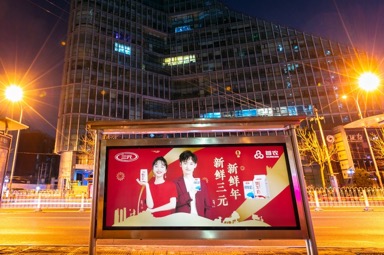
What is it: Light box advertisements at bus stops, although not in vehicles, belong to the bus media system.
Core advantage: Located at a must pass for waiting passengers, it has a longer viewing time. It can form a combination of "dynamic (vehicle)+static (pavilion)" with vehicle advertising to achieve a three-dimensional surround of the target area.
Suitable for brands such as real estate, automobile 4S stores, commercial districts, and shopping malls who wish to deeply cultivate specific areas and guide offline stores.
Part 3: Beginner's Four Step Method: Launch Your First Guangzhou Public Transport Advertising Campaign
Assuming you are a local chain dessert brand in Guangzhou, let's take a step-by-step look at how to operate it.
Step 1: Clarify the goal - what do we want?
Clear goals are the starting point for all decisions.
Core objective: To attract traffic to 5 new stores in Tianhe and Yuexiu districts during the summer, and enhance the brand's popularity among young consumers.
Target audience: Urban young white-collar workers and students aged 18-35 who love clocking in and sharing.
Success indicators: Increase in store foot traffic, increase in targeted check-in posts on social media, and improvement in group purchase coupon redemption rate.
Step 2: Match Resources - Choose the Right Form and Route
Based on the objectives, develop the most effective media mix:
Form combination: Choose vehicle side mounted advertisements as the main focus (wide coverage), and assist with precise traffic guidance at the bus shelters around the core stores.
Route selection: of utmost importance. You need to choose a bus route that passes through the target business district (such as Tianhe City, Sports West), key office buildings, and university town. You can use tools such as Baidu Maps to view bus route waypoints, or consult professional organizations for advice.
Step 3: Creative Design - How to Catch Passersby at a Glance?
Bus advertising is a "3-second art" that must be communicated in an instant.
Super symbol: Use brand colors with high saturation, strong contrast, and oversized logos.
Minimalist copywriting: A core slogan is enough (such as "Sunshine savior! XX dessert is full of ice cold").
Strong action guidelines: Clearly label "Nearest store: 50 meters right turn from Exit A of Sports West Road Station" or attach a prominent "Scan QR code to collect coupons" QR code.
Localized affinity: It can cleverly integrate local cultural elements such as "Cantonese" and "Five Goats" to bring people closer together.
Step 4: Execution and Evaluation - Make the Results Clearly Visible
Professional execution: Public transportation advertising involves complex processes such as vehicle scheduling, image production and installation, and online verification. It is strongly recommended to cooperate through professional platforms, such as Tianci Media, which is a professional public transportation advertising platform. They are familiar with all the rules and resources of Guangzhou's public transportation media, and can provide one-stop services from scheme formulation, price negotiation, publication monitoring to effect tracking, saving you a lot of time and trial and error costs.
Effect tracking: It is necessary to design a traceable conversion path, such as using store exclusive discount codes and different activity QR codes for different routes, in order to accurately evaluate the actual customer flow and sales brought by advertisements on each route.

Part 4: Three "pitfalls" that beginners must avoid
Blind route selection pit: not studying the route direction, only looking at the price. You have chosen low-cost routes that pass through logistics parks or old industrial areas, but your target customer group (young consumers) is unlikely to appear there. The value of the route far exceeds the unit price.
The "information overload" pit: On the fast-moving body of the car, there are densely packed product introductions, phone numbers, and addresses. As a result, passersby couldn't see or remember anything clearly. Adhere to the minimalist principle of "one picture, one article, one action".
The trap of "individual combat": attempting to contact the bus company on their own, facing complex resource catalogs and inefficient approval processes, and difficulty in obtaining discounted prices due to small procurement quantities. Utilizing a professional agency platform is the optimal solution to improve efficiency and cost-effectiveness.
Step 5: Leveraging professional platforms to simplify complexity
For beginners, integrating Guangzhou's vast and diverse bus advertising resources (from different bus companies and hundreds of routes) on their own is a daunting task. Collaborating with professional platforms like Tianci Media is equivalent to having a 'headquarters':
Scientific planning: Based on databases and advertising experience, we match you with the most cost-effective combination of routes and forms, rather than simply listing resources.
Efficient execution: Handle all tedious communication, approval, production, and publication processes to ensure that advertisements are presented on target vehicles on time and with quality.
Cost optimization: With the advantage of large-scale procurement, it often helps you obtain better media prices.
Conclusion: Integrating Brands into the Rhythm of Cities
Placing bus advertisements in Guangzhou is essentially a seamless integration of brand information into the daily pulse of the city. For beginners, the wisest strategy is to conduct small-scale testing and refine operations.
Suggest concentrating the budget and focusing on 1-2 core golden routes that have been thoroughly researched, conducting saturated advertising for at least one month, and setting clear conversion tracking points. When you can truly see the changes in store customer flow brought about by advertisements, you have mastered the first key to efficient offline marketing in "Flower City", laying a solid foundation for larger scale brand campaigns in the future.