Is it better to place bus advertisements on the platform or on the bus body? A comprehensive comparison and scientific decision-making guide
2026-02-05Tianci MediaViews:140
Highlights
This article provides an in-depth comparison of the core advantages, applicable scenarios, and selection strategies of bus stop advertising and bus body advertising, offering a scientific decision-making framework from four dimensions: exposure, reach, creativity, and cost. If you require professional bus advertising services, Tianci Media, as a professional bus advertising platform, can provide you with full support.
For many brands that hope to efficiently reach the general public in offline scenarios, bus advertising is a classic and cost-effective choice. However, once the budget is determined, a real and crucial question arises: is it better to advertise on bus platforms or on bus bodies? This is not a question that can be simply answered with "yes" or "no". Platform advertising and vehicle advertising are two completely different types of outdoor media, with significant differences in their communication logic, applicable scenarios, and effectiveness evaluation methods. This article will abandon subjective assumptions and provide you with a clear decision-making framework from the perspectives of advertising communication and practical marketing, helping you make the most scientific and effective choices based on your own marketing goals.
Part 1: Deconstructing the Core Differences - What is the Essence of Platform and Body?

To make the right choice, one must first have a thorough understanding of the fundamental attributes of these two media. They are not simply the difference between "stationary" and "mobile", but represent two different traffic acquisition modes.
Platform advertising: a 'destination' media that waits for rabbits by the tree
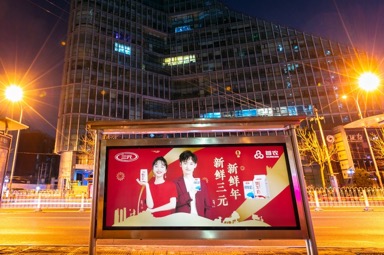
The essence of bus stop advertising is a "fixed point high-frequency traffic interceptor".
Scene characteristics: It is fixed at a specific location on the city street, serving the crowd waiting for the bus here. The audience is in a relatively static "waiting" state, with idle attention and a long period of time (usually 3-10 minutes) to be exposed to advertising information.
Communication logic: Deep communication, repetitive memory. Due to the longer audience stay time, advertisements can carry more information, such as product details, activity rules, long articles, etc., making them suitable for "persuasion" and "education".
Geographical value: It has a strong "business district" or "community" label. For example, advertisements placed on the platform of the core business district reach the shopping crowd; The platform placed at the entrance of a large community targets household residents. Geographic positioning is extremely precise.
Vehicle advertising: a mobile shuttle "wide area network" media
The essence of car advertising is a "dynamic and flowing urban exhibition hall".
Scene characteristics: It follows the trajectory of the bus and shuttles through the streets and alleys of the city. Its target audience includes pedestrians, cyclists, drivers and passengers of other vehicles on the road, covering a wide range.
Communication logic: extensive exposure, brand building. The core advantage of vehicle advertising lies in the ultra-high coverage and multi angle display brought by mobility. The information it conveys must be extremely concise and eye-catching, aimed at establishing brand recognition and impression in a short period of time, rather than conveying complex information.
Trajectory value: Its value depends on the bus route. A route that runs through the main roads of a city or connects important areas, like a flowing advertising strip, can dynamically display brand information to a large audience at different locations along the route.
Part 2: Four Step Decision Making Method - How to Choose Scientifically Based on Your Goals?
Choosing between a platform or a vehicle should not be based on personal preferences, but on clear marketing objectives. Please follow the following four steps to make a decision.
Step 1: Clarify your primary marketing objective
This is the cornerstone of decision-making. Please take your seat accordingly:
If your goal is to achieve broad-spectrum brand exposure and increase brand awareness, car advertising has more advantages. A bus is like a mobile landmark that can quickly show the brand to a massive audience. Combining multiple routes can quickly create a brand presence throughout the city.
If your goal is to achieve precise regional penetration and guide offline actions, platform advertising is more effective. Placing advertisements on platforms near target stores or competitor stores can directly influence the audience who are about to make consumer decisions. Combined with guidance information such as "XX meters ahead" and "Get off at this station and you will arrive", the conversion path is extremely short.
If your goal is to convey complex information and conduct market education, platform advertising is a more suitable carrier. The boredom of waiting makes the audience more patient in reading longer texts such as product feature comparisons and activity participation details.
If your goal is to strengthen brand vision and shape a high-end image, the two can be combined. Full body painted advertisements have strong visual impact and are suitable for creating a high-end brand image; High quality lightbox signs in the core business district can also effectively enhance brand tone.
Step 2: Evaluate your target audience and their behavioral paths
Who is the audience? If you want to reach car owners and street merchants, vehicle advertising (especially on the side and rear of buses) is more effective in covering road vehicles. If you want to reach commuters, students, and middle-aged and elderly people who rely on public transportation, platform advertising is their daily must visit point.
Where is the path? Describe the key locations where your ideal audience appears throughout the day: are they fixed commuting routes (corresponding to specific bus stops) or a wide range of activities (covered by multiple bus routes)? The fixed and extensive nature of the path directly leads to the platform or vehicle body.
Step 3: Consider the complexity of your creative form and content
Creative pursuit of visual impact: Full body painting can maximize the use of vehicle contours, designed in shapes such as tigers and beverage cans, with high topicality and spreadability, which cannot be achieved by platform advertising.
Large amount of content information: If detailed information such as QR codes, phone numbers, and event addresses need to be displayed, the static and close-up viewing characteristics of platform advertisements make their success rate much higher than that of fleeting vehicle advertisements.
Pursuing interactivity and a sense of technology: Digital intelligent kiosks can integrate new technologies such as touch screens and AR interaction, which is difficult to achieve with traditional car advertising.
Step 4: Balance your budget and expected results (cost-effectiveness analysis)
Single point cost and coverage cost: Typically, the cycle cost of a single advertising space on a prime location platform may be higher than the cycle cost of advertising on a regular bus body. But when evaluating, it is necessary to consider the cost per thousand impressions (CPM). The mobile nature of vehicle advertising may result in lower CPM.
Durability of effect: Platform advertisements are displayed statically for 24 hours during the advertising period, regardless of wind or rain. The effectiveness of vehicle advertising is directly related to the bus operating time (usually 16-18 hours/day) and departure rate.
The combination strategy is often the optimal solution: for most brands, especially customers with moderate budgets, the combination strategy of "breadth and volume of vehicle advertising+deep conversion of core platform advertising" can often achieve a synergistic effect of 1+1>2.
Part 3: Common Misconceptions and Avoiding Pits Guide
In the decision-making process, please be sure to avoid the following typical misconceptions:
Misconception 1: The binary oppositional thinking of either or.
The biggest misconception is that only one of the two must be chosen. For most marketing activities, the platform and the vehicle body are complementary rather than substitutive. Think about how to allocate the proportion based on the budget, rather than doing Single choice question questions.
Misconception 2: Neglecting data research on routes and stations.
Not all car advertising has the same effect. Placed on a route that shuttles through remote communities, the effect is vastly different from being placed on the "Golden Circle" that surrounds the city's CBD and transportation hubs. Similarly, not all platforms are priceless, and it is necessary to study their traffic, waiting environment, and audience composition.
Misconception 3: Mismatch between creativity and media format.
Print a string of phone numbers densely on a fast-moving vehicle, or compress a grand visual image that requires a distant view to understand the whole picture into a station sign lightbox that people can see up close. This mismatch will result in zero advertising effectiveness.
Part 4: Professional Execution Suggestions
Efficient execution is crucial regardless of the choice of platform, vehicle, or combination placement. Facing thousands of public transportation resources and complex approval processes in a city, collaborating with professional institutions is a wise choice.
Tianci Media is a professional public transportation advertising platform, whose value lies in providing integrated solutions. Through such platforms, you can:
Obtain scientific planning: The platform can match the combination of bus routes and stops with the highest degree of coincidence with the target audience's travel trajectory based on the database, and provide data-driven advertising recommendations.
Simplified execution process: one-stop solution for media inquiries, contract signing, material review, publication monitoring, and other tedious processes, ensuring timely and high-quality delivery.
Realize effect optimization: Professional platforms can provide more transparent effect reports (such as line coverage range, trip rate monitoring, etc.), and can dynamically optimize and adjust based on feedback during the advertising stage.
Conclusion: There is no best, only the most suitable
Returning to the original question: Is it better to advertise on bus platforms or on bus bodies?
The answer is: it depends on your specific marketing goals, target audience, creative content, and budget allocation.
Pursuing maximum urban exposure and brand building, choosing car advertising, especially high-quality route full car painting.
Pursuing precise regional penetration, offline conversion, or complex information transmission, choosing platform advertising in core locations.
For the vast majority of brands that pursue synergy between quality and efficiency, the combination strategy of "wide body coverage+deep platform communication" is the scientific way to maximize the value of bus advertising.
The final decision should start with clear strategic thinking, result in refined media data analysis, and be supported by professional execution guarantees. Only in this way can your investment in public transportation advertising truly be transformed into effective market investment that drives brand growth.