Shenzhen Airport Advertising Fees: A Budget Blueprint for Winning the "Technology Gateway" of the Guangdong Hong Kong Macao Greater Bay Area
2026-01-22Tianci MediaViews:135
Highlights
This article provides an in-depth analysis of the advertising fee standards at Shenzhen Airport (Bao'an International Airport), breaking down the price structure and billing models of media such as LED screens, corridor advertisements, and light boxes. It also offers practical guidance on strategic planning, location selection, and cost optimization. Assist you in precise budgeting and efficient layout of the core hub of the Guangdong Hong Kong Macao Greater Bay Area.
As the core aviation hub and technology gateway of the Guangdong Hong Kong Macao Greater Bay Area, Shenzhen Bao'an International Airport has already surpassed its simple transportation function and become a brand strategic highland that gathers global scientific and technological innovation elites, high net worth business people, and emerging consumer forces. For brands intending to deeply cultivate the South China market, engage with cutting-edge technology audiences, or establish an international innovative image, advertising here is a highly forward-looking investment.
However, when you start to enter this market, the diverse media formats and vastly different pricing ranges often confuse you: what logic does Shenzhen airport advertising fees follow? What causes the gap between budgets ranging from tens of thousands to millions? This article will systematically sort out the value system and price composition of advertising at Shenzhen Airport, transforming you from a "seeing the flowers in the mist" to a "knowing decision maker".

Part 1: Strategic Perception - The Unique Value and Media Ecology of Shenzhen Airport
Before discussing specific numbers, it is necessary to understand the unique strategic positioning of Shenzhen Airport that distinguishes it from Beijing and Shanghai, which constitutes the underlying logic of its media value.
Greater Bay Area Technology and Innovation Hub: Backed by the science and technology innovation industry in Shenzhen and the entire Greater Bay Area, the density of technology company executives, entrepreneurs, R&D personnel, and highly educated talents among airport passengers is leading in the country. This determines that advertising content needs to have a stronger sense of technology, design, and internationalization.
A dynamic gateway that combines domestic and international activities: it has dense domestic business routes and continues to expand international routes, with diverse passenger composition and strong consumption vitality.
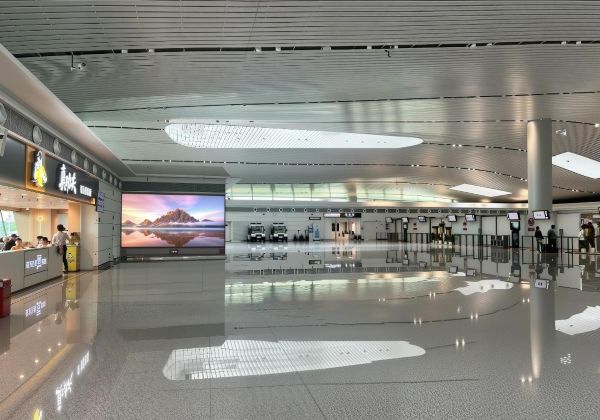
Modern intelligent terminal: The design of T3 terminal and satellite hall is modern and spacious, providing an excellent display environment for high-quality digital media and creative installations.
Therefore, when advertising at Shenzhen Airport, what you are buying is not only exposure to the high-end mobile population, but also a deep binding to the regional brand labels of "innovation, vitality, and future".
Part 2: Deconstruction of Fee Structure - Where Does Your Budget Flow?
The advertising fee of Shenzhen Airport is not a single quotation, but a composite system composed of multiple modules. The total cost mainly consists of the following three parts:
Module 1: Media publishing fees (core costs, accounting for approximately 60% -75% of the total budget)
This is a fee paid to the airport advertising operator to obtain specific advertising space usage rights. Its pricing is highly complex and mainly based on the "value formula":
Media publishing fee ≈ Point benchmark price x Time coefficient x Exclusivity coefficient
Point benchmark price: determined by the following dimensions:
Regional value: This is the biggest price leverage. The usual order is: international departure/arrival zone>domestic departure/arrival zone; Inside the security check (isolation zone)>outside the security check; Main channel>Secondary channel. For example, the unit price of LED screens in international arrival corridors far exceeds that of light boxes in domestic baggage claim halls.
Media format: Different forms of pricing units and prices vary greatly.
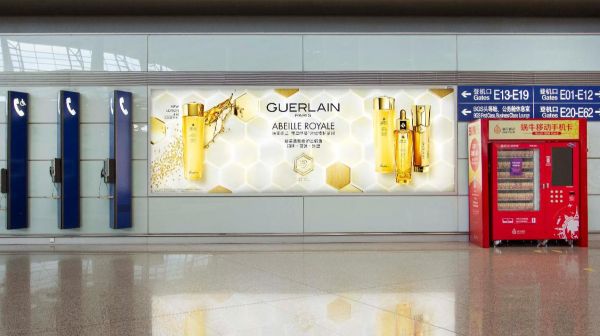
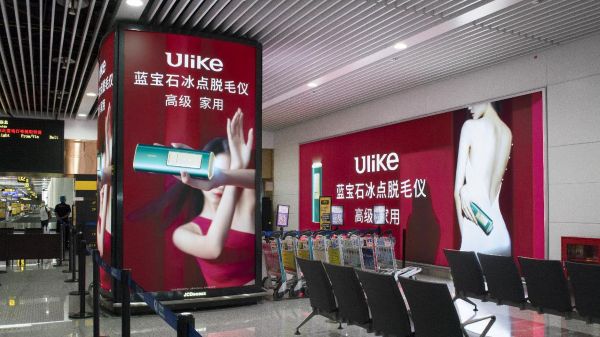
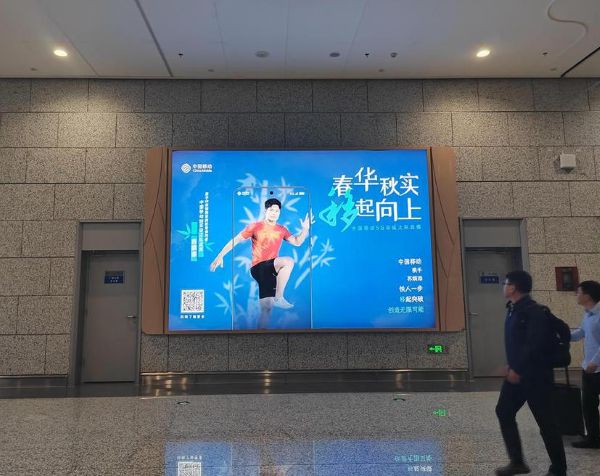
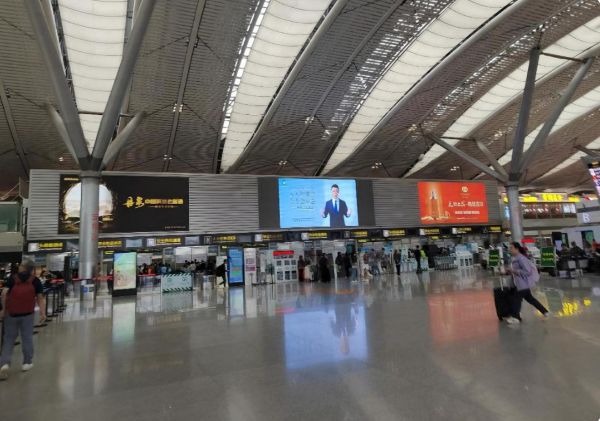
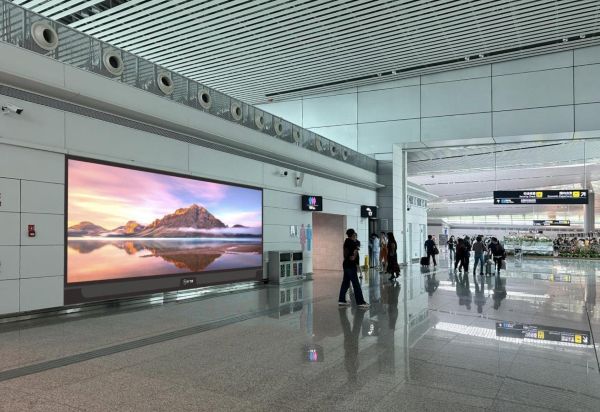
LED giant digital screen: located in core positions such as check-in hall and arrival hall, priced on a per second/weekly cycle, it is the visual high ground and has the highest price.
Langqiao advertisement (static/digital): covering the last leg of the boarding journey, with a precise audience, priced on a monthly basis.
Luggage turntable light box: When passengers retrieve their luggage, their attention is highly focused, and pricing is based on the "plate", resulting in a good conversion effect.
Check in Island Lightbox/Column/Wall Stickers: Brand reminder media, priced by location/cycle.
Time coefficient:
Placement period: Long term contracts (annual, quarterly) can receive significant unit price discounts. The highest monthly or short-term advertising price.
Premium during peak season: During the Spring Festival travel rush, summer transport, National Day, and large-scale exhibitions (such as the China International Fair for Trade and Industry), there will be a surge in passenger flow, and media prices will correspondingly increase.
Module 2: Creative Planning and Production Costs (Key Investment, accounting for approximately 15% -30% of the total budget)
This cost is often underestimated, but it directly determines the final effect and brand image of the advertisement.
Ultra high definition video/graphic design: Special creativity and production must be carried out for the pixel matrix, viewing distance, and lighting environment of airport specific screens. Ordinary promotional videos cannot be directly used.
Creative complexity: Do you need naked eye 3D effects, dynamic interactive design, or creativity combined with airport building structures? Special effects production will significantly increase costs, but it can also attract more attention.
Material and Craftsmanship: High quality output of static images, use of special materials (such as high-end lightbox panels), and ensuring smooth and beautiful installation all require budget guarantees.
Module 3: Comprehensive technical services and taxes (necessary expenses, accounting for approximately 5% -10% of the total budget)
Publication execution and monitoring fees: professional installation and debugging fees, as well as fees for third-party publication monitoring certificates and reports.
Content review and reporting fees: All advertising content must undergo strict review by the airport and relevant departments, with a rigorous process that may result in service fees.
Taxes and Fees: Major expenses such as media publishing fees are usually subject to value-added tax.

Part 3: In depth analysis of key variables affecting the level of "fees"
In addition to the above structure, there are several key variables that will significantly affect the final bill:
T3 terminal vs satellite hall: The newly built satellite hall carries more domestic boutique routes, with updated facilities, and its media value is rapidly increasing. Unlike the pricing strategy of the T3 core area, it may provide a more growth oriented value combination.
Digitization level: Does it support programmatic purchasing (P-DOOH) for digital screens? Can dynamic content updates and real-time data triggering be achieved? These intelligent features may bring a premium, but they also provide more flexible advertising methods and the possibility of optimizing effectiveness.
Package and packaging strategy: Media operators usually provide "media packages", such as purchasing core LED screens and pairing them with a certain amount of digital screen brushing machines or light box locations. The overall cost-effectiveness of packaged purchases is often higher than that of individual purchases.
Supplier hierarchy: Are you purchasing through the official operator of airport advertising resources, their exclusive strategic agents, or multi-level subcontractors? The more levels there are, the higher the markup may be, and the service guarantee and resource stability may decrease.
Part Four: From Goals to Budget - Four Step Practical Planning Path
Step 1: Clarify the strategic objectives for advertising
Are you serving international brand debut (focusing on international regions), technology product release (matching the flow of science and technology innovation crowds), or Greater Bay Area business expansion (covering domestic business arteries)? The goal determines the priority of resource selection.
Step 2: Conduct preliminary media research and inquiry
Based on the objectives, delineate the core areas (such as the international departure hall and the domestic mixed flow layer).
Request the "Media Resource Handbook" of the area from the official or first level agency to obtain real-life images, dimensions, technical parameters, and estimated passenger flow data of available locations.
Based on the manual, propose a preliminary media combination idea (such as "A area LED large screen+B channel corridor bridge advertisement"), conduct a preliminary inquiry, and obtain a quotation range.
Step 3: Build your budget proposal and evaluation framework
Budget draft: Total budget=Media release fee (inquiry result)+Creative production fee (market forecast)+Technical service fee (estimate)+Emergency reserve fund (10%).
Evaluation framework: Don't just look at the total price. Calculate and compare the effective cost per thousand (CPM) of different options, and evaluate their compatibility with the target population.
Step 4: Negotiation, Confirmation, and Effect Tracking Design
Negotiation points: Discuss the cost-effectiveness of long-term cooperation discounts, package discounts, and off-season advertising.
Effect tracking: Exclusive QR codes, activity codes, or 400 phone numbers must be implanted in the creativity to track direct effects after placement, converting some "brand investment" into "measurable effects".
Part 5: Common Misconceptions and Rational Cognition
Misconception: Simply pursuing low price points. Placing in marginal areas with extremely low value, even for free, wastes marketing time and opportunity costs. We should pursue the optimal value cost ratio.
Misconception: Spending the vast majority of the budget on media expenses and severely compressing creative production. In a modern window like Shenzhen Airport, rough creativity can seriously damage the brand's carefully crafted innovative image, leading to investment failure.
Misconception: Ignoring the uniqueness of the Greater Bay Area market. The audience in Shenzhen and the Greater Bay Area have high aesthetic and technological requirements for advertising, and the rigid and traditional indoctrination style advertising will greatly reduce its effectiveness.
Misconception: Believing that airport advertising cannot track its effectiveness. Through digital tracking methods (scanning codes, online interaction) and brand public opinion monitoring, it is entirely possible to quantitatively evaluate the increase in voice volume and mental impact.
Conclusion
In summary, the advertising fee system at Shenzhen Airport is a precise measure of the value of "high-end attention resources in the Greater Bay Area". Its complexity stems from its strategic scarcity as a hub for technology and business.
For brands, the key to scientifically planning this budget lies in shifting from passive acceptance of quotes to proactive value planning: based on clear business goals, selecting media scenarios that match them, and transforming media potential into brand assets through excellent creativity. Understanding its charging logic is the first step in achieving this value transformation. Above this vibrant future city, make every appearance precise and powerful.