Beijing Airport Advertising Deployment in Practice: Precise Positioning and Value Enhancement in the Era of Dual Hubs
2026-01-21Tianci MediaViews:131
Highlights
This guide systematically dissects the entire process of advertising deployment at Beijing Airport, encompassing dual-hub strategy selection, passenger flow analysis, high-value media mix, creative content strategy, and data-driven effect evaluation. It aids you in making scientific decisions and executing efficiently, enabling your brand to achieve precise positioning and value enhancement at the national gateway.
When a brand is determined to engage with high-net-worth individuals in China and even globally, Beijing Airport is an unavoidable strategic high ground. However, under the dual-hub structure formed by Capital International Airport and Daxing International Airport, "advertising placement at Beijing Airport" has evolved from a single media procurement to a complex "brand space strategy". It requires decision-makers to not only understand the value of media, but also to be proficient in customer flow, scenario marketing, and scientific evaluation of investment returns.
For many brands, the challenge lies in: how to convert a limited budget into the most penetrating brand presence in the two major hubs? This article will move beyond general discussions and provide you with a practical operational framework, encompassing strategic diagnosis, tactical combinations, and effect review, ensuring that your brand presence becomes a precise strategic attack, rather than a vague image expenditure.
Part 1: Strategic Diagnosis - Clarifying Your "Airport Role" and Core Objectives
Before engaging with any media resources, internal strategic alignment must be completed. Please answer the following questions to define your "role" at Beijing Airport:
Are you a "national image endorser"? The core objective is to leverage the inherent authority of Capital Airport to infuse credibility and premium status recognition into the brand.
Are you a "bettor on future growth"? The core objective is to link the modern image of Daxing Airport with the future passenger flow dividend, attracting emerging customer groups and partners.
Are you a "precise sniper"? The core objective is to abandon comprehensive exposure and focus on specific airline passengers (such as intercontinental business travelers and passengers traveling to specific destinations) who are highly aligned with your business in the two major airports.
Are you a "regional market igniter"? The core objective is to deeply cultivate the Beijing-Tianjin-Hebei market, utilizing airport advertising as a core ignition point to reach high-end consumer groups in the region.
A clear role positioning serves as the "constitution" for all subsequent media selection and creative strategies.
Part 2: Tactical Map - Building Your "Mobile Media Package"
The charm of airport advertising lies in its "continuity of scenes". Efficient deployment must follow the combination design of passengers' physical and psychological movement lines. We summarize it into three key scene combinations:
Combination package 1: "Authoritative trust chain" for international business travelers
Core circulation route: International check-in → International departure corridor → International departure lounge bridge.
Media mix:
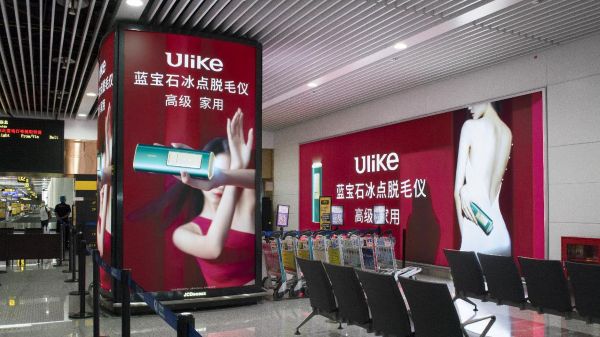
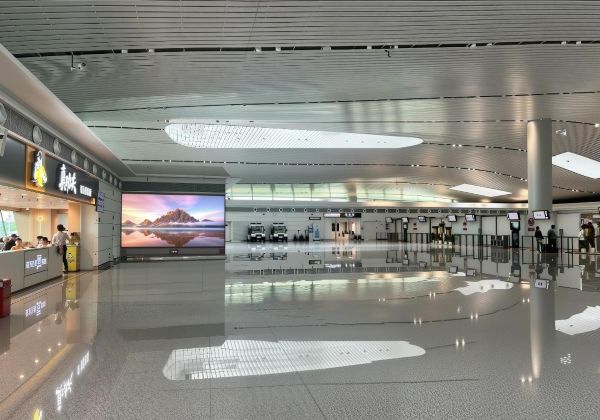
Starting point (check-in area): The brand image lightbox above the check-in island establishes the first impression.
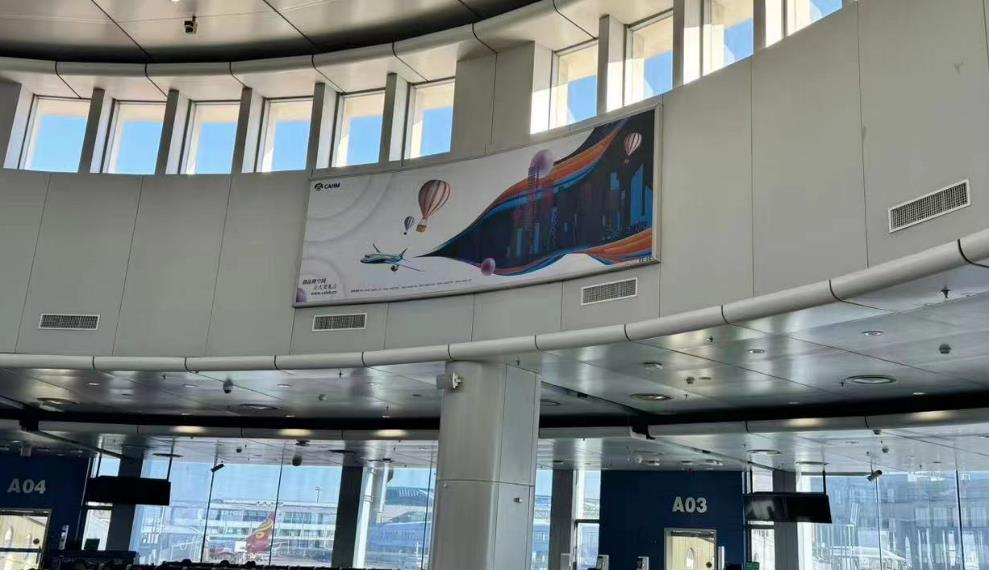
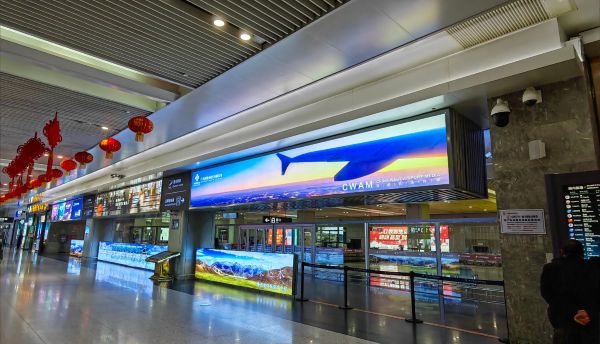
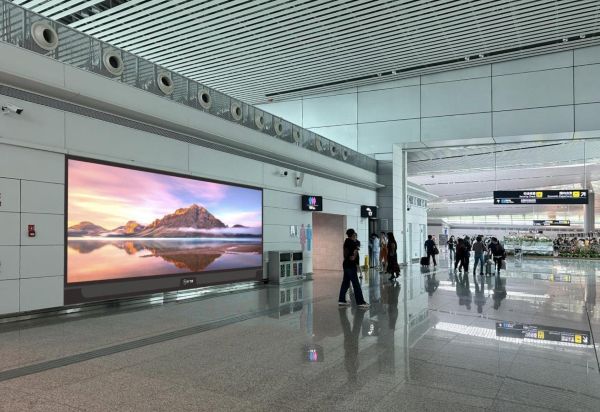
Core (departure corridor): LED giant digital screen or series of wall stickers for high-intensity brand exposure and core value output.
"Last-minute touch (airbridge): Fully-inclusive airbridge advertising or internal lightboxes in the airbridge provide an opportunity for deep communication within the final enclosed space before passengers board the aircraft.".
Applicable target: Applicable to brands in finance, high-end manufacturing, multinational enterprise services, and other industries that require establishing top-level professional trust.
Combination package 2: "Efficiency Experience Chain" for domestic high-end customers
Core circulation route: Domestic high-end check-in/security check → boutique commercial area/lounge passage → domestic departure gate/baggage claim hall.
Media mix:
Exclusive flow (before and after security check): Dedicated channel media for first-class and business-class passengers, as well as frequent fliers, conveys a sense of exclusivity and privilege.
Leisure scene (commercial area): digital screen machines, delivering brand information at a more flexible frequency.
Arriving at the destination (baggage carousel): The light box on the baggage carousel provides localized service guidance (such as high-end hotels, limousine services), achieving a closed loop from cognition to action.
Applicable target: Brands catering to domestic high-net-worth individuals in the fields of high-end consumption, automobiles, luxury goods, and cultural tourism.
Combination package three: "Social Ignition Chain" of emerging brands
Core logic: Abandon full-line coverage and focus the budget on creating a visual spectacle that is "photographable, interactive, and communicable".
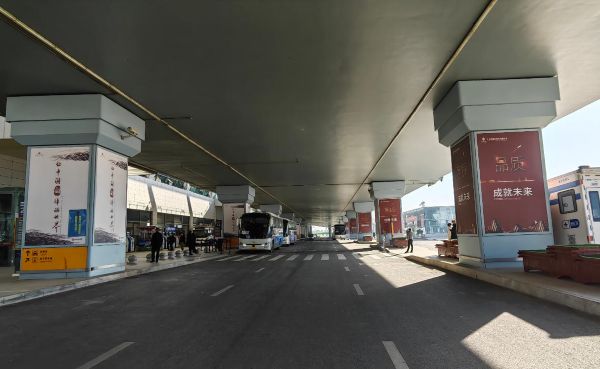
Media selection: Preferred media should possess visual dominance, such as the giant artistic LED at the main entrance of Daxing Airport, or a creative installation site with a unique architectural structure at a certain location of Capital Airport.
Core action: Design the advertisement itself as a "check-in point", actively initiate topic challenges on social media, drive UGC dissemination, and leverage small budgets to generate significant social buzz.
Applicable target: Applicable to new consumer brands, tech fashion brands, and event marketing that requires rapid breakthrough into existing circles.

Part 3: Execution Engine - Data-Driven Content, Publishing, and Optimization
1. Creative content strategy: Customization for "scenes" and "characters"
International area content: Adhere to the principle of "Less is More". Emphasize the globally unified brand identity, core slogan, and ultimate aesthetic appeal. Textual information should be highly concise to achieve cross-cultural understanding.
Domestic content: It can reinforce specific interest points, foster localized emotional connections, and clearly embed conversion paths (QR codes, mini-program codes).
Dynamic content creation: For digital screens, explore the use of flight information, weather, and real-time social media trends to trigger content changes, enhancing relevance and a sense of technology.
2. Digital management of publication and broadcast monitoring
The contract specifies data terms: it requires the service provider to provide a media manual containing specific point codes, technical parameters, and estimated daily exposure impressions, and clarifies the delivery standards for the on-air monitoring report (such as images, videos, and third-party monitoring data).
Exploration of Programmatic Buying: For the digital screen network within airports, the possibility of programmatic buying can be explored to achieve dynamic bidding and precise scheduling based on time slots and passenger flow, thereby enhancing budget flexibility.
3. "Three-dimensional model" of effect evaluation
Abandon the mindset of "launch and forget" and establish a three-dimensional evaluation system:
Brand dimension: Monitor the changes in the brand's search index and volume on mainstream search engines and social media before and after the launch period.
Interaction dimension: Track the scanning volume of the exclusive QR code and the user behavior path after scanning (following, leaving information, downloading).
Business dimension: For brands with offline stores or services, analyze the correlational fluctuations in customer flow, consultation volume, or sales volume in target cities (especially in the Beijing-Tianjin-Hebei region) during the advertising period.
Part 4: Common Misconceptions and Higher-Order Thinking
Misconception: Simplifying "dual hubs" to "choose one or the other". Higher-order thinking involves "functional allocation". For instance, using the capital airport to establish an image of an "authoritative headquarters", while utilizing the domestic trunk network of Daxing Airport to test new products and penetrate younger customer segments, achieving coordinated operations.
Misconception: Blindly pursuing "area" rather than "attention share". Large-area advertisements in cluttered areas may have a much lower attention share than a well-designed small light box on the core circulation route. The evaluation criterion is "eye share".
Misconception: Ignoring the "long tail effect" of airport media. The value of airport advertising extends beyond the deployment period. High-quality content at strategic locations will be captured, disseminated, and discussed by passengers, media, and the industry for a long time, forming sustained asset value. The "long tail communication potential" should be considered from the outset of creative development.
Misconception: Partnering with traditional agencies lacking technical capabilities. In the new advertising environment, agencies not only require resources, but also possess the ability to interpret data, conduct programmatic trading, and integrate digital creative technologies. When selecting partners, their technical strength should be a key evaluation criterion.
Conclusion:
Advertising deployment at Beijing Airport in the era of dual hubs is essentially a precision marketing campaign based on "spatial computing". It requires brand owners to position themselves with the vision of strategists, design the combination of moving lines with the thinking of product managers, and measure the effectiveness with the rigor of data scientists.
Successful advertising deployment will ultimately achieve a leap from "occupying physical locations" to "monopolizing cognitive awareness". It is not only the purchase of a period of advertisement display, but also the purchase of a scarce right to "define brand identity" in the most frequent and concentrated scenarios of the brand's target customers. Through scientific planning and precise execution, this investment will become a highly valuable part of brand assets, continuously providing potential energy for business growth.