Hangzhou Airport Advertising Placement Guide: The First Lesson for Newcomers to Xiaoshan International Airport in 2026
2026-02-13Tianci MediaViews:142
Highlights
Is advertising at Hangzhou Airport worth investing in? This article deeply breaks down the four dimensions of passenger flow quality, T3/T4 dual terminal resource comparison, point value, and price system, telling you under what circumstances Hangzhou Airport is a brand battleground and under what circumstances it is an expensive background board. A must read for beginners, get the decision-making list for advertising placement at Xiaoshan International Airport immediately!
You must have heard these stories about Hangzhou——
This is the capital of e-commerce, half of China's Internet, and the place where countless new consumer brands started.
But you may not have paid much attention to another Hangzhou:
More than 40 million passengers land and take off from here every year.
Xiaoshan International Airport is the third largest aviation hub in the Yangtze River Delta, second only to Shanghai Pudong and Hongqiao. It serves not only Hangzhou people, but also small commodity owners in Yiwu, manufacturing tycoons in Wenzhou, textile traders in Shaoxing, and e-commerce entrepreneurs in Jinhua, Zhejiang Province.
Hangzhou airport advertising is never just about airport advertising in Hangzhou.
It is the air gateway for Zhejiang and even the entire Zhejiang business community to enter and exit the world.
But for novice marketers, the four words' airport advertising 'often come with two stereotypes: expensive and unclear effectiveness.
Expensive is true, but few people explain how much it is expensive, where it is expensive, and whether there are more cost-effective alternative solutions.
This guide is not meant to convince you that 'Hangzhou airport advertising must be invested'. On the contrary, it is designed to help you establish a calm decision-making framework that allows you to draw your own conclusions within your budget, goals, and brand stages.

Chapter 1: First understand - whose airport is Hangzhou Airport?
Before discussing advertisements at Hangzhou Airport, you must first understand the airport's "persona".
It is not a pure tourist airport or a pure business airport, it is a hybrid of the two.
Mixed race gene one: a high concentration of high net worth business customers.
Hangzhou is the stronghold of the private economy. The proportion of business passengers at Xiaoshan Airport has remained stable at over 45% throughout the year, far higher than the national average level of airports.
The characteristics of this group of people are extremely distinct: 30-50 years old, male dominated, business owners or executives, with consumer decision-making power in their hands, insensitive to price, but extremely sensitive to quality and efficiency.
Luxury brands, high-end Baijiu, luxury cars, private banks, entrepreneurial business schools - these categories rank among the top three in the transformation efficiency of airports in Hangzhou.
Mixed race gene 2: a group of tourists and vacationers who explode during peak seasons.
Hangzhou is always a popular tourist city. The West Lake in spring, the Xianghu Lake in summer, the full rain of Longgui in autumn, skiing in Lin'an in winter, and the year-round Songcheng and Xixi wetlands.
Every year on May Day, National Day, summer vacation, and Spring Festival, the arrival hall of Xiaoshan Airport is crowded with tourists from all over the country. Their mentality is completely opposite to that of business travelers: they are not in a hurry, willing to spend money, and are planning their itinerary for the next few days.
Cultural and tourism groups, hotels and homestays, online travel platforms, catering chains, souvenir brands - this window period is your golden 72 hours.
Mixed race gene three: the cross-border e-commerce gene of globalization.
Hangzhou is the capital of cross-border e-commerce. Xiaoshan Airport has a large number of international routes covering major cities in Southeast Asia, Japan, South Korea, Europe, and America. After the T4 terminal was put into operation, the proportion of international and regional passenger throughput steadily increased.
Duty free retail, overseas tourist destinations, international schools, immigration and study abroad - these brands are launched in the international zone of Hangzhou Airport, reaching the most globally minded families in Zhejiang.
So, when you ask 'How is the advertising at Hangzhou Airport?', you first need to ask yourself: which of these three passenger flows is your target audience?
Chapter 2: Dual Terminal Era - How to Choose T3 and T4?
After the T4 terminal is put into operation in 2022, Hangzhou Airport enters a new stage of dual terminal coordinated operation. This is the easiest place for beginners to get dizzy.
Terminal 3: Big Brother, stability is the top priority.
Main function: Mainly domestic routes, with consideration given to some international/regional routes.
Passenger flow characteristics: Business passengers account for a high proportion, with airlines mainly including Air China, China Southern Airlines, China Eastern Airlines, Hainan Airlines, etc.
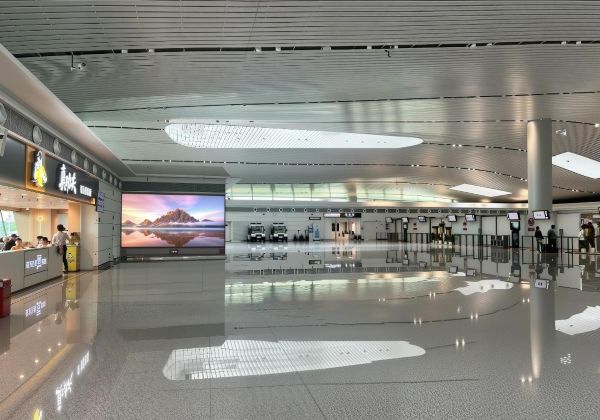
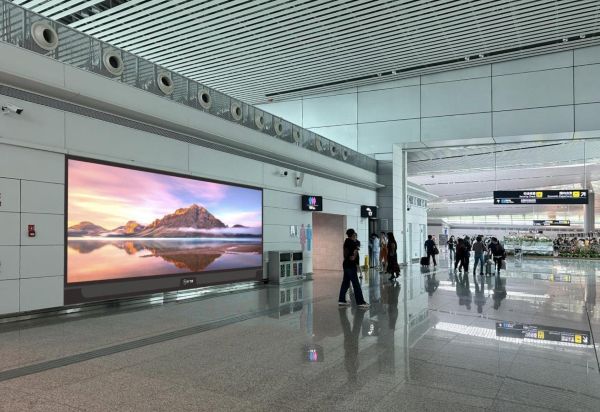
Advertising resources: LED lights above the check-in island in the departure hall, light boxes in the arrival channel, large screens in the baggage claim hall, corridor advertisements, etc.
Core advantages: stable customer flow, high-quality business customers, mature media resources, and predictable results.
Suitable for: Business services, high-end consumption, finance and insurance, Zhejiang business brands.
T4 Terminal: Newcomers, beauty is king.
Main function: As the mainstay of international and regional routes, it also takes into account some domestic routes.
Passenger flow characteristics: The proportion of tourists is high, with more family customers and young people. Xiamen Airlines, China Southern Airlines, and International Airlines are the main airlines.
Advertising resources: New digital media devices, large LED screens, interactive experience areas, immersive corridors, etc.
Core advantages: spacious and innovative media formats, suitable for creative and experiential advertising, with great potential for social communication.
Suitable for: cultural and tourism brands, international education, fashion and beauty, cross-border e-commerce, tourism destinations.
The most common mistake beginners make: not distinguishing between terminals, only looking at the four words' Hangzhou Airport '.
The consumption motivations and behavioral patterns of T3's business customer group and T4's tourist customer group are completely different. Use T3's creativity to invest in T4, or use T4's audience logic to buy T3's spots - the advertisement remains the same, the person is wrong, and the effect is halved.
Chapter 3: The Four Core Values of Hangzhou Airport Advertising - What exactly is it selling?
The first example is the identity admission ticket for the Zhejiang business circle.
Doing business in Zhejiang, the fact that there are advertisements at Hangzhou Airport itself is an invisible proof of trust.
Zhejiang merchants are an extremely pragmatic group. They may not recognize your spokesperson, they may not remember your advertising slogan, but they recognize the screen at Xiaoshan Airport - the brands that can appear there are not small workshops, they will not run away, and they will not smash their own signs.
This kind of transfer of trust at the circle level cannot be given by any Internet advertisement.
Secondly, decision interception in business travel scenarios.
A business owner flew from Hangzhou to Shenzhen to talk business, and saw an advertisement for a high-end Baijiu when he was boarding the VIP lounge; Flying back and landing in Xiaoshan, I saw the same brand again in the luggage claim hall.
On the third occasion, his secretary asked, "What kind of wine will be used for the annual meeting?" He replied, "Ask me about the one I saw at the airport last time
Hangzhou airport advertising is not about forcing you to place an order on the spot, but about putting your brand on the list of options in advance when you need this type of product the most.
Thirdly, it is the golden first stop for tourism consumption decision-making.
A Beijing family was having breakfast at home in the morning and had already landed in Xiaoshan by noon. Their decision on where to play, what to eat, and where to stay in the next three days is currently blank.
The advertisements in the arrival hall are the first few paintings to be written in this blank space.
The ROI of advertising in the arrival area of Hangzhou Airport is higher than any online channel in the internal evaluation of many tourism related brands.
Fourthly, the technological premium in the capital of the digital economy.
Hangzhou is the birthplace of China's digital economy. The airport advertisements here naturally carry the expectation of a sense of technology.
A regular LED screen, which is LED screen in Shanghai, may be subconsciously thought to have "big data algorithms behind it" at Xiaoshan Airport. This subtle transfer of brand temperament is a unique premium capability of Hangzhou Airport.
Chapter 4: Five Step Decision Making Method - Should You Invest in Hangzhou Airport Advertising?
Step 1: Confirm where your target audience is.
Focusing on high-end business customers? T3 departure hall, VIP area, and business route corridor bridge.
Focusing on family tourists? T4 arrival hall, baggage claim hall, and tourist route boarding gate.
Targeting international customer base? T4 international arrival area and surrounding duty-free shops.
First comes the crowd, then the media. This order cannot be messed up.
Step 2: Confirm your advertising target.
Want a nationwide brand reputation? The main screen of the departure hall and the prominent signage at the core location.
Want to deeply cultivate the Zhejiang market? → Arrival channel light box and luggage claim hall combination.
Do you want instant traffic conversion? → QR code interactive screen, cart advertisement, mobile charging station advertisement.
Without clear goals, airport advertising is the most expensive lightbox.
Step 3: Calculate the actual total cost.
There are three hidden consumption traps in airport advertising:
Production cost: Airport screens have extremely high technical requirements for video materials, with strict standards for format, resolution, color gamut, and bitrate. Simply cut a 15 second video and upload it, but the image will be distorted, color cast, and stuttered - money will be wasted.
Cost of painting replacement: Some locations support remote painting replacement, while others do not. For unsupported points, changing the screen will incur a new production and installation fee.
Maintenance costs: LED screen defects, brightness degradation, and image damage - who will repair them? How long will it take to fix? Is it clearly stated in the contract?
Step 4: Design a conversion path to prevent traffic from flowing away.
The biggest pain point of airport advertising is' just leave after watching '. Leaving the terminal, your brand is left behind.
Solution: Either put a memorable search term in the advertisement, or put a QR code - but the QR code must appear in the scene where the passenger is staying, such as in the waiting area, baggage claim hall, and definitely not in the fast lane.
Step 5: Find the right partner.
The advertising resources at Hangzhou Airport are represented by multiple media companies with a complex pricing system. At the same point, Company A may report 1 million yuan, while Company B may report 700000 yuan - it's not that anyone has ulterior motives, it's because of different levels of agency.
Tianci Media has accumulated over ten years of resources in the airport media field in East China. They may not be the cheapest, but they can tell you:
——What is the actual transaction price range for this point?
——Which is more cost-effective for T3 and T4 points of the same type?
——Can your 15 second video catch people in the first 3 seconds when played on this screen?
These pieces of information are much more valuable than cutting value money.
Chapter 5: Four Misunderstandings in Hangzhou Airport Advertising that Must Be Avoided
Misconception 1: Equating "high proportion of business customers" with "all locations are suitable for investing in business brands".
Business travelers are in T3, not T4; they are in the departure hall, not the arrival hall; In the VIP area, not in the remote seat.
There are indeed many business travelers, but you need to go where they are to find them.
Misconception 2: Believing that T4 is "superior" to T3, so one should only invest in T4.
T4 is indeed new, beautiful, and has good media equipment. But the quality of T3's business customer base cannot catch up with T4 in the short term.
Advanced is not the goal, matching is. International luxury brands can invest in both, while local high-end service brands should hold onto T3 first.
Misconception 3: Moved by the phrase '40 million people per year', I forgot to ask 'how many are my target customers'.
40 million is the total traffic, not the effective traffic. If your brand only does local business in Zhejiang, do you have any connection with tourists who fly from Xinjiang, Northeast China, and Guangdong?
First, define your target area and audience, and then incorporate traffic data into it.
Misconception 4: Underestimating the arrival hall and overestimating the departure hall.
Newcomers naturally feel that 'when setting off, having a good mood is suitable for watching advertisements'. Wrong.
The mood at departure is anxiety - afraid of traffic jams, afraid of missing flights, afraid of overweight baggage, afraid of queuing for security checks. At this moment, all attention is focused on the journey ahead.
The mood upon arrival was relaxed - finally arrived, the task was completed, and now it was time for oneself.
The baggage claim halls of T3 and T4 at Hangzhou Airport are one of the most cost-effective advertising resources in the entire venue. The price is cheaper than the departure hall, and the effective stay time is three to five times that of the departure hall.
Conclusion: What is the advertising style at Hangzhou Airport?
Now, we can provide a complete and honest answer.
For brands that need to reach high net worth business customers in Zhejiang, the T3 terminal of Hangzhou Airport is one of the most strategically valuable airport media platforms in East China.
For brands that need to seize the window of tourism consumption decision-making, the media in the arrival area of Hangzhou Airport T4 terminal has a higher ROI than the vast majority of online channels.
For businesses with limited budgets and brands still in the early stages of regional development, Hangzhou Airport may not be the optimal solution - investing money in target communities and commercial districts first will yield more direct returns.
The advertising at Hangzhou Airport is not a matter of usability, but rather a matter of suitability.
It is the high ground of the Zhejiang market. Before reaching the summit, you need to ask yourself: Can my physical fitness keep up? Have I prepared all my equipment? Have I thought clearly about what to do after reaching the summit?
Tianci Media can help you conduct an objective "Hangzhou Airport Advertising Adaptability Evaluation" - without persuading you to invest or withdraw, only helping you calculate clearly: with your marketing goals and budget for this year, what role should Xiaoshan International Airport play, or does it not need to play any role at all.
After all, in the field of airport advertising, the biggest waste is not investing too much, but investing too early.
Now, with this guide, go and get to know Hangzhou Xiaoshan International Airport again.
It is not just a terminal building, it is an attention transfer station for 40 million passengers, an aerial business card for Zhejiang's economy, and a strategic location that your brand must see clearly before fighting a tough battle in the Yangtze River Delta.