Spending millions on airport advertising, 90% of people's money is wasted on the first two steps - a guide to avoiding pitfalls from seat selection to effect evaluation
2026-02-14Tianci MediaViews:152
Highlights
Spending millions on airport advertising, 90% of people's money is wasted on the first two steps - a guide to avoiding pitfalls from seat selection to effect evaluation
Friend, if you are a novice who has never invested in airport advertising before, you must have many questions in your mind when facing this budget for the first time:
With so many options, which one should I choose?
Can we really negotiate the numbers on the quotation?
After the advertisement is published, how can we know if anyone has viewed it?
The boss asked about the results. How should I answer?
No one will proactively provide you with answers to these questions.
The advertising market at airports is deep, but no matter how deep it is, it can't prevent you from mapping out your strategy in advance.
Today's article serves as your map.
The entire process of airport advertising deployment: from location selection to effect evaluation, we'll teach you step by step - no nonsense, no secrets, we'll explain every step thoroughly to you.
Let's divide this journey into six steps in chronological order.
Step 1: Set goals first, then allocate budget
This is the most important step, and also the one that is most easily skipped.
Many novices ask right away, "How much does that screen at Daxing Airport cost?"
This question is equivalent to telling the other person: "I don't know anything, you can just choose whatever you like.".
The correct approach is to first clearly think about what you want.
Ask yourself three questions:
1. What is my core objective?
"Want to increase brand awareness and let more people know I'm in Beijing? → Choose the security checkpoint and departure hall."
To achieve effect transformation and give those who see me the opportunity to take action, → choose the arrival hall or baggage claim hall
Want to precisely reach a specific type of crowd? → For business travelers, choose the security checkpoint; for tourists, choose the arrival hall
2. What is the state of my target audience at the airport?
Business traveler: rushing, anxious, and distracted
Tourists: relaxed, open-minded, and willing to accept information
Airport pickup crowd: local residents, with clear goals, and calm attitude
At the same airport, different groups of people are targeted with completely different advertising strategies.
3. Can my offline handling capacity keep up?
"Only brand, no store → Security checkpoint is enough."
If there are stores and the capability to accommodate, the arrival hall must be considered
With activities and promotions, the waiting area and boarding gate become more valuable
Once you have clarified these three issues, proceed further.
Step 2: Choose the right location, and you will achieve twice the result with half the effort
The locations of airport advertisements can be divided into three categories based on passenger flow:
Category 1: Departure Area
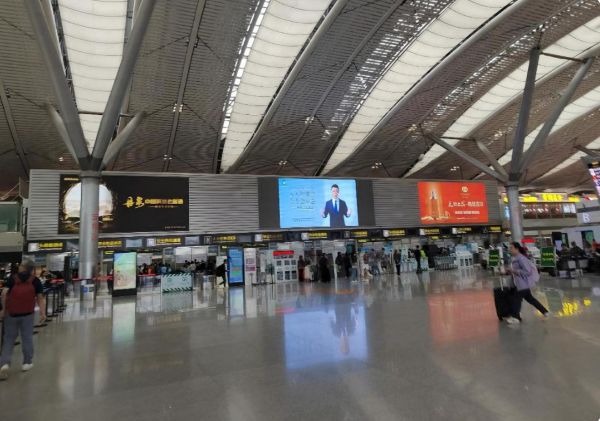
Including: departure hall, the area above the check-in island, security checkpoint, and the post-security passage.
Core characteristics: The highest passenger flow volume and the highest proportion of business travelers, but passengers are anxious and have scattered attention.
Who is it suitable for: Large brands that require broad exposure and brand volume building; brands whose target audience is primarily business customers.
Positioning skills:
Directly opposite the security checkpoint > On both sides of the security checkpoint > Above the check-in island
LED screen in the queue area > light box in the express lane
The position where passengers have to look up > The position where they can ignore by looking down at their phones
Category 2: Waiting Area
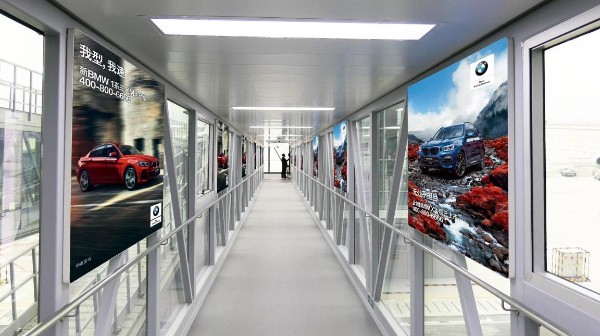
Including: the area around the boarding gate, the departure lounge, the commercial area, and the entrance of the boarding bridge.
Core characteristics: Passengers stay for a long time, feeling relaxed, and have ample time to read advertisements.
Suitable for: Brands that require in-depth communication and convey complex information; brands with scanning and interactive needs.
Positioning skills:
Directly opposite the boarding gate > On both sides of the departure lounge > Commercial area passageway
Advertisements near the rest area > Advertisements that pass by in a hurry
"Seated area > Unseated area (with a 3-fold difference in dwell time)"
Category 3: Arrival Area
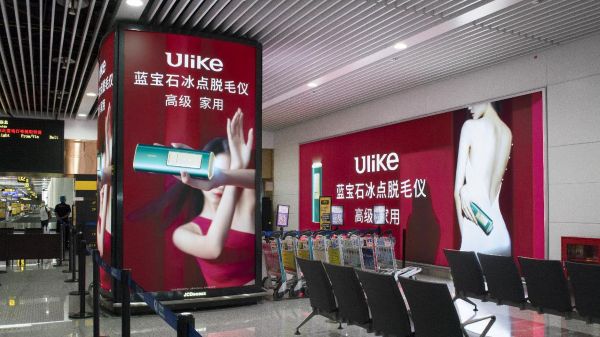
Including: baggage claim hall, arrival corridor, exit, and pick-up area.
Core characteristics: The most relaxed passenger mindset, the longest stay time (luggage waiting time of 3-8 minutes), and the most unobstructed conversion path.
Suitable for: Tourist destinations, hotels, local high-end services; brands with offline stores capable of accommodating immediate customer flow.
Positioning skills:
Directly above/opposite the baggage carousel > On both sides of the carousel > Arrival corridor
Directly above the exit > On both sides of the exit > Outside the pickup area
The natural point of gaze for passengers > The position that requires turning the head to see
Novice formula: Speak loudly in the departure area, communicate deeply in the waiting area, and achieve real transformation in the arrival area.
Step 3: Understand prices and learn to negotiate
The pricing system for airport advertising is a black box to outsiders.
But you don't need to become an expert, just need to know a few core logics:
What determines the price?
Airport level: For airports handling tens of millions of passengers vs. those handling millions of passengers, a price difference of 3-5 times is quite normal.
Location level: S-level locations (security checkpoints, baggage halls) vs A-level locations (passages, waiting areas), with a price difference of 2-3 times.
Area size: The comparison between a 30-square-meter large screen and a 10-square-meter light box is not about a threefold difference, but rather about scarcity.
Campaign period: annual vs quarterly vs monthly, with completely different discount rates.
Busy and off-peak seasons: Prices often increase by 20-30% around May Day, National Day, and the Spring Festival.
How to negotiate?
First, don't bargain with the published price.
The listed price is just for show. What you should ask is, "What is the approximate recent transaction price?"
Second, ask clearly what is included and what is not.
Many novices only ask about "media fees" and ignore:
Screen production cost (light box film, printing, installation)
Image change fee (image change is required for long-term deployment)
Maintenance fee (Who is responsible for repairing damages? How long will it take to respond?)
Monitoring fee (Do I need to pay extra for the data report?)
Third, put the commitment into the contract.
"We guarantee that this point will not be blocked" and "We will clean the screen regularly" - these verbal promises are meaningless unless written into the contract.
Newbie advice: When making your first investment, don't go for the lowest price. Instead, aim for "clear terms and guaranteed service".
Step 4: Creative production, customization for "airport scene"
This is the step that is most easily underestimated.
Many novices spend a lot of money to buy a product, then take a screenshot from the e-commerce product detail page, enlarge it, and upload it.
And the result? The advertisement is on, but the effect hasn't been achieved. The screen is indeed lit, but people who pass by only see it for three seconds and remember nothing.
The creativity of airport advertisements differs from that of outdoor billboards, e-commerce product detail pages, and WeChat Moments content.
Rule 1: The 3-second rule.
At the airport, no one will stare at your advertisement for 30 seconds.
From raising the eyes to lowering the head, it takes an average of 3 seconds.
So, your advertisement must convey three things within 3 seconds:
Who are you? (The brand LOGO should be the largest)
What do you sell? (The category should be instantly recognizable)
What's it got to do with me? (The benefit should be stated directly)
Rule 2: Design for long-distance.
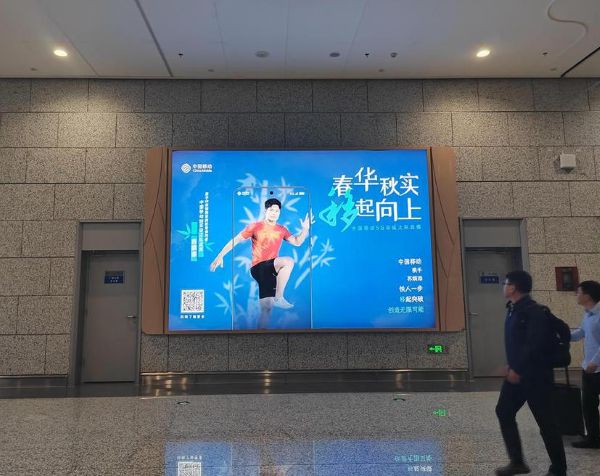
The typical viewing distance for airport advertisements is 5-10 meters. The font size that feels just right when you're sitting in front of a computer might be completely unreadable when displayed at that distance.
When designing, reduce the image to the size of a mobile phone screen and view it from a distance of 50 centimeters away from your eyes. If you can see it clearly, it will be clearer when displayed on a wall.
Rule 3: Consider the ambient light.
The lighting in the baggage claim hall is usually dim, and light boxes work best.
The departure hall is well-lit, and attention should be paid to the brightness setting of the LED screen.
The outdoor area should be designed to consider direct sunlight and rainwater obstruction.
Rule 4: Design for scanning, not for reading.
No one in the airport will stand and read your advertising copy.
So:
The title should be large enough, and the subtitle can be smaller
Put the core selling points in the title, don't expect anyone to read the body
The QR code should be large enough, and there should be a prompt next to it that reads "What is the purpose of scanning?"
Novice's trick: Airport advertisements are not meant for you to read, but for you to remember in 3 seconds.
Step 5: Monitor the publication and broadcast to ensure your investment is not wasted
The advertisement has been produced, the placement has been selected, and the contract has been signed. Finally, the day of publication has arrived.
And then?
Many novices tend to wait for the supplier to send photos.
The correct approach is to actively monitor the broadcast.
What should the broadcast monitor do?
First, confirm the publication date.
The on-site photos must be obtained on the publication date specified in the contract. Any delay shall be handled in accordance with the contract terms.
Second, confirm the picture quality.
Is the color correct? Is the brightness sufficient? Are there any wrinkles, damages, or obstructions?
Third, confirm whether the location is correct.
Sometimes, the signed spot is A, but it gets changed to B when it's published. If you don't monitor the broadcast, no one will proactively inform you.
Fourth, confirm the effect at night.
Is the LED screen bright during the day and dim at night? Does the light box not light up at night? These issues can only be discovered when viewed at night.
Fifth, regular reports are required.
For long-term advertising campaigns, suppliers are required to provide monthly monitoring photos and simple data reports (covering metrics such as reach and exposure frequency).
The criteria for government procurement are: submit monthly monitoring reports and repair any damages within 3 days. You can also adopt this standard.
Step 6: Effect evaluation, aiming for greater accuracy next time
The advertisement has been published and the money has been spent. The boss asks: How effective is it?
Many novices are tongue-tied and can only say "it feels pretty good".
Effect evaluation is not an optional question, but a mandatory answer sheet.
How to evaluate? There are three levels:
Level 1: Exposure data.
This is the most basic level, and it's what the supplier can offer:
Number of people covered (how many people have passed through)
Exposure frequency (average number of times per person)
Cost per thousand impressions (CPM)
But be aware: exposure does not equate to effective reach. If 100,000 people pass by, but all are looking down at their phones, then these 100,000 are ineffective exposures.
Level 2: Interactive data.
If your advertisement includes a QR code, search box, and phone number, you can track:
Scanned quantity
search volume
The volume of telephone inquiries
This part of data serves as the core basis for your evaluation of effectiveness.
Level 3: Brand data.
This part is the most difficult, but also the most important:
Brand search index (have Baidu Index and WeChat Index increased?)
Social media presence (Are there many people mentioning you on Xiaohongshu and Tiktok?)
Store foot traffic (During the campaign period, has there been any change in the foot traffic of nearby stores?)
Brand favorability (can be investigated through small-scale research)
Only by combining these three layers of data can you answer the question of "how effective it is".
Chapter 7: 5 Common Pitfalls for Novices
Pitfall 1: Being deceived by "coverage of people".
"Our site serves 30 million people a year!" - Sounds impressive.
But you didn't ask: Out of these 30 million visits, how many are from my target audience? How many of them saw me in an effective state?
Remember: Even if the exposure is large, it's still 0 if it's ineffective.
Mistake 2: Considering "publishing" as "completion".
Many novices tend to think that once an advertisement is published, the task is completed.
No. Publication is just the beginning.
Is it blocked?
Is the brightness sufficient?
Is there any damage to the picture?
Is anyone watching?
These issues require your continuous attention during the launch period.
Pitfall 3: Only considering media expenses, without accounting for production costs.
When signing the contract, I thought the price was reasonable. However, upon payment, I discovered that the combined cost of production, installation, and image replacement was even higher than the media fee.
Before signing the contract, make sure to ask clearly: what does this price include and what does it not include.
Pitfall 4: The cycle is too short, and the publication is terminated just after getting familiar with each other.
It takes time for airport advertisements to establish recognition. If you only run them for 2-4 weeks, many people will just start to notice you, and then the advertisements will be gone.
General recommendation: Invest for at least 8 weeks. If your budget allows, invest on a quarterly basis.
Pitfall 5: Recapping without data, relying solely on intuition.
"The effect seems decent" "It seems like no one watched it" - such reviews provide no help for the next launch.
From the very beginning, you need to think about: What data will I use to evaluate the effectiveness? How will I collect these data?
In conclusion: You don't need to be an expert, but you do need a map
The whole process of airport advertising deployment: from placement selection to effect evaluation, we'll teach you step by step - this article is the map for you.
But with the map in hand, you don't necessarily have to walk the entire journey yourself.
The water in airport advertising is indeed deep: there are numerous resource providers, prices are opaque, locations are complex, and production requirements are high.
For beginners, the safest approach is not to forge ahead blindly, but to find a reliable guide.
Tianci Media has accumulated over a decade of resources in the field of airport advertising. They have served hundreds of brands, from placing luxury goods at security checkpoints to intercepting travelers at arrival halls of tourist destinations. They are well aware of what kind of target should be matched with what kind of location, and what kind of budget should be matched with what kind of period.
What they can do for you is not just "selling you a few points":
I will help you analyze your goals and determine strategies
I'll help you filter locations and match your budget
Assist you in negotiating prices and overseeing contracts
I will help you monitor the broadcast and ensure its execution
I will help you review the data and optimize for the next round
All you need to do is to make it clear:
What is my brand currently lacking the most?
What does my target audience look like?
What is my budget approximately?
Leave the rest to professionals.
After all, you don't need to become an expert to handle the entire process of airport advertising deployment.
You just need to find a trustworthy expert and follow him, don't fall behind.
I wish you a triumphant start for your first airport advertisement campaign.