Complete Guide to Advertising Placement at Xi'an Airport: Analysis of Resources, Strategies, and Effects
2026-02-10Tianci MediaViews:156
Highlights
This guide provides an in-depth analysis of the media value, mainstream resources (T2/T3/T5 terminals), advertising strategies, and budget planning of Xi'an Airport advertisements, and highlights common misconceptions. Whether you are a startup brand or a mature enterprise, you can find efficient solutions to reach high-end travelers. Read now to get exclusive airport advertising strategies!
As the air gateway and national central city of the northwest region, Xi'an Xianyang International Airport is not only a transportation hub, but also a golden flow field that gathers business elites, tourists, and high consumption customers. Placing advertisements here means that your brand will be deeply tied to the "departure expectations" and "first impressions" of travelers, achieving a high level of brand growth and capturing precise customer groups.
For marketers who are new to airport advertising, how can they find the most suitable screen or lightbox in this behemoth with an annual passenger throughput of tens of millions? This guide will provide you with a systematic breakdown, from cognition to execution, to gradually grasp the essence of advertising placement at Xi'an Airport.
Chapter 1: Recognizing the Unique Value of Advertising at Xi'an Airport
1.1 Why Xi'an Airport?
The strategic value of Xi'an Airport far exceeds the scope of an ordinary transportation hub:
High end passenger flow filter: Airports naturally screen high-value and high consumption intention groups such as business travelers, vacation families, and high-end tourists. Their attention is more focused during the waiting and arrival periods.
Closed scene strong reach: The terminal building is a relatively closed environment with less interference information. Advertisements have a "mandatory" exposure advantage here, and the duration of passengers' stay allows for more in-depth information transmission.
Brand authority multiplier: appearing in the international and modern scene of airports, it can greatly enhance the credibility, high-end sense, and international image of the brand, and is a strong endorsement of the brand's strength.
Regional radiation core: As a hub in the northwest, airport advertising can not only influence local citizens, but also cover all passengers entering and leaving the northwest region, achieving regional expansion of brand influence.
1.2 Mainstream Advertising Forms and Core Resource Distribution
Xi'an Xianyang International Airport currently mainly operates T2, T3, and the under construction T5 terminal building. The characteristics of passenger flow and the value of advertising resources vary in different regions:
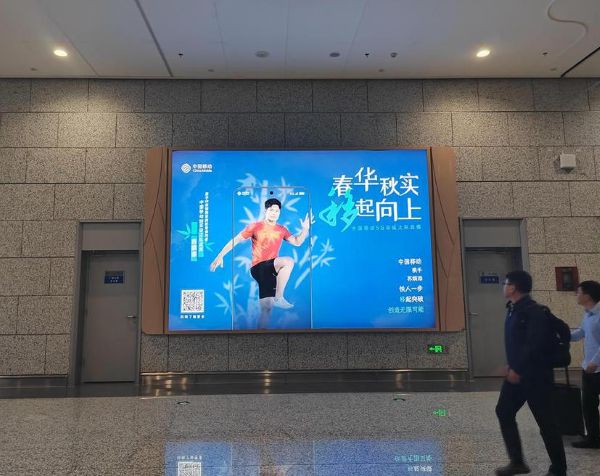
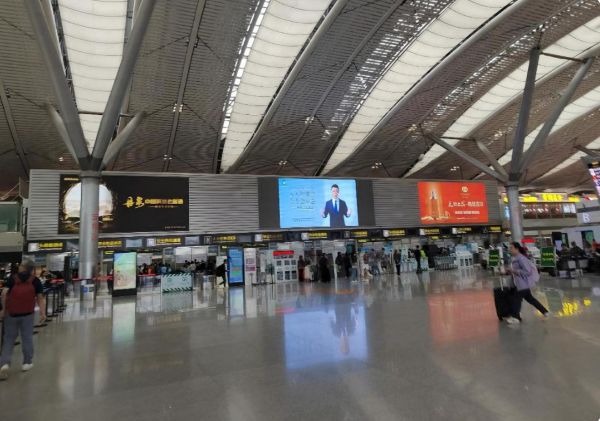
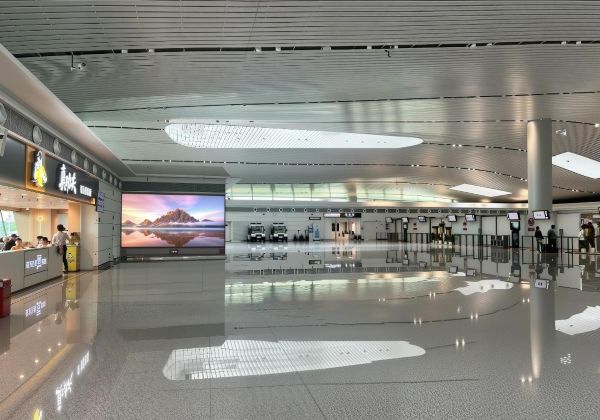
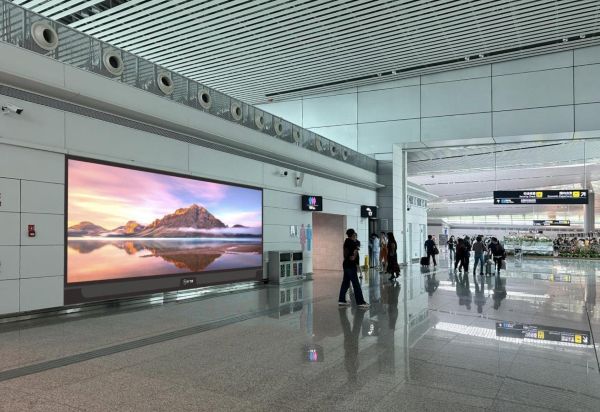
LED digital large screen
Location: Core crowd gathering points such as check-in hall, behind security checkpoint, exit of baggage claim hall, waiting area at boarding gate, etc.
Features: Dynamic video with the strongest visual impact, suitable for releasing brand image videos and new product advertisements, and is the first choice to ignite public attention. Especially the large screen at the exit of the luggage claim hall is the golden spot to capture the first attention of passengers upon arrival.
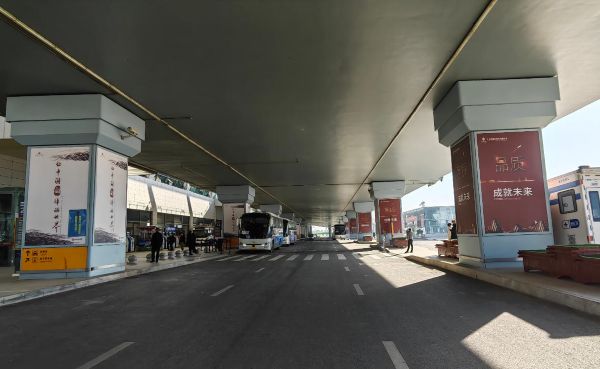
Lightbox and Brand Gallery
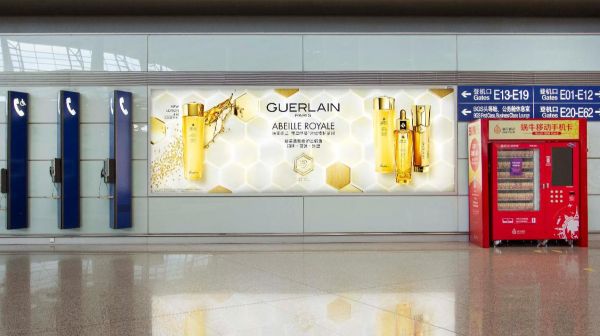
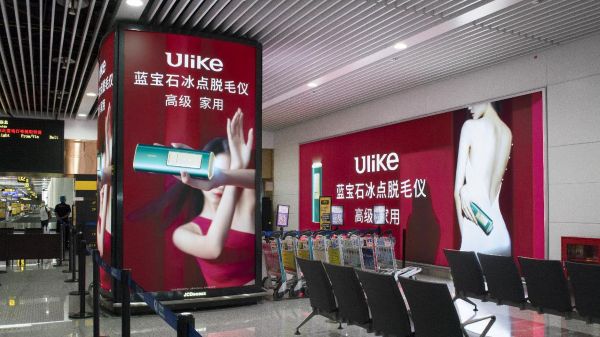
Location: Along the departure level check-in island, arrival passage, both sides of escalators, corridor bridges, etc.
Features: Static image, but with persistent position and long exposure time. Especially the hundred meter long arrival channel lightbox can form a coherent "brand corridor" and immerse passengers in brand information dissemination.
Langqiao advertisement
Location: Inside the enclosed passage connecting the terminal building and the aircraft.
Characteristic: It is a must pass route for passengers, achieving "zero distance" contact at the final/initial moment of boarding or disembarking, with unique memory points. The environment is closed, and advertising has strong exclusivity.
Creative experiential advertising
Form: Check in island overall packaging, featured theme display area, interactive devices, etc.
Characteristics: High budget requirements, but able to create a unique immersive experience that triggers spontaneous photo sharing among travelers, achieving online and offline word-of-mouth fission, commonly used for large-scale brand events or top luxury goods.

Chapter 2: Five Step Practical Experience: The Scientific Process from Planning to Delivery
Step 1: Clarify the advertising target and audience portrait
Everything starts with a clear goal. Please ask yourself first:
Main objective: To enhance national brand awareness? Promote local high-end services or real estate projects in Xi'an? Or provide exclusive information for passengers on specific routes (such as international routes)?
Audience description: Are your target customers international business travelers, domestic tour groups, or local high-end travelers? Different audiences have different routes and focus points at the airport.
Step 2: Deep resource exploration and combination strategy
Be careful not to make impulsive choices. You need to:
Flow analysis: Simulate the passenger process (departure: check-in → security check → waiting; arrival: disembark → corridor bridge → luggage retrieval → exit). Search for advertising spots in the waiting and walking areas at each step.
Resource matching: Select resource combinations based on the target. For example, shaping a high-end image can focus on "international departure VIP channel LED+duty-free shop area light box"; Local customer sources can be targeted towards the media of "domestic arrival channels and baggage claim halls".
Professional platform empowerment: For beginners, the process of connecting with airport media is complex. At this point, it is crucial to rely on professional airport advertising platforms such as Tianci Media. Tianci Media is a professional airport advertising platform that has precise control over real-time inventory, foot traffic data, and combined pricing of various media resources at Xi'an Airport. It can quickly generate cost-effective solutions based on your budget and goals, greatly improving efficiency.
Step 3: Creative Content Design: Born for the "Airport Scene"
Airport advertising is not a simple enlargement of graphic design.
The 3-second rule and minimalism: Most passengers watch while on the move. The screen must clearly convey the brand, core products, or proposition within 3 seconds. The information hierarchy should be extremely simplified, and the logo should be eye-catching.
Scenario based copywriting: Combining the emotions of "departure/arrival" at the airport. For example, financial investment advertisements can use the phrase 'arrive safely, plan your next wealth'; Travel advertisements can use the phrase 'Start your Tang Dynasty journey from here'.
Enhanced Call to Action (CTA): Clear QR codes (ensure size is large enough), search box instructions (such as "Search Mini Program XXX"), or simple brand slogans to guide passengers to take the next step.
Step 4: Budget Planning and Negotiation Execution
Budget composition: Total budget=media rental (main part)+advertising space production and installation fees+possible creative design fees+monitoring and evaluation fees.
Price factors: Airport advertising prices are greatly influenced by location (traffic volume), area, form (static/dynamic), and purchase duration (week/month/quarter/year). Usually, the price of the departure layer is higher than that of the arrival layer, and dynamic LEDs are higher than static light boxes.
Execution guarantee: With the assistance of a professional platform, ensure that the contract clearly lists the publication time, location number, and screen specifications, and agrees to provide publication monitoring photos or reports as the basis for acceptance.
Step 5: Effect evaluation and optimization iteration
Although the effectiveness of airport advertising focuses on branding, it can also be tracked:
Direct feedback: Use the activity exclusive QR code, discount code, or 400 phone number to track direct inquiries or conversions brought by offline advertisements.
Indirect measurement: compare the search volume and discussion heat of brand words and "Xi'an Airport" related words on mainstream search engines and social media (such as Xiaohongshu, Tiktok) before and after launch.
Research Assistance: A small-scale questionnaire survey can be conducted at the airport to directly inquire about passengers' memory and brand awareness changes towards advertisements.
Chapter 3: Four major misconceptions that beginners must avoid
Misconception 1: Only ask about price, not value.
Wrong: Blindly choosing the cheapest remote location.
Yes: Evaluate the "cost per thousand people" and population accuracy. An advertisement with a slightly higher price but located at the international departure security checkpoint has a much higher value in reaching a high-quality customer base than a remote location with a lower price but mixed pedestrian flow.
Misconception 2: Complex design and information overload.
Wrong: Fill the official website or brochure content with small fonts.
Yes: Adhere to the principle of 'one image, one core message'. Ensure that the main information is still clear at a distance of 5-10 meters.
Misconception 3: Believing that once the advertising campaign is over, everything will be fine.
Wrong: After the advertisement is published, there is no monitoring or online linkage.
Yes: A monitoring report must be collected to confirm implementation. At the same time, we initiated topics such as' I met XX brand at Xi'an airport 'on social media to increase our offline exposure and enhance our dissemination effect.
Misconception 4: Lack of long-term thinking, one shot determines the winner.
Wrong: Expecting a short-term advertising campaign to lead to a surge in sales.
Yes: Airport brand building is a process of "moistening things silently". Consider continuous advertising on a quarterly or annual basis, or long-term positioning in fixed areas (such as fixed bridges), in order to establish a stable brand awareness.
Conclusion
Placing advertisements at Xi'an Airport is a combination of "precision sniping" and "brand building". It requires marketers not only to understand the attributes of the media itself, but also to gain insight into the behavior and psychology of high-end travelers. For beginners with limited resources and experience, the wisest strategy is to clearly define one's own strategic goals and delegate professional tasks to professionals.
By collaborating with professional platforms like Tianci Media, you can efficiently avoid pitfalls and focus your energy on brand strategy and creativity itself, ensuring that every budget is spent on the cutting edge and leaving the loudest and most lasting feedback for your brand on the Northwest Sky Portal.
Start planning now and make Xi'an Airport the next starting point for your brand leap.