Authoritative Guide for Airport Advertising Placement: Seize High end Passenger Flow and Achieve a Leap in Brand Value
2026-01-20Tianci MediaViews:162
Highlights
Planning to advertise at the airport? This guide provides a detailed explanation of the selection of advertising locations, pricing structure, and key advertising considerations in high-end scenarios. Help brands accurately reach high net worth customers and achieve a balance between quality and efficiency. Get professional advertising strategies immediately and enhance brand image!
In the era of information explosion, the challenge for advertisers is no longer to make a sound, but to make their voice heard in the right context, by the right people, and in the right way. Airport advertising placement is precisely such a golden track that can simultaneously meet these three "correct" requirements. It is not only a rental of advertising space, but also a deep brand dialogue with high net worth and high intention groups, and the ultimate display of brand strength and pattern.
However, for beginners, the world of airport advertising is both tempting and shrouded in fog: how to choose truly effective placement locations? What is the logic behind the hundreds of thousands of advertising prices? What are the crucial considerations for advertising that determine success or failure? This article will serve as your panoramic navigation map, dismantling the complete closed-loop system from strategy formulation to execution and implementation.

Step 1: Why choose an airport? ——Understand the irreplaceability of high-end traffic pools
Before investing in the budget, it is necessary to fundamentally understand the unique value of airport media. This determines whether it resonates with your brand goals on the same frequency.
1.1 Audience Value: Accurately targeting the "Three Highs" audience
Airports naturally have crowd screening functions, gathering the most commercially valuable social elites:
High net worth and high consumption power: Business travelers and high-end tourists generally have strong economic strength and independent decision-making power, which is the core goal of new luxury goods, high-end services, and B2B business.
High attention and immersive environment: During the "boring time" of waiting and arrival, passengers are in a window period of information reception, and their acceptance and memory of high-quality advertisements are much higher than those in noisy daily environments.
High correlation scenario: Travel itself is associated with diverse consumer demands such as finance, automobiles, hotels, tourism, and technology, and brand information can easily trigger scenario based associations.
1.2 Brand Value: Shaping High end Perception on the Top Stage
As the gateway between a country and a city, the modern and international architectural space of an airport itself is a powerful brand endorsement. Advertising appearing here can directly give the brand a positive association of "high-end", "reliable", and "international", which is an added value that other media find difficult to purchase with money.
Step 2: Cultivate meticulously - scientifically plan the "placement location" of airport advertisements
Airports are a three-dimensional and complex ecosystem. Different placement locations correspond to completely different psychological states and attention levels of passengers. The core of success lies in the precise positioning of passenger flow lines.
2.1 Deep analysis of core advertising space flow line
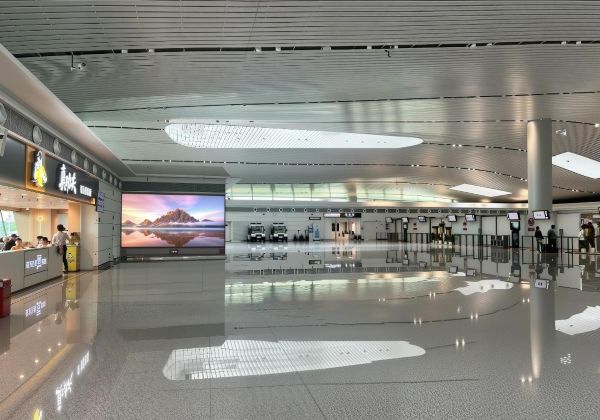
Act 1: Departure Hall - "Shocking Debut Area" of Brand Image
The passenger has just arrived at the airport and is checking in and checking in. At this time, the time is relatively relaxed and the mentality is stable. This spacious area is an excellent stage for establishing a brand's first impression.
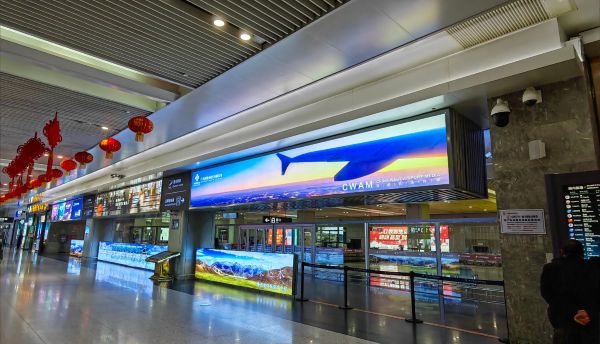
Typical locations: Giant LED screen above check-in island, independent brand pillar, check-in counter film.
Communication strategy: Emphasize the macro pattern, strong strength, and high-end positioning of the brand. Visually pursuing grandeur and grandeur, suitable for car brands, financial institutions, high-end watches, and city image promotion.
Act 2: Security check area and passage - unavoidable 'mandatory memory area'
This is the most densely populated and slow-moving throat passage within the airport. Passengers are queuing and waiting, forcing their gaze to focus within a limited area, resulting in an advertising reach rate of nearly 100%.
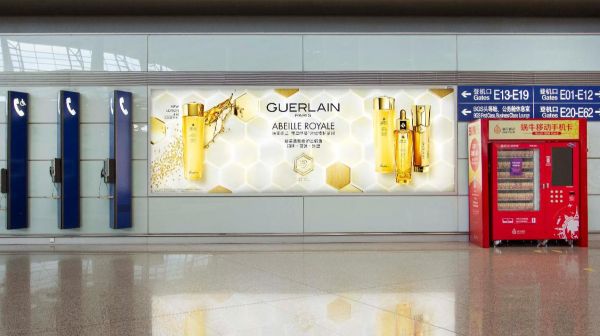
Typical locations: Continuous lightbox walls on both sides of the security checkpoint, and long corridors leading to the waiting hall after security checks.
Communication strategy: Information must be extremely focused, slogans loud, and visually prominent. Suitable for categories that require quick penetration into user minds, such as credit card services, insurance products, high-end skincare products, and luxury hotel bookings.
Act Three: Waiting and Quarantine Area - Emotional Resonance Zone for Deep Communication
Passengers complete security checks, release psychological pressure, and enter a fragmented waiting time of 30 minutes to several hours. This is a valuable scene for deep brand storytelling.
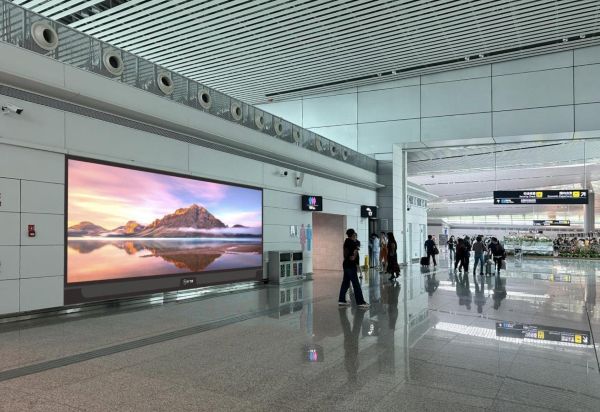
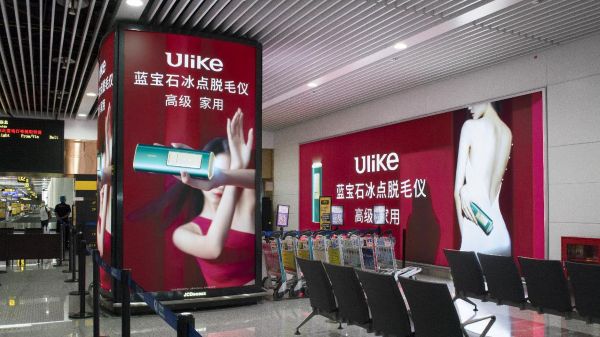
Typical locations: digital screens at boarding gates, lightboxes on the backrests of waiting seats, and advertisements inside the corridors.
Communication strategy: You can tell a more warm brand story, showcase product details or brand philosophy. High end alcoholic beverages, luxury leather goods, tourist destinations, high-end education or immigration services can have in-depth "conversations" with the target customer group here.
Act 4: Arriving at the Passage - The 'One Step Zone' that Inspires Action
Passengers arrive at their destination with a relaxed mindset or an urgent need for local services. This is the final key touchpoint that affects their subsequent consumption behavior.
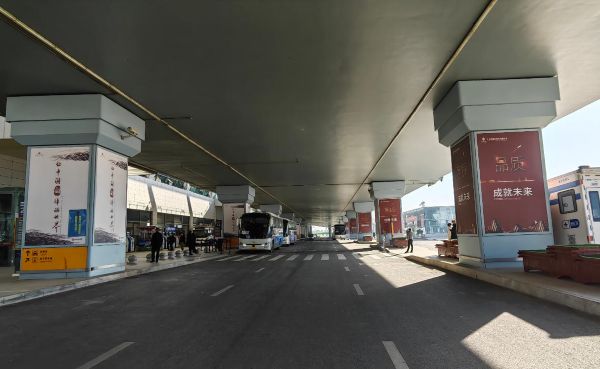
Typical locations: circular LED screen in luggage claim hall, light box in arrival channel, escalator stickers, and welcome advertisement at customs exit.
Communication strategy: Focus on "instant guidance". Advertisements should clearly provide localized service information, such as welcome messages for luxury car rentals, five-star hotels, high-end real estate projects, or top local business districts, to promote immediate conversion.
2.2 Special Value Area: VIP Lounge
This is a 'private reception room' that reaches the top of the pyramid. The environment is quiet and comfortable, with extremely high audience value.
Communication strategy: Advertising is integrated into the environment in an extremely exquisite and artistic way, such as indoor art lightboxes, high-end magazine pages, or customized product displays. It is an ideal place for top tier circle marketing by private banks, supercar brands, and customized travel agencies.
2.3 Selection Strategy: Combination, Focus, and Data Driven
Dynamic combination punch: The ideal advertising strategy is a combination of "brand exposure in the departure hall+mandatory memory in the security check area+deep communication in the waiting area", achieving multi frequency and three-dimensional reach to the same passenger.
Budget focus principle: When the budget is limited, the firepower should be concentrated on a core terminal or a prime location, pursuing a "penetrating" effect rather than dispersed coverage.
Make good use of data assistance: Require media outlets or agents to provide specific historical passenger flow data and crowd profiling analysis for specific locations, so that decision-making can be based on evidence.
Step 3: Budget Decoding - Comprehensive Perspective on the "Airport Advertising Pricing" System
Understanding price composition is the foundation for effective investment evaluation. The value of airport advertising lies in its scarcity and precise traffic.
3.1 Six core variables that affect prices
Airport hierarchy and urban economic level: The prices of international hubs such as Beijing Capital, Shanghai Pudong, and Guangzhou Baiyun are much higher than those of regional trunk airports.
Golden location: Located at the core of the main entrance of the departure hall and domestic security checkpoint, its price may be several times higher than that of remote boarding gate locations.
Media format and technology: high-definition LED digital large screen>traditional static light box; Interactive Device>Flat Display.
Placement cycle and density: Long term contracts (quarterly, annual) enjoy discounts. The more media purchased within the same region, the greater the bargaining space.
Purchase channels: Through media direct customers, first level exclusive agents, or second level agents, prices and services may vary.
Peak season and off-season: Holidays and large-scale exhibitions are considered peak seasons, with prices rising and resources being scarce.
3.2 Practical Suggestions for Budget Planning and Negotiation
Clearly define the budget scope and objectives: Clearly define the core objectives of this campaign (brand image or product promotion?) and allocate the budget accordingly.
Calculate effective cost per thousand people (eCPM): Don't just look at the total price. Calculate costs and evaluate cost-effectiveness based on the actual and effective passenger flow at the location, especially the proportion of the target customer group.
Seeking innovative collaboration models: For brands with limited budgets, they can consider partnering with airport themed events, cultural exhibitions, or testing with more flexible short-term (such as 2 weeks) placements.
Clarify contract details: Clearly stipulate in the contract the precise time for publication and publication, the responsibility for image production and installation, and the handling plan for unexpected situations (such as changes in passenger flow caused by flight seasons).
Step 4: Risk avoidance and efficiency enhancement - crucial "airport advertising placement precautions"
On the high-end stage, details determine success or failure. Ignoring any of the following points may greatly reduce the effectiveness of massive investments.
4.1 Content Creativity: Integrating with the environment, rather than simply posting
Airport advertising is a part of the environment. Content design must conform to its high-end, international, and concise tone.
Visual sophistication: The image resolution must be extremely high, and the design should have white space and a sense of breathing, avoiding the cluttered style of "pushing posters on the ground".
Internationalization of copywriting: It is recommended to have core information in both Chinese and English. The copy should be concise and poetic, conveying the brand's core value proposition.
Regulations and safety review: All visual elements (text, images, logos) must be reviewed in advance by airport management and industry and commerce departments to ensure absolute safety and compliance.
4.2 Execution process: Reserve sufficient time for complex approvals
The approval process at the airport involves multiple departments, with a long chain and strict standards. It usually takes 1-2 months from the final draft of the image to the actual publication. This must be included in the overall project plan to avoid delaying marketing schedules.
4.3 Effect evaluation: Beyond exposure, tracking real interactions
Abandoning the mindset of 'advertising ends'. A traceable effectiveness evaluation system must be established:
Establish an exclusive conversion path: Use unique and beautifully designed QR codes (linked to customized mobile pages), exclusive discount codes, or brand activity keywords.
Online and offline linkage: take airport advertising as an offline traffic portal, and guide it to the brand's online private domain (official account, applet, APP) for subsequent incubation and transformation.
Brand public opinion monitoring: During the advertising period, strengthen the monitoring and analysis of brand mentions and check-in content on social media at the airport, and evaluate the increase in voice volume.
4.4 Three common misconceptions for beginners
Misconception 1: Greed for the bigger picture and scattered budget. It is better to concentrate resources on creating a "phenomenal" presence at a core airport rather than making superficial investments at multiple airports or locations.
Misconception 2: Applying materials without adapting to local conditions. Directly using advertising materials intended for online information flow or niche markets at airports can seriously undermine brand image and create negative perceptions.
Misconception 3: Focus on advertising and neglect acceptance. The advertisement attracted the attention of high-end customers, but after scanning the code, they entered a generic page with poor user experience and slow loading, resulting in wasted traffic.

Conclusion: Make a crucial leap in the brand's high-altitude journey
Airport advertising placement is essentially a strategic investment in brand confidence. It tests the brand's confidence in its own positioning, insight into the mindset of high-end audiences, and control over every execution detail. Starting from a deep understanding of its media value, carefully planning the placement, rationally analyzing the composition of placement prices, and rigorously avoiding the risks mentioned in all placement precautions, you can transform the physical space of the airport into an accelerator for brand value enhancement.
Call to Action (CTA):
The height of a brand determines the way it is seen. If your goal is to communicate with the elites of the era, then the airport is a strategic high ground that you cannot miss.
Now, please take the first step: review your annual brand goals, select a core city airport that highly aligns with your customer base, and personally complete a full process experience as a passenger. Use the framework provided in this article to observe and evaluate. When theory is combined with practical insights, there is a clear blueprint for your brand's truly efficient high-altitude communication campaign.