Airport Outdoor Advertising Budget: A Scientific Investment Guide from Strategic Planning to Precise Execution
2026-01-19Tianci MediaViews:134
Highlights
This article systematically analyzes the complete composition of airport outdoor advertising budget, compares the media value differences between Capital Airport and Daxing Airport, and provides a practical budget framework from goal setting, media selection, cost estimation to effectiveness evaluation. Assist you in scientific planning, efficient investment, and immediately obtain exclusive budget plans!
When a brand decides to advertise on national gateways such as Capital Airport or Daxing Airport, it usually means the start of a strategic brand upgrade campaign. However, a realistic and sharp question will immediately be presented to decision-makers: "How much budget do we need to prepare?" The answer to this question is not a simple numerical range, but a planning system that precisely matches brand strategic goals, media value perception, and financial resources.
Blindly "reading dishes before meals" or "quoting based on intuition" can easily lead to two consequences: either the budget is severely insufficient, resulting in marginalization in the competition for core resources; Either the budget is used inefficiently, resulting in significant waste in non core areas. This article will build a logic for airport outdoor advertising budget planning from scratch, transforming you from a "passive inquiry" to a "proactive planning" wise investor.

Part 1: The Starting Point of Budget Planning - Defining Your Strategic Goals
Before considering any specific numbers, we must first answer a fundamental question: "What exactly are we going to buy for this launch
The level of airport advertising budget directly depends on the target hierarchy:
Goal A: Establish a national brand image and global trust endorsement.
Budget level: High (over tens of millions)
Strategic path: It is necessary to showcase the brand image in the international departure/arrival core area of the capital airport or Daxing airport through top media such as LED screens and large light boxes for long-term and stable display. The budget is mainly used to pay for long-term occupancy fees of core scarce resources.
Goal B: Ignite new product launches or major marketing campaigns.
Budget Level: Medium to High (Millions)
Strategic path: Concentrate on specific time periods (such as 1-2 months) and conduct high saturation, multimedia combination advertising in the core flow lines of the target customer group (such as domestic high-end flight waiting areas, baggage claim halls). Balance the budget between media release expenses and high-quality creative production expenses.
Goal C: Accurately reach specific high-end customer groups and achieve conversion guidance.
Budget level: Medium (tens of thousands to millions)
Strategic path: Highly precise. For example, targeting the international business customer group, select the specific international route boarding gate bridge advertisement at Capital Airport; Targeting high-end tourists, choose the luggage carousel advertisement for domestic boutique routes at Daxing Airport. The budget focuses more on the combination of precise positioning and effect tracking design.
Core principle: The budget must serve strategic objectives, not the other way around.
Part 2: Deconstructing Budget Costs - Where Do You Spend Every Penny?
A complete airport advertising budget table typically consists of the following four core modules:
Module 1: Media publishing fees (usually accounting for 60% -75%)
This is the fee paid to the airport or media operator to purchase the right to use advertising space. Its price is determined by a rigorous "value formula":
Airport and regional weight: Capital International Airport Area>Daxing International Airport Area>Domestic Core Area. Within the same airport, the value of the departure hall is usually higher than that of the arrival hall.
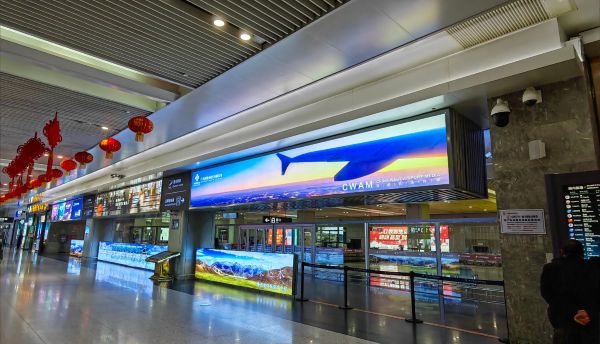
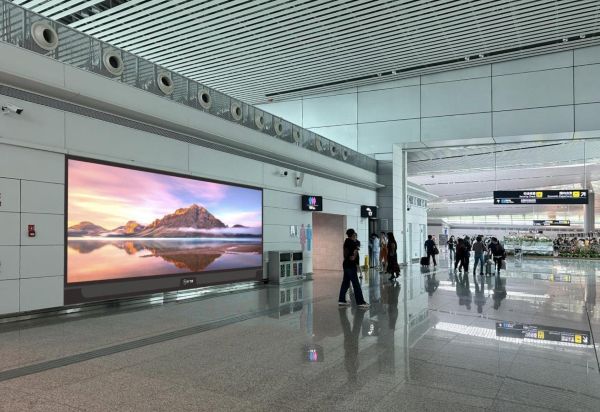
Media format: LED digital large screen (priced per second/week)>Large lightbox for corridor/passage>Luggage turntable lightbox>Pillar/check-in island lightbox.
Time and schedule: Prices significantly increase during peak seasons (holidays, Spring Festival travel rush/summer transportation). Signing an annual framework agreement can result in the highest discount and the highest monthly short-term advertising unit price.
Procurement scale: Purchasing multiple locations or media combinations in a bundled manner can obtain a better overall price than purchasing individually.
Module 2: Creative Planning and Production Costs (usually accounting for 15% -25%)
This is the most easily underestimated investment that determines the success or failure of the effect. The airport environment has extremely high requirements for creativity:
Ultra high definition video/graphic design: It must be designed specifically for the size, resolution, and viewing distance of a particular screen or lightbox.
International visual language: Especially in international regions, design needs to conform to global aesthetics, with concise and powerful information.
Special creative requirements: If special effects such as naked eye 3D are needed, the production cost will significantly increase.
Professional advice: This expense must not be forcefully squeezed out of media fees, as low-quality creativity is a huge waste of top media resources.
Module 3: Comprehensive Technical Services and Taxes (usually accounting for 5% -10%)
Execution and monitoring fees for publication: professional installation, debugging, and third-party monitoring report fees.
Content review and approval fees: Airport advertising content needs to undergo strict review, and the process is complex, which may result in related service fees.
Taxes and Fees: Media publishing fees usually include value-added tax and need to be clearly stated in the budget.
Module 4: Emergency and Optimization Reserve Fund (recommended to account for 5% -10%)
Used to respond to market changes, such as temporarily increasing high-quality spot opportunities, optimizing and adjusting advertising based on initial results, etc.
Part 3: Five Steps to Build Your Exclusive Budget Framework
Step 1: Target and Scene Locking
Based on the target definition in the first part, clarify the main airport (Capital Airport or Daxing Airport) and core areas (such as international arrival channels). This step determines the basic budget plan.
Step 2: Preliminary inquiry for media proposal
Request a preliminary plan from the official or primary agency. The key is not to ask "how much money", but to provide your goals and ask the other party to provide "recommended media combinations, location lists, and corresponding quotation ranges to achieve this goal".
Step 3: Conduct value assessment and cost estimation
Calculate the effective cost per thousand (CPM) for different scenarios.
Evaluate the basic requirements and market value of creative production.
Fill in the preliminary budget table: total budget=media release fee (inquiry)+creative production fee (estimate)+technical service fee (estimate)+reserve fund.
Step 4: Develop a combination strategy and negotiation plan
Strategy: For example, "Focus on domestic high-end passenger flow at Daxing Airport with 80% budget, and use 20% budget for brand promotion in the international area of the capital airport.
Negotiation: Based on the preliminary plan, negotiate long-term cooperation discounts, packaging prices, and complimentary resources to optimize media release costs.
Step 5: Set Effect Evaluation and KPI
The budget must include investment for effect tracking. For example:
Exclusive QR code design and tracking system fees.
Third party brand research or public opinion monitoring expenses.
This will shift your budget from 'cost expenditures' to' measurable investments'.

Part 4: Key Misconceptions and Avoiding Pits Guidelines
Misconception 1: Budget equals media expenses, severely compressing creative production costs. Causing the broadcast of shoddy advertisements on top stages, damaging brand image, and resulting in zero investment.
Misconception 2: Without reserve funds, the budget rigidity is too strong. The market is constantly changing, and inflexible budgets cannot seize optimization opportunities or respond to risks.
Misconception 3: Blindly pursuing low price points and ignoring target matching. Placing in areas where non target customers pass through, even if the unit price is low, is 100% wasteful.
Misconception 4: Simply average the budgets of two airports. The customer base structure and media value of Capital Airport and Daxing Airport are different, and budget allocation should be tilted based on the distribution of target customers, rather than simply dividing in half.
Misconception 5: One time thinking and lack of long-term planning. Brand building requires continuous investment. Airport advertising should be viewed as an annual or even multi-year strategic project, with multi-year rolling budgets planned to achieve better resource allocation and price advantages.
Conclusion and Call to Action
Developing a scientific budget for airport outdoor advertising is essentially a rigorous "brand strategy financial deduction". It requires decision-makers to possess strategic vision, market insights, and financial planning capabilities. From clarifying goals to deconstructing costs, from combining strategies to pre-set effects, every step is crucial.
On national stages like the Capital Airport and Daxing Airport, every budget should be impactful and translated into clear brand value.
If you are determined to embark on this brand upgrade journey, please immediately follow the following three steps to turn uncertainty into executable plans:
Step 1: Strategic Clarification Meeting - Convene the core team and use the framework presented in this article to reach a written consensus on the target audience, core customer base, and expected outcomes.
Step 2: Obtain professional benchmark solutions - immediately contact professional advertising agencies with rich experience and legitimate resources at Capital Airport and Daxing Airport. Provide them with your strategic goals and obtain a feasibility analysis and budget benchmark plan for airport outdoor advertising investment, which includes detailed media mix, quotation explanation, and case references.
Step 3: Complete your first draft budget - Based on professional solutions, use the budget composition module in this article to prepare your first detailed budget draft, and set clear decision-making processes and timelines.
Make a scientific budget the first solid cornerstone for your brand to conquer the national gateway.