
- Photos
- Specs
- Advantages
- Value
- Media Map
| Area:Chongqing | Type:Outdoors | Frequency:0 |
| Address:No. 174, Zheng Street, Daping, Yuzhong District | Format:Film | Duration:0 |
| Location:Longfor Times Tianjie | Min Qty:4面 | Operating Time:0-24o'clock |
| Size:\ | Min Period:week |
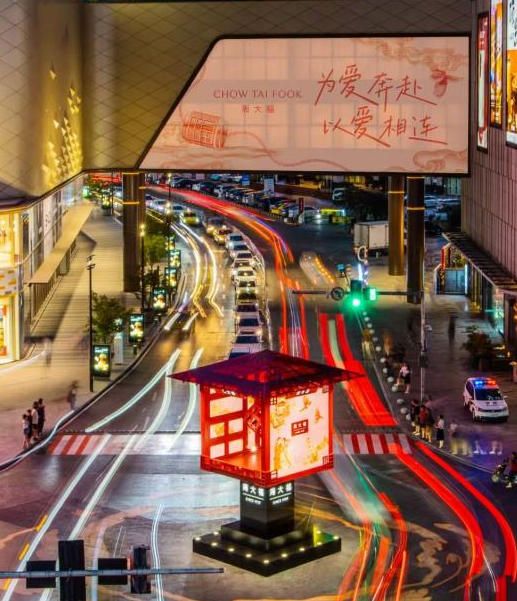
As a prime location with an average daily footfall of over 500,000 people, this outdoor adhesive film advertisement allows brand messages to reach every consumer in the natural flow. It transforms the corridor space from a mere passageway into a cultural landmark, achieving deep resonance between the brand and urban life. The high exposure at the intersection makes the reach efficiency of outdoor adhesive advertisements far exceed traditional advertising formats, attracting tens of thousands of consumers to voluntarily check in and share daily.
At the intersection of Halls C, D, and E, a Sky Street temple fair installation has been set up. The sidewalk features a red-and-white corridor background surrounding giant lanterns, creating a strong festive atmosphere. On the 3rd-floor corridor of Hall CD, panoramic photos of lanterns and door gods have been placed, becoming a hot spot for check-ins. Corridor murals are often combined with large-scale mall events; for example, during periods like the Spring Festival and Children's Day, themed decorations are updated.
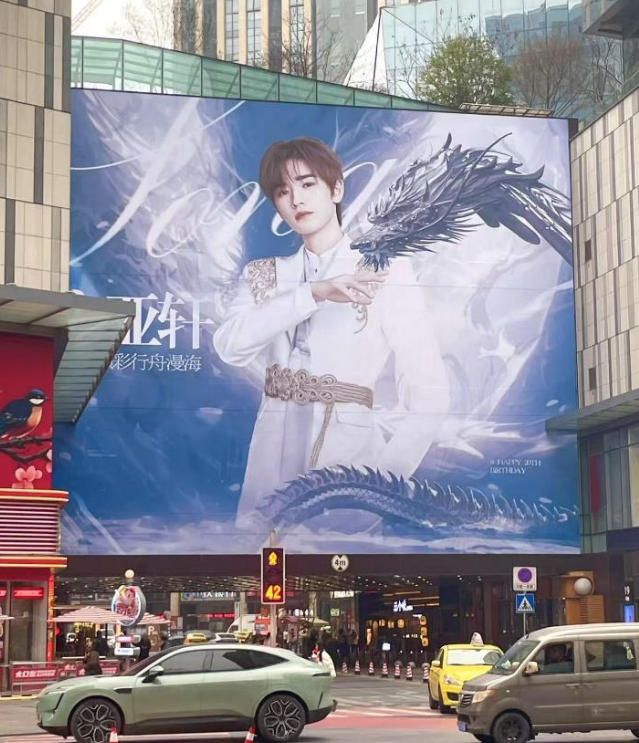
With its unique design, it has become a cultural symbol of Chongqing's commercial spaces. The dialect murals have hosted over 800,000 check-in visitors. Related short videos have exceeded 500 million views on the Douyin platform. In 2025, support murals for Ding Chengxin attracted fans nationwide to visit specifically, increasing the proportion of non-local customers in the mall to 28%. Through strong visual appeal, foot traffic conversion is activated; for example, during celebrity support mural events, the average spending in restaurants around the corridor increased by 15%, and in-store visits to trendy clothing stores grew by 22%. Festival-themed murals boosted gift-related sales in the mall by 30% month-on-month.
To the north, it connects to the extended passage of Exit 2 at Shiyou Road Station on Metro Line 1, and to the south, it links to the main store clusters in Hall B. It is a must-pass area with an average daily footfall of over 100,000 people, with peak traffic during holidays reaching 200,000. It can simultaneously cover both horizontal and vertical lines of sight, achieving 360-degree exposure without blind spots.
The wall murals at the Chongqing Longfor Times Tianjie intersection corridor are iconic visual symbols marking the core circulation area connecting Halls A and B. This corridor is located at the cross junction of the F3 floor and above in Halls A and B, with a northern connection to the extended passage of Exit 2 of Shiyou Road Station on Metro Line 1, and a southern connection to the main store cluster in Hall B. It is a passageway with an average daily foot traffic exceeding 100,000 people, peaking at 200,000 during holidays. Centered around these murals, they have become a dual carrier of both commercial scenarios and cultural communication.
The business district radiates to key urban areas such as Yuzhong and Jiulongpo, with 600,000 permanent residents, 200,000 students, and high-end office workers nearby, showing strong consumption capacity. The mural audience mainly consists of young and middle-aged people aged 25-40, also including family visitors and trendy youth. This closely aligns with target users in categories like beauty, fast-moving consumer goods, and technology. Through Longfor's commercial digital platform, the complete path of ad exposure, user dwell time, scan interaction, and consumption conversion can be tracked.
As a benchmark case for commercial space media in Southwest China, its investment value lies in four dimensions: traffic siphon effect, scenario innovation capability, technological empowerment potential, and city-level brand premium, forming a unique closed loop of commercial value. Against the backdrop of Chongqing building an international consumption center city, the corridor murals, due to their scarcity, innovation, and high conversion rate, continue to lead the development trend of commercial space media and serve as a strategic location for brands to capture the Southwest market.