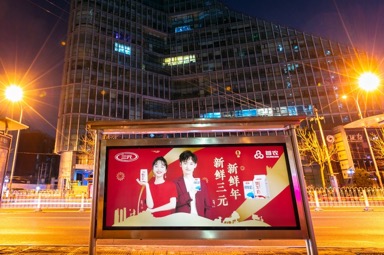
Bus advertising shelter: the "doorstep" attention entrance for mainstream urban population
2026-01-16Tianci MediaViews:132
Highlights
In depth analysis of the advertising value, cost composition, and execution strategy of bus shelters. This article will provide you with a detailed explanation of its core advantages, location selection methods, creative design points, and common misconceptions, to help you efficiently carry out urban outdoor advertising placement. Get professional solutions immediately and accurately reach mainstream consumer groups.
In today's ubiquitous digital advertising, a seemingly traditional media has always firmly occupied the streets and alleys of Chinese cities - it is bus advertising shelters. For office workers commuting every day, housewives shopping outside, and students returning home from school, bus shelters are a familiar and fixed scene in daily life. For brands, this is a golden medium that can reach the mainstream consumer group in the city with stability, high frequency, and low cost.
Unlike bus advertisements that pass by at high speed, bus shelter advertisements provide audiences with time to stop and a relatively quiet reading environment. This upgrades it from a simple exposure media to a communication platform that can convey certain depth of information. This article will provide you with a systematic breakdown of how to scientifically plan and execute an efficient bus advertising shelter placement.

Part 1: Irreplaceable Core Values - Why is it still the offline king?
When evaluating any type of outdoor advertising, we need to examine its irreplaceability. The core value of bus shelter advertising is established in the following four dimensions:
1. Covering the "essential needs scenarios" of mainstream daily life in cities
Public transportation is the artery of a city, and bus shelters are key nodes on the artery. It covers the entire daily life path of citizens, including work, study, shopping, and medical treatment, and is a natural entrance for brands to integrate into urban public life. Its target audience is not niche, but the widest and most mainstream urban class.
2. Mandatory and low interference reading brought about by "waiting time"
The few minutes waiting for the bus are the 'leisure time' for people to put down their phones and look around. The lightbox advertisement in the bus shelter is located at the core of its field of view. This type of reading behavior that occurs during boring waiting results in more focused attention, deeper memory, and stronger penetration of advertising information.
3. Accurate positioning, capable of achieving regional deep cultivation
The bus shelter network is spread throughout the city, and brands can flexibly choose location combinations to achieve precise regional marketing:
Surrounding the commercial district: Placing at stations around the core shopping mall directly affects the shopping crowd.
Community penetration: Placed at stations around large residential areas, continuously influencing household consumption decisions.
Commuting route coverage: connecting office and residential areas with mainline stations, accurately reaching office workers.
4. Extremely high cost-effectiveness and stable visual effects
Compared to LED screens that often cost millions, the single point cost of bus shelter advertising is affordable. Brands can achieve a large-scale coverage of "connecting points into lines, connecting lines into surfaces" within the target area with a reasonable budget. At the same time, as a static lightbox, it displays 24 hours a day, with stable images that are not affected by weather and light (with built-in lighting at night).
Part 2: Four Steps to Practical Placement - From Strategy to Publication
A successful advertising campaign requires a scientific process. The following are the four core steps:
Step 1: Clarify goals and strategies
Brand global exposure: Select top locations on urban main roads and transportation hubs, and pursue the maximum range of brand awareness enhancement.
Regional market explosion: Targeting new store openings and real estate sales, deeply cultivate all high-quality locations within 3-5 kilometers around stores/real estate, and achieve saturation attacks.
Promotion activity diversion: Place advertisements containing clear promotional information, addresses, and QR codes at commercial sites with high foot traffic to directly guide sales.
Step 2: Scientific selection and combination of points
This is the key to determining the success or failure of the advertising campaign. Don't blindly pursue the "golden point", but should pursue the "effective point".
Human traffic data: Priority should be given to sites with high daily passenger traffic (which can be obtained through media or on-site observation).
Crowd quality and matching: The audience of science and technology park sites is completely different from that of residential areas in old urban areas, and needs to be matched with the target customers of the brand.
Visual environment assessment: Is the point facing towards the direction of pedestrian flow? Is there any tree or building obstruction? Is the advertising space itself clean and well lit?
Combination strategy: Adopt a combination of "key detonation+comprehensive coverage". Purchase high-quality points at core locations (such as city square stations) to ignite the brand, while expanding coverage to other sites in the target area to form a network effect.
Step 3: Creative Design and Visual Production
Bus shelter advertising is a "three second art", and its design must conform to its media characteristics:
Headlines with less text: Core information (brand name, slogan, main product) must be clearly captured within three seconds. The main text should not exceed 3 lines.
Strong visual impact: using high contrast, bright colors, and large high-definition images to stand out from complex street scenes.
QR code and call to action: Make full use of waiting time, place clear QR codes, guide users to scan the code to follow, claim discounts or learn more details, and achieve online and offline linkage.
Consider viewing distance and angle: When designing, it is necessary to simulate the full view viewing effect of pedestrians approaching from a distance and waiting on the side.
Step 4: Execution, Publication, and Effect Tracking
Clear details of the contract: specify the specific dates, location numbers, and image specifications for the publication and publication in the contract, and require the provision of monitoring photos for the publication and broadcast.
Ensure publication quality: The image installation should be flat, bubble free, and the night light box lighting should be uniform.
Establish an effectiveness tracking mechanism: Use independent 400 phone numbers, QR codes, or promotional codes to track direct inquiries and transactions brought by advertisements in different routes or regions, and evaluate ROI.
Part Three: Cost Composition and Budget Planning - Where is the Money Spent?
The placement of bus advertisements in bus shelters is usually priced based on "location/cycle" (such as one location for one month). The total cost mainly includes:
Media publishing fee: a fee paid to media companies (such as advertising companies under the Public Transport Group). This is the main cost, greatly influenced by the following factors:
City level: Prices in first tier cities are much higher than those in second - and third tier cities.
Location level: The prices of core commercial districts and transportation hub stations in the city center are several times higher than those of ordinary community stations.
Purchase quantity and cycle: Large quantities and long-term (quarterly/annual) purchases can receive significant discounts.
Screen production and installation costs: The cost of printing, laminating, and manual installation for advertising screens. It is necessary to ensure that the manufacturer uses high-quality outdoor materials that are UV resistant and fade resistant.
Design and service fees: If an advertising company is commissioned to plan, design, and execute the entire project, corresponding service fees will be incurred.
Budget planning suggestion: For local businesses, it is recommended to start by "cultivating a region deeply". For example, planning a budget of 50000 to 100000 yuan, selecting 20-30 high-quality bus shelter locations around the stores, and conducting a one month centralized advertising campaign, the effect is far better than scattered advertising of 5 locations throughout the city.
Part 4: Common Four Misconceptions and Avoiding Pits Guide
Misconception: Point selection is based on intuition, not on data. Blindly advertising the intersection as' lively 'may result in a low actual number of people waiting at the station. It is essential to request the media to provide or verify passenger flow data on their own.
Misconception: Overloading design information, like product manuals. The content of the official website and brochure was placed on billboards, but no one read it. We must adhere to the principle of 'one core information'.
Misconception: Neglecting image maintenance and lighting. If the lightbox does not light up and the picture is damaged and not repaired in a timely manner, the advertisement will not only be ineffective, but also damage the brand image. The maintenance responsibility and response time should be clearly stated in the contract.
Misconception: Lack of online and offline linkage thinking. Consider bus shelter advertisements as isolated offline activities. Modern advertising placement must be integrated, with the preheating of online social media, exposure of offline advertising, and private domain operation after scanning codes forming a closed loop.
Conclusion and Call to Action
Bus advertising shelters are the "basic platform" and "ballast stone" for brands to communicate with the public in a city. It may not be cool, but it is absolutely solid; It may not cause a sensation, but it will definitely last. In a fragmented media environment, it provides a stable, reliable, and vibrant means of contact.
It is particularly suitable for enterprises that need to establish extensive local awareness, carry out regional marketing, or pursue long-term brand asset accumulation. In the digital torrent, it is an offline attention fortress worth defending.
If your brand is seeking to integrate into a city or establish a solid foundation in a regional market, then bus shelter advertising should be an indispensable part of your media mix:
Step 1: Regional Mapping - Mark your target area on the map (store surroundings, competitor area, target customer settlement area).
Step 2: Preliminary Inquiry - Contact local mainstream public transportation media agencies to obtain location maps, pedestrian flow assessments, and price lists for the waiting shelters in the area.
Step 3: Strategy Development - Based on professional data and your budget, develop a focused and measurable "regional deep cultivation" advertising placement trial plan for bus shelters.
Make your brand a familiar and trusted landscape in the daily lives of citizens.