How to calculate the advertising price for Beijing public transportation? From the car body to the bus shelter, understand all the costs in one article
2026-03-03Tianci MediaViews:104
Highlights
What is the price for advertising on public transportation in Beijing? This article provides a detailed explanation of the latest prices for core forms such as double decker body, single decker body, bus shelters, station signs, and in car videos in 2026, providing a reference for actual published prices and budget planning guidelines. Tianci Media, a professional public transportation advertising platform, helps you scientifically plan your budget and efficiently reach millions of passengers!
In Beijing, a super large city with a population of over 20 million, buses carry a daily passenger flow of nearly 8 million people, shuttling between Chang'an Avenue, Third Ring Road, Financial Street, and Zhongguancun, forming a dynamic communication network covering the whole city. What is the price for advertising on Beijing public transportation for a brand? How to achieve optimal dissemination effect within a limited budget?
This article will systematically break down the pricing system of Beijing's public transportation advertising, from vehicle advertising to bus shelter lightboxes, from in car videos to station media, providing an actionable budget guide.
1、 Understand the core pricing logic of Beijing public transportation advertising
Before discussing specific prices, it is necessary to understand a truth: bus advertising is not a "fixed price", but a composite pricing system determined by five dimensions: city, route, vehicle type, form, and cycle.
The five core factors that affect the cost of a single vehicle:
Route value: The golden route passing through the core business district and main roads is several times more expensive than suburban routes
Advertising format: Full body>Bilateral body>Rear>In car media
Model difference: Double decker bus>Single decker bus, special models (such as retro trams) have a premium
Placement period: Long term (quarterly/semi annual/annual) can result in significant discounts
Fleet size: The more investments made, the lower the average price per bike
2、 Core Forms of Public Transport Advertising in Beijing and Its Price in 2026
(1) Double decker bus body advertisement - a visual landmark of urban mobility
Double decker buses have become the most impactful form of public transportation advertising in Beijing due to their huge display area and unique visual effects, especially suitable for brand image building and large-scale exposure.
Model level published price (monthly/vehicle) Applicable routes
A five-star sightseeing route worth 236000 yuan that passes through core business districts and landmark attractions, offering top-notch sightseeing
Four star 176000 yuan backbone lines for urban main roads and business core areas
Samsung 96000 yuan sub core area and auxiliary lines
Production and installation fee: 18000 yuan/vehicle/time, including the first publication production
(2) Single layer bus body advertising - the king of cost-effectiveness
Single decker buses are the main type of public transportation in Beijing, covering a wide range of routes and available in various forms such as full body, double-sided body, and rear end.
Explanation of Advertising Format Price Range (Monthly/Vehicle)
Full body advertising costs 25000 to 50000 yuan, with higher core line prices and the strongest visual impact
The most mainstream choice for double-sided car advertising is between 10000 and 25000 yuan, with high cost-effectiveness
Tail advertising costs 30000-10000 yuan, targeting rear vehicles, making it the most cost-effective option
Core routes in first tier cities: Full body advertising can start at 25000 yuan/month/unit, or even higher
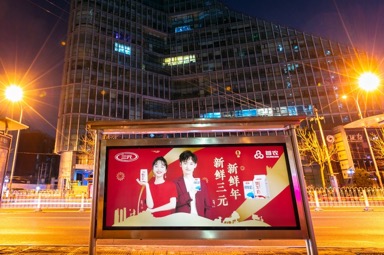
(3) Bus shelter lightbox advertising - the golden media for targeted interception
Bus shelter advertisements are located at bus stops, covering the waiting crowd, and can form a complete contact loop with vehicle advertisements from before travel to during boarding.
Specification, Publication, Price, Discount, Price Explanation
3.5m x 1.5m lightbox costs 34000 yuan/month and 9800 yuan/month, covering the core area within the Fourth Ring Road
The cost of production and installation needs to be separately inquired about, and the cost of screen production and publication will be calculated separately
Media advantage: Daily coverage of 5 million people and 8 million vehicles
(4) Bus stop advertising - the lowest cost supplementary media
Bus stop advertisements are directly operated by Beijing Public Transport Group, with transparent prices and suitable for brands that require extensive coverage but have limited budgets.
Formal publication fee (monthly/block), production fee, and publication fee
Solar power station sign 650 yuan 40 yuan 60 yuan
Box type station sign 600 yuan 40 yuan 60 yuan
Special note: Customers who print their own advertising images are exempt from production fees
(5) Mobile TV Advertising in Cars - Touchpoints for Deep Communication
The in car TV covers the entire journey of passengers, with an average travel time of over 20 minutes, providing a great opportunity to convey detailed information.
Explanation of Advertising Format and Publication Price
Hard advertising costs 8000 yuan/60 seconds, covering 536 bus routes
Public service advertisements worth 2000 yuan must comply with the review of public service content
Broadcast frequency: Multiple frequency rolling broadcasts, reaching an average of 8 million viewers per day
3、 Real transaction case reference: How to implement budget?
Case 1: Full body advertising of a certain fast-moving consumer goods brand
Goal: Enhance the city's visibility and reach commuters
Strategy: Select 5 main routes, advertise on the entire vehicle, and advertise for 3 months
Budget calculation: 35000 yuan/vehicle/month x 5 vehicles x 3 months=525000 yuan (excluding production costs)
Case 2: Deep cultivation of a certain educational institution in the region
Goal: To attract traffic to the new campus in Haidian District
Strategy: Select 3 single-sided vehicle advertisements that pass through Zhongguancun and the university area, and place them for 6 months
Budget calculation: 18000 yuan/vehicle/month x 3 vehicles x 6 months=324000 yuan
Case 3: Combination of a local merchant's bus shelter and signage
Goal: To cover the surrounding areas of communities in Chaoyang District
Strategy: 10 core station bus shelter lightboxes+50 solar powered station signs, to be deployed for 3 months
Budget calculation: 10000 yuan/unit/month x 10 units x 3 months for bus shelters=300000 yuan; Station sign 650 yuan/block x 50 yuan x March=97500 yuan; Approximately 400000 yuan in total
4、 Practical deployment: How to scientifically plan the budget?
Step 1: Clarify marketing objectives
Brand exposure throughout the city: Prioritize choosing double decker buses or core routes with full body
Regional precise reach: Select a single-sided vehicle passing through the target area (such as Financial Street, Zhongguancun)
Local store traffic diversion: combination of bus shelters and station signs, covering surrounding communities
Deep information transmission: In car video advertisements that passengers can watch for a long time
Step 2: Choose a combination based on the budget
Budget size recommendation, combined advertising cycle recommendation
100000 to 300000 yuan station sign+shelter, or 3-5 single-sided vehicles for 3 months
300000 to 600000 yuan, 5-10 vehicles with single-sided body and shelter supplement for 3-6 months
600000 to 1 million yuan core line full body+in car video combination for 6 months
Multiple trunk lines with a total body matrix of over 1 million yuan per year
Step 3: Calculate the actual total cost accurately
Total cost=media publishing fee+production and installation fee+taxes and fees
Vehicle advertising production cost: about 18000 yuan/time for double decker vehicles and about 8000-12000 yuan/time for single decker vehicles
Bus shelter lightbox production: approximately RMB 2000-50000 per unit
Long term advertising needs to consider the cost of changing publications (such as changing seasonal themes)
Step 4: Choose a professional partner
Beijing's public transportation advertising resources are mainly managed by official operators such as Beiba Media, with a complex pricing system. Through professional agency companies, one can:
Obtain real resource prices and schedules
Obtain advice on route combinations based on experience
Enjoy discounts on large-scale procurement
Obtain full process services from design review to publication monitoring and broadcasting
Tianci Media is a professional public transportation advertising platform with a rich database of Beijing's public transportation routes. It can quickly output a matching route list and cost-effectiveness analysis report based on your goals.
5、 Common Misconceptions and Avoiding Pits Guide
Misconception 1: Only focus on price, not the value of the route
The cheapest route may lead to the suburbs, with sparse daily passenger flow. Although the main routes passing through the core business district have high unit prices, the cost per thousand people may be lower.
Misconception 2: Neglecting the cost of production and installation
The media release fee on the quotation usually does not include production and installation fees. The production cost of a double decker car reaches 18000 yuan, which is a significant proportion of the total budget.
Misconception 3: The advertising cycle is too short
Bus advertising requires cumulative effects. After 1-2 months of deployment, it is difficult to form effective awareness as the vehicles have not yet covered the entire line. It is recommended to advertise for at least 3 months.
Misconception 4: Creative design does not consider mobile viewing
Vehicle advertising is a 'three second art' - complex copy and details cannot be seen clearly during rapid movement. We must adhere to the minimalist principle of "big pictures, big characters, big brands".
Misconception 5: Failure to conduct advertising monitoring
It is necessary to require the agency to provide a "publication monitoring report", including vehicle number, operating status, and advertisement screen photos/videos, to ensure that the advertisement is published normally according to the contract.
VI. Conclusion
Beijing has a rich pricing system for public transportation advertising, ranging from 600 yuan/month at bus stops to 236000 yuan/month for double decker buses, with corresponding options available for different budgets.
The key lies in scientific planning: clear goals, carefully selected routes, combined advertising, creative adaptation, and professional execution. For beginners, it is recommended to start with small-scale testing, selecting 3-5 core routes to deploy for 3 months, verifying the effectiveness, and then gradually scaling up.
Tianci Media is a professional public transportation advertising platform that has been deeply involved in Beijing's public transportation media for many years, with rich resource accumulation and advertising experience. From demand analysis and route evaluation to creative execution and effect tracking, we provide you with professional one-stop services, allowing your brand to travel through the city network with Beijing buses and meet millions of citizens accurately.