How is the cost of bus advertising calculated? Understand all pricing variables from route to vehicle model in one article
2026-03-04Tianci MediaViews:135
Highlights
How is the cost of bus advertising calculated? This article elaborates on the two major components of media publishing fees and production and installation fees, and breaks down the five pricing variables of route value, advertising form, and vehicle model differences. It also provides real price references and a four step budget planning method. Tianci Media, a professional public transportation advertising platform, helps you accurately plan your budget and efficiently reach your target audience!
When you consider putting your brand on the streets and following the flow of buses through the streets and alleys of the city, the most direct question is in front of you: how to calculate the advertising cost of bus bodies? Why do some quote thousands and some quote hundreds of thousands? How should this account be calculated?
Directly asking "how much does a car cost" is like asking "how much does a house cost", and cannot get an effective answer. The cost of bus advertising is a complex function determined by multiple variables such as route value, advertising format, vehicle type differences, advertising duration, and production cost.
This article will thoroughly dissect the pricing logic of bus advertising, transforming you from a "novice" to an "expert" who can accurately budget and negotiate.
1、 Understanding the core: the cost composition of bus body advertising
Firstly, it is necessary to establish the correct understanding that the fee you pay is not simply to purchase a "mobile billboard", but to purchase attention resources on the city's core circulation line. The total cost of bus advertising mainly consists of two parts.
1. Media release fee - main cost
This is the 'venue rent' paid to the bus company or its advertising agent, which means buying out the advertising publishing rights of a certain bus or route for a certain period of time. This part of the cost is usually calculated on a monthly, quarterly, or annual basis. It determines which routes and vehicle models your advertisement can appear on, and is the big part of the entire budget.
2. Screen production and installation costs - easily overlooked budget
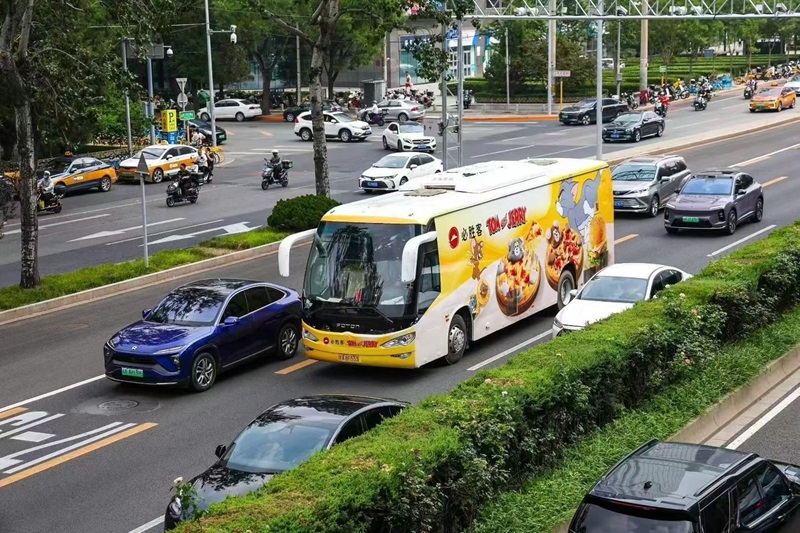
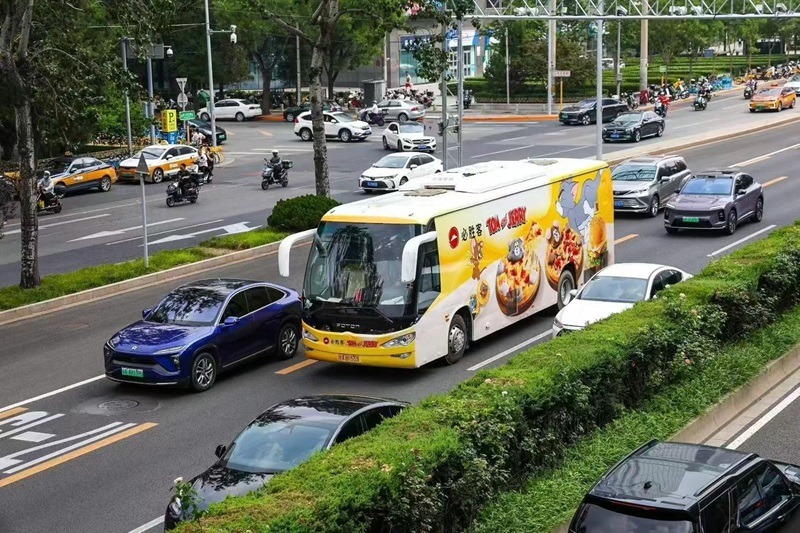
This part is often underestimated by first-time advertisers. The production cost is calculated based on the material, area, and complexity of the artwork. For example, full body advertising requires high-precision body stickers, large area, high process requirements, and naturally high production costs. The installation fee includes the labor cost for the first publication, and subsequent screen replacement and damage repair will also be charged separately.
2、 Five core variables that affect fees
It is the combination of the following variables that leads to significant differences in bus advertising prices.
Variable 1: Line Value - From "Golden Arteries" to "Remote Branches"
This is the most crucial pricing factor. The advertising value of the golden route that passes through the core commercial district, main roads, and business districts of the city is several times or even dozens of times that of suburban routes.
The evaluation of the value of the route mainly focuses on three points. The first is the coverage area, whether it passes through commercial centers, transportation hubs, or high-end residential areas. The second is the average daily passenger flow, which directly determines the number of exposed passengers on the route. The third factor is the visual environment, where road width, congestion, and surrounding building density can all affect the actual viewing effect of advertisements.
Variable 2: Advertising Form - From "Whole Body" to "Rear End"
The coverage area and location of vehicle advertising vary significantly, resulting in significant price differences.
Full body advertising covers both sides of the vehicle, the rear, and some parts of the front, with the strongest visual impact and naturally the highest price. Bilateral vehicle advertising covers the main areas on both sides of the vehicle, making it the most cost-effective choice. Rear end advertising targets rear vehicles and pedestrians, with a smaller area and the most economical price. In car advertisements include billboards, handles, etc., which passengers have ample time to watch during the ride and are suitable for deep communication.
Variable Three: Vehicle Type Differences - From "Single layer" to "Double layer"
The advertising area and visual impact of different car models are different, so the price naturally varies.
The advertising area of a double decker bus exceeds 70 square meters, with a maximum visible distance of up to 100 meters, making it a mobile giant billboard. Its price is usually several times that of a single decker bus. The advertising area of a single decker bus is about 30 square meters or more, making it the main model of urban public transportation with relatively controllable prices. Special vehicle models such as trams and vintage buses have cultural attributes and may have a certain premium in price.
Variable 4: Duration and Scale of Advertising - Discount on Quantity
Bus advertising requires time to accumulate effects, and long-term advertising can achieve better unit prices.
The duration effect is reflected in significant differences in unit prices across different periods of three months, six months, and one year. The scale effect is manifested as the more vehicles deployed, the lower the average price per vehicle. Media companies are willing to offer discounts for packaged purchases.
Variable 5: Production and Approval Costs
Bus advertisements need to be approved by the urban greening department and comply with local regulations on urban and environmental sanitation management. The production material needs to have weather resistance, UV protection, waterproofing, and wear resistance characteristics to ensure stable image quality during the release cycle. These compliance requirements and material standards are included in the total cost.
3、 How to calculate the total cost? One formula to solve it
The total cost of bus advertising can be calculated using the following formula: the total cost is equal to the monthly cost of a single vehicle multiplied by the number of vehicles placed, multiplied by the number of months of placement, plus the cost of image production and installation.
Among them, the monthly fee for a bicycle is determined by multiplying the basic price by the route coefficient, form coefficient, and vehicle type coefficient.
Real price reference
Based on recent market cases, we can understand the approximate price level.
In a bus route advertising procurement project in Xiangyang, the advertising cost for one bus for three months ranges from 7000 yuan to 8400 yuan. In a bus route advertising procurement project in Huai'an, the total budget for five routes over three months is 40000 yuan, with each route costing approximately 8000 yuan. In the leasing project for advertising operation rights of bus bodies in Ganzhou, the starting rental price for the five-year operation rights of 687 buses is over 27 million yuan, which translates to a monthly rental fee of approximately 660 yuan per vehicle.
These cases indicate that the prices of bus body advertisements vary significantly depending on the city, route, and cycle. Full body advertising on core routes in first tier cities, with monthly fees ranging from 25000 to over 50000 yuan per bike; Third - and fourth tier cities are relatively affordable.
4、 Four steps to develop your precise budget plan
Step 1: Clarify marketing objectives and audience
This is the starting point for all decisions. You need to ask yourself three questions. What is the goal, is it to expose the brand throughout the city, deeply cultivate the regional market, or create momentum for the launch of new products. Who is the target audience, white-collar commuters, household users, or business people. Where is the core market located, whether it covers the entire city or specific commercial districts.
Step 2: Filter matching routes
Select the route type based on the target audience. To reach white-collar workers, priority should be given to routes that pass through business districts and densely populated office areas. To reach households, choose routes that cover large residential communities. To reach tourists, choose routes that pass through tourist attractions and transportation hubs. To build brand image, choose the golden routes of urban main roads and core business districts.
Step 3: Determine the form and scale of the advertisement
When the budget is limited, you can choose to advertise on one side of the car or on the rear of the car, and place two to three core routes. When the budget is moderate, choose full body advertising and advertise three to five routes. When the budget is sufficient, double decker buses or core route matrix deployment can be considered.
Step 4: Obtain a quotation and calculate the actual cost
When inquiring with a professional platform, it is important to clarify whether the quotation includes tax, production and installation costs, how to maintain damaged images, who will bear the costs, whether the images can be replaced during the contract period, and how the costs are calculated.
Tianci Media is a professional public transportation advertising platform with a rich database of national public transportation routes. It can quickly output a matching route list and cost-effectiveness analysis report based on your goals, providing one-stop full process services from demand analysis, route evaluation to creative execution and effect tracking.
5、 Common Misconceptions and Avoiding Pits Guide
Misconception 1: Only focus on price, not the value of the route
The cheapest routes often lead to the suburbs, with sparse daily passenger flow and limited exposure effect. The golden route passing through the core business district may have a high unit price, but the effective target audience may have lower reach costs.
Misconception 2: Neglecting the cost of production and installation
The media release fee on the quotation usually does not include production and installation fees. The production cost of full body advertising may reach several thousand yuan per vehicle, which needs to be separately included in the total budget.
Misconception 3: The advertising cycle is too short
Bus advertising requires time to accumulate effects. After a month of deployment, the vehicles may not have fully traveled the entire route, making it difficult to form effective awareness. It is recommended to advertise for at least three months.
Misconception 4: Creative design does not consider mobile viewing
Vehicle advertising is a 'three second art' - complex copy and details cannot be seen clearly during rapid movement. We must adhere to the minimalist principle of big pictures, big characters, and big brands.
Misconception 5: Lack of Compliance Awareness
Bus advertisements need to be approved by the local urban greening department. It is essential to advertise through legitimate channels to ensure the legality of the location.
6、Conclusion
How is the cost of bus advertising calculated? It is not a single price number, but a composite function determined by the value of the route, advertising format, differences in vehicle models, advertising duration, and production costs.
The key lies in scientific planning: clear goals, carefully selected routes, reasonable combinations, creative adaptation, and professional execution. For beginners, it is recommended to start with small-scale testing, choose two to three core routes to deploy for three months, verify the effectiveness, and then gradually scale up.
Tianci Media is a professional public transportation advertising platform that has been deeply involved in public transportation media for many years, with rich resource accumulation and advertising experience. From demand analysis and route evaluation to creative execution and effect tracking, we provide you with professional one-stop services, allowing your brand to accurately reach the target audience with the pulse of the city.