2025 Airport Advertising Strategy: A Comprehensive Guide from Budget Planning to Doubling Effectiveness
2025-12-09Tianci MediaViews:219
Highlights
By 2025, the size of China's airport advertising market has exceeded 40 billion yuan, becoming a battleground for high-end industries such as cloud services and smart cars. Unlike ordinary outdoor advertising, the airport scene gathers a high net worth customer group with an annual income of over 300000 yuan, accounting for more than 65% of the total. The enclosed environment where passengers wait for an average of 1.5 hours makes the advertising recall rate much higher than online media. For beginners, airport advertising can achieve brand upgrades without a huge budget - this article will combine the latest cases such as KFC and Google Cloud to break down the complete path from media selection to effect quantification, and answer core questions such as "what are airport media" and "how to achieve high conversion with low cost".
By 2025, the size of China's airport advertising market has exceeded 40 billion yuan, becoming a battleground for high-end industries such as cloud services and smart cars. Unlike ordinary outdoor advertising, the airport scene gathers a high net worth customer group with an annual income of over 300000 yuan, accounting for more than 65% of the total. The enclosed environment where passengers wait for an average of 1.5 hours makes the advertising recall rate much higher than online media. For beginners, airport advertising can achieve brand upgrades without a huge budget - this article will combine the latest cases such as KFC and Google Cloud to break down the complete path from media selection to effect quantification, and answer core questions such as "what are airport media" and "how to achieve high conversion with low cost".
一、 First understand the underlying logic: 3 core advantages of airport advertising in 2025
Before novice advertising, it is important to understand that the value of airport advertising is no longer just about "exposure", but rather the triple empowerment of "precise reach+mental occupation+conversion loop". This is also the core reason why companies such as Alibaba Cloud and Volcano Engine are competing to lay out their strategies.
1. High net worth traffic pool: spending a small amount of money to reach core customer groups
The proportion of business people and high-frequency travelers among airport passengers is significantly higher than other scenarios. Taking Shanghai Hongqiao Airport as an example, the daily passenger flow has exceeded 30 million, with 92% of them being domestic airline passengers who are accurately adapted to local brands. During the Spring Festival travel rush in 2025, Hanglv XiaoU's airport advertisements for KFC reached 6.215 million people and achieved over 32 million screen exposures, covering only six major airports, proving the high cost-effectiveness of airport traffic.
2. Strong scene reach: Advertising information is not "wasted"
The fixed flow of passengers from check-in, security check to boarding creates a "forced exposure" effect for advertising. According to the data of Changsha Huanghua Airport, the recall rate of transfer channel advertisements exceeded 68%, far higher than the average of 12% of Internet advertisements. More importantly, by 2025, airport advertising has achieved a "scenario adaptation" upgrade, such as IoT sensors being able to push content based on the environment - automatically displaying cool beverage advertisements in the waiting hall during summer to enhance user acceptance.
3. Short conversion link: Only 3 steps from seeing to buying
Nowadays, airport advertising has already connected the entire process of "offline exposure online interaction in store conversion". A certain brand has increased its advertising conversion rate by three times through the combination of "luggage tag QR code+duty-free product page"; AR interactive lightboxes can also achieve "scan code to generate boarding pass Easter eggs", increasing private domain traffic conversion rate by 27%.
二、 Core question: What are the media outlets for airports in 2025? Take your seat according to the budget
Newcomers are most prone to the misconception of blindly choosing high-end locations, but in fact, by 2025, airport media has formed a clear hierarchical system, with corresponding choices for budgets ranging from 100000 to 2 million. Based on the latest resources from Adia Media and Hanglv Xiao U, mainstream media can be divided into four categories:
1. Traffic king type: S-level point (suitable for budgets over 1 million)
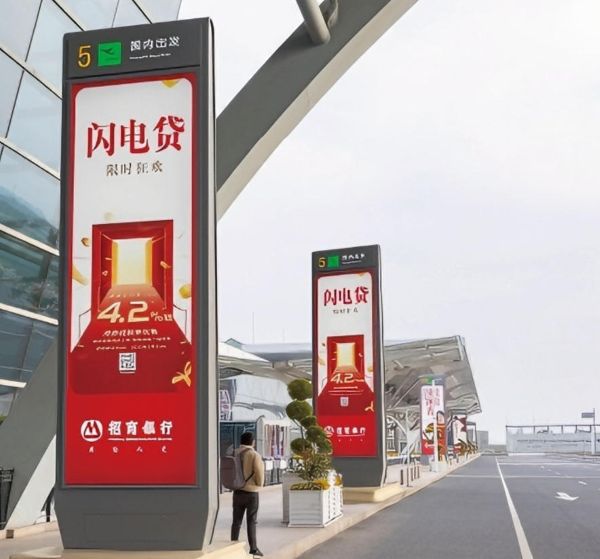
This type of media is located in core areas such as check-in islands and security checkpoints, covering over 90% of departing passengers, and is the first choice for brands to create a "visual hegemony". The light box (22 × 4m) on the check-in island of Guangzhou Baiyun Airport can break through advertising blind spots and increase the attention rate by 150%; The 72 square meter LED giant screen at Shenzhen Bao'an Airport rotates 220 times a day, with 15 seconds of dynamic display forming strong memory points. In 2025, Google Cloud's S-level LED advertising at San Francisco Airport will directly and accurately reach the enterprise CIO group, helping to boost its AI service signing volume.
2. Precise penetration type: A-level location (suitable for budget of 500000 to 1 million)
Covering waiting hall lightboxes, boarding gate electronic screens, etc., suitable for conveying product details and interactive information. Ningbo Airport's luggage hall lightbox costs 350000 yuan per month, catering to newly arrived passengers, especially suitable for local service, hotel and other brands; The LED set (238.41 square meters) at the security checkpoint of Changsha Airport broadcasts 240 times per day, which can reach business people with high frequency. During the KFC2025 Spring Festival travel rush, we achieved 13.104 million exposures on small screens with the theme of "good taste of travel" through such locations.
3. Cost effective choice: Long tail location (suitable for budgets of 100000 to 300000 yuan)
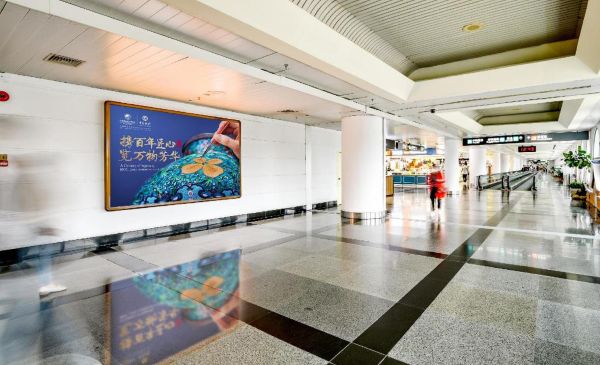
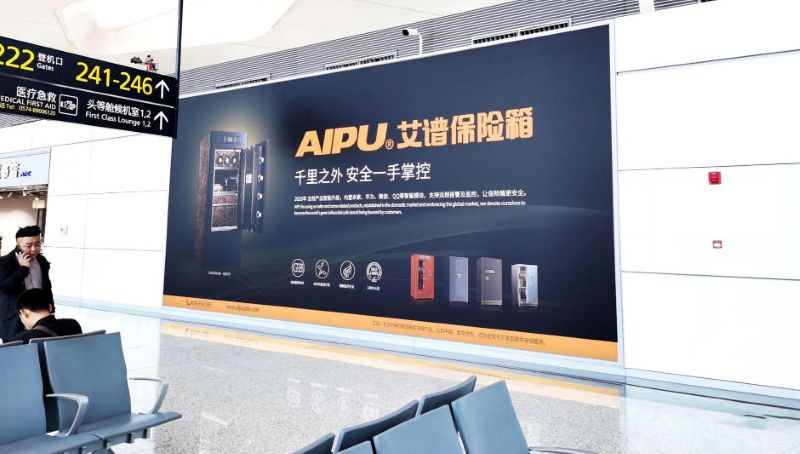
Including corridor lightboxes, luggage cart advertisements, and dedicated screens for early flight hours, it is the best choice for beginners to try and make mistakes. The Shanghai Hongqiao ADF set can be split and deployed by three brands, covering the core area with only 98000 yuan per week; The advertising at the exit of Quzhou Airport is 105000 yuan per item, which not only binds to the city image but also accurately reaches the arriving passenger flow. Although the single point traffic of this type of media is not as high as S-level, its advantage lies in its controllable cost and suitability for regional brands to preliminarily test the waters.
4. Innovative interactive type: digital media (flexible budget adaptation)
As the fastest-growing type of airport media by 2025, it includes Wi Fi pop ups, AR navigation advertisements, metaverse exhibition halls, and more. The AR navigation channel launched by Hongqiao Airport, integrated with virtual brand exhibition halls, has increased passenger stay time by 200%; The interactive advertising of Hanglv XiaoU significantly enhances brand stickiness through QR code scanning games. This type of media can be charged based on the amount of interaction, and beginners can start testing the effectiveness from small-scale advertising.

二、 Novice must learn: 5 steps of airport advertising placement process (with 2025 pitfalls avoidance techniques attached)
Based on the practical experience of Adia Media and Hanglv Xiao U, airport advertising placement has formed a standardized process by 2025, and beginners can avoid 80% of risks by strictly following it.
1: Clarify the matching formula for "crowd target"
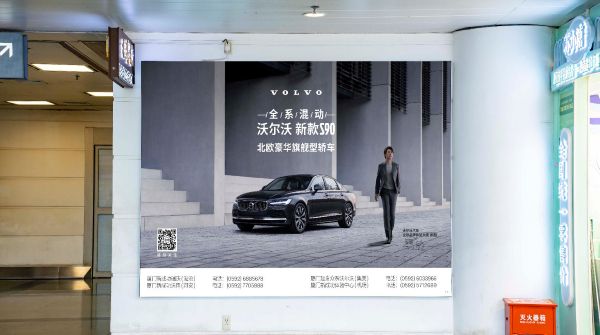
First, ask yourself two core questions: Who is your customer base? What goal do you want to achieve? For example, luxury brands should target the S-level lightboxes at the Shanghai Pudong International Departure Hall and cater to high spending outbound consumers; Financial and insurance brands are suitable for the combination of check-in island and luggage hall, covering the entire process of passenger flow. The strategy of Amazon Web Services (AWS) in the United States is more informative, as it directly displays cases of "customer cost reduction of 99%" in airport advertisements, accurately impressing enterprise CIOs who are concerned about ROI.
2: Save 30% of budget with 'spatiotemporal combination'
There is a significant temporal and spatial difference in airport advertising prices in 2025, and beginners can use this pattern to reduce costs: during peak seasons, corridor lightboxes (with a premium of 15%) can be used instead of security checkpoint LEDs (with a premium of 40%); Lock in National Day resources during the off-season from March to April and avoid the 20% peak season surcharge; You can also enjoy a 75% discount on the publication price if you have been advertising for at least 6 months. KFC's deployment during the Spring Festival travel rush accurately avoided the peak premium of hub airports in first tier cities, choosing popular tourist destinations such as Guangzhou and Haikou to achieve a balance between cost and effectiveness.
3: Advertising Content Design "3-second Principle"
Airport passengers are in a hurry, and advertisements must capture attention within 3 seconds. There are three core techniques: firstly, the main visual should highlight the core information, such as Google Cloud advertising directly pointing out "Gemini Enterprise opens up a new working mode"; The second is to add interactive commands, such as "scan the code to claim airline miles" and "generate exclusive boarding pass Easter eggs"; Thirdly, by combining the emotions of the scene, the theme of "Warm and Happy Year" during the Spring Festival travel rush is more likely to resonate than hard advertising.
4: Choose the right partner and avoid 'hidden costs'
Novices are advised to prioritize two types of partners: one is the official advertising department of the airport, which is suitable for directly connecting with core locations; The second is a national agent (such as Adia Media, which covers over 200 airports) that can provide integrated services for design, delivery, and monitoring, with exclusive discounts. When signing the contract, it is essential to clearly define the cost structure to avoid overlooking hidden costs such as production and maintenance fees, while also specifying the rights and interests of data monitoring.
5: Monitoring effect using "three frequency resonance"
By 2025, airport advertising has achieved quantitative effectiveness, and beginners can use the three frequency model of "base station positioning+AI visual recognition+LBS tracking": by using base station data to see the actual number of people reached, using AI to analyze passenger gaze duration, and relying on LBS tracking to guide offline store traffic. After the launch of a certain automobile brand, it was monitored through this system that the brand awareness of high-end customers increased by 83 points, providing clear direction for subsequent advertising.
三、 The 4 easiest pitfalls for beginners to step into in 2025, avoid them directly after reading
Pit 1: Blindly pursuing the "first" and ignoring customer group matching
Many beginners follow the trend and advertise S-level points at Beijing and Shanghai hub airports, but if the brand's target audience is regional customers, it may actually result in budget waste. Regional brands are more suitable for cultivating second tier hubs, such as the Ningbo T1 corridor row light box, which can accurately cover local high net worth individuals with a monthly price of 288000 yuan.
Pit 2: The advertising content is self explanatory and detached from the scene
Placing complex product parameters at the boarding gate or displaying advertisements unrelated to arrival needs in the luggage hall are typical misconceptions. The approach of Amazon AWS is worth learning from, as it directly displays "cost reduction and efficiency improvement" cases in the arrival hall advertisements, which meets the work needs of business people after landing.
Pit 3: Neglecting technological empowerment and wasting conversion opportunities
Continuing to invest in pure static lightboxes without incorporating interactive technology in 2025 is equivalent to giving up the possibility of high conversion rates. AR scanning, IoT dynamic adjustment and other functions have become basic configurations. A certain brand uses "carbon footprint advertising" to allow users to scan codes and accumulate environmental points, increasing the brand equity exchange rate by 40%.
Pit 4: Ignoring and lacking optimization awareness after placement
Airport advertising is not a one-time investment, the key to the success of Hanglv XiaoU lies in real-time optimization - adjusting the advertising rotation time according to the peak passenger flow of different airports; Through interactive data, optimize the guidance path after scanning, and continuously improve conversion efficiency.
四、 Conclusion: 2025 airport advertising, a "high-end entry-level coupon" for beginners
After reading this guide, you will find that airport advertising in 2025 is no longer exclusive to large enterprises. As long as beginners understand the core logic of "precise matching of customer groups", comprehend the classification differences of "what airport media are", and make good use of spatiotemporal combination strategies and technical tools, they can reach high net worth customer groups with a budget of 100000 to 300000 yuan.
Let's take action now: first, sort out whether the brand's core customer base matches the airport scene, and then select 1-2 long tail or A-level spots for trial advertising based on the budget, leveraging the technological dividends of 2025 to achieve a breakthrough in the effectiveness of the first airport advertising. The next brand to go viral at the airport could be yours!