South Korea Airport Advertising: Incheon, Gimpo & Jeju Media Strategy
2026-06-26Tianci MediaViews:64
Highlights
South Korea’s airport advertising market is undergoing a rapid transformation. With record passenger volumes, full-scale digitalization, and a surging inbound tourism market, Korean airports have become prime real estate for brands seeking premium traveler audiences. In 2025, Incheon International Airport alone expects approximately 73 million passengers—a scale that guarantees reach unmatched by city-based advertising.
Why Advertise at Korean Airports?
Premium International Audience – Korean airports, particularly Incheon, serve as a major gateway for high-spending travelers from China, Japan, Southeast Asia, and beyond. In September 2025, the Korean government introduced a temporary visa-free policy for Chinese group travelers, expected to bring at least one million additional Chinese visitors. Most of these travelers pass through Incheon’s gates, making airport advertising the most direct channel to reach them.
Extended Dwell Time & Strategic Touchpoints – Airport terminals offer extended dwell time and strategic positioning at critical decision-making points: customs exits, baggage claims, and boarding gates. Travelers are most attentive when navigating arrivals and departures, creating a captive audience for impactful brand messaging.
Signal Value – A prominent airport presence signals brand strength and global ambition. Luxury houses, cosmetics giants, and technology firms already view Korea’s airport media networks as launchpads to intercept visitors before they reach city centers.
Key Airports for Advertising
Incheon International Airport (ICN)
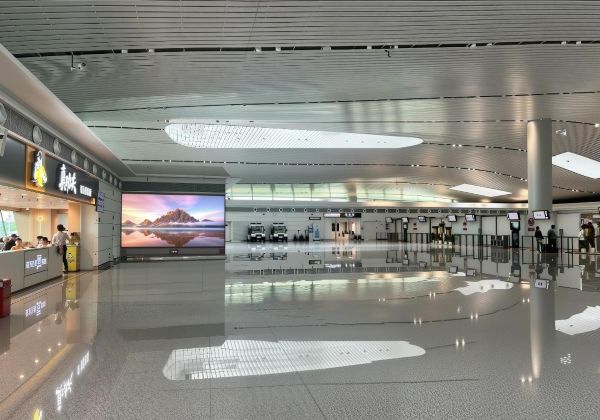
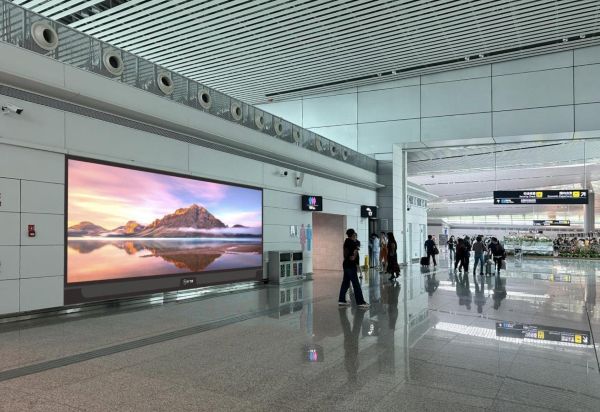
As South Korea’s largest aviation hub and a top-10 global airport, Incheon is the undisputed centerpiece of Korean airport advertising. In January 2024, the Korea Economic Daily (KED) secured a 7-year contract to revolutionize all airport advertising media at Incheon. The transformative plan replaces static displays with cutting-edge LED advertising media across both terminals, moving toward 100% digitalization.
Premium Formats at Incheon:
Giant LED – A 23-meter-high display in the Terminal 1 departure hall. Bvlgari utilized this screen for its high jewelry campaign, while Ballantine’s deployed it for luxury whiskey promotions.
Twin Towers – Two synchronized screens measuring 37m × 5m each. Inspire Entertainment Resort used these to position itself as Korea’s leading leisure destination.
Antler Panels – Dual synchronized screens (15.4m × 4.5m) at Terminal 1 duty-free zones. Chanel leveraged these for its BLEU DE CHANEL campaign.
Bridge LED & Panorama Media Art – Flagship digital platforms spanning Terminal 2 passenger pathways.
Baggage Claim & Arrival Zone LEDs – Strategic placements capturing travelers during 5–15 minutes of waiting time.
Gimpo International Airport (GMP)
Serving the Seoul metropolitan area for domestic and short-haul international routes, Gimpo attracts business travelers and frequent flyers. In February 2026, Baedal Minjok (Baemin) launched a large-scale campaign at Gimpo using large media walls and LED screens.
Jeju International Airport (CJU)
As the gateway to Korea’s top tourist destination, Jeju Airport handles millions of leisure travelers annually. The same Baemin campaign also targeted Jeju Airport, demonstrating the value of airport advertising for brands targeting vacationing consumers.
Digital Out-of-Home (DOOH) Takes Center Stage
South Korea’s OOH and DOOH market is expected to grow at a 5.45% CAGR through 2035. Airport DOOH offers distinct advantages:
Dynamic Creative Optimization – Real-time adjustments based on time of day, flight status, or passenger segment
Omnichannel Integration – Airport DOOH screens provide a natural extension for campaigns running on TikTok, WeChat, or Douyin
Measurable Impact – Research shows that adding OOH to a media plan can double short-term ROI by amplifying the effectiveness of connected TV, social, and mobile campaigns
Why Choose Tianci Media for Korean Airport Advertising
Tianci Media provides comprehensive airport advertising solutions across South Korea’s major aviation hubs. The company holds strategic media resources at Incheon International Airport (T1, T2, and Transportation Center) , including刷屏机 (digital screen networks) distributed across every key passenger touchpoint—from check-in and security to boarding, baggage claim, and transportation transfer areas.
Key Incheon assets available through Tianci Media include:
T2 Departure Hall Landside Exhibition Booths – Central island and passage displays capturing passengers at the start of their journey
T2 Arrival Greeting Hall LED – Positioned above the必经通道 connecting baggage claim to public transport
T2 Arrival Baggage Claim Area LED – 100% coverage of all arriving international passengers with 5–15 minutes average dwell time
T2 Arrival Airside LED – The first visual touchpoint for passengers “landing in Korea,” capturing attention during the post-flight attention gap
Beyond airport media, Tianci Media leverages AI-powered audience segmentation—analyzing traveler cabin class, flight frequency, destination preferences, and consumption behavior—to ensure precise targeting. The company also integrates airport audience data with global digital platforms (Meta, TikTok) through lookalike audience expansion and retargeting strategies.
The Bottom Line
South Korea’s airport advertising landscape offers brands an unparalleled opportunity to reach premium, high-spending travelers in a focused environment. With Incheon’s full digital transformation underway, Gimpo’s business traveler concentration, and Jeju’s leisure tourism volume, the market delivers both scale and precision. For brands ready to capture the attention of Korea’s most valuable travel audience, Tianci Media provides the expertise, resources, and data-driven capabilities to make your campaign take off.