- Photos
- Specs
- Advantages
- Value
- Media Map
| Area:Taiyuan | Type:airport | Frequency:0 |
| Address:Taiyuan Wusu Airport | Format:Light box | Duration:0 |
| Location:Opposite the escalator at remote stands on Level 1 of Terminal 2 | Min Qty:1 | Operating Time:0-24o'clock |
| Size:4.95×1.95 | Min Period:year |
Positioned on the mandatory passage leading to the baggage claim hall, it achieves 100% coverage of outbound passengers heading for baggage collection, ensuring brand messages accurately reach every target audience without omission. Passengers’ eyes will naturally linger on the lightbox visuals opposite for an extended period. Such fixed line of sight creates an optimal exposure window for brands and greatly boosts ad readership and memorability.
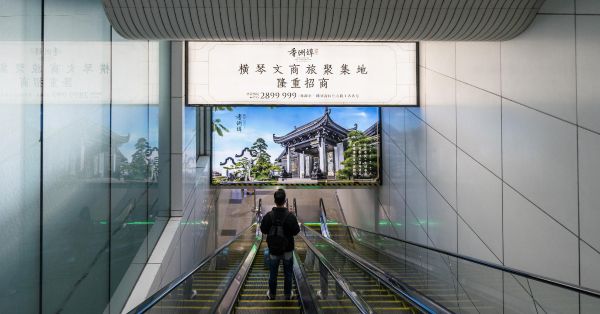
The lightbox sits opposite the downward escalator for remote stands on Level 1 of Terminal 2, occupying the exclusive mandatory traffic route for passengers arriving via remote stands. After passengers from all flights docking at remote stands arrive at the terminal by shuttle bus, they take this escalator downward uniformly. The lightbox faces the direction of escalator travel, so passengers face the visuals throughout their descent with ample effective viewing time. This media precisely covers all arriving passenger flow from remote stand flights and supplements the audience groups unreachable by arrival media at jet bridges.
Most airport arrival media are concentrated in jet bridge arrival zones and cannot reach passengers arriving via remote shuttle buses. This location enables dual coverage of both jet bridge passenger flow and remote stand passenger flow. With no forks, obstructions or alternative routes, it creates a high-attention scenario where "the lightbox comes into view immediately upon descending the escalator and cannot be missed while moving". The reach rate is nearly 100%. Its installation height aligns with passengers’ horizontal sightline (approximately 1.5m–1.8m), eliminating the need to look up or down and enabling immersive viewing with zero cognitive load.
This location has no passenger diversion passages, enabling 100% full coverage of passengers arriving at remote stands. It perfectly fills the traffic blind spots of conventional arrival media at jet bridges. Unlike scenarios where passengers pass quickly through corridors, travelers descend slowly on the escalator with their gaze fixed forward, enjoying ample visible dwell time. This completely overcomes the communication shortcoming of traditional corridor advertisements that only flash briefly, creating natural immersive forced exposure.
Situated along the mandatory traffic route for passengers arriving from remote stands, it effectively covers passenger blind spots unreachable by arrival media at jet bridges. Travelers face the light box throughout their descent on the slowly moving escalator, granting sufficient advertisement viewing time and delivering high-quality forced exposure. The audience mainly consists of tourists and business travelers entering Shanxi from other provinces, with a high proportion of out-of-town visitors who have immediate consumption demands upon arrival. The media adopts indoor backlit light boxes featuring clear, stable visuals with minimal competing advertisements in the area.
This escalator leads down to the baggage claim hall without any diversion passages, fully covering all passengers arriving at remote stands. The light box faces the descending escalator, skillfully leveraging the relatively fixed viewing direction and dwell time of passengers on escalators. While descending slowly, travelers naturally keep their eyes on the light box visuals opposite them for an extended period with little distraction. Such "forced exposure" delivers an excellent viewing window for brands and greatly boosts advertisement memorability.