
- Photos
- Specs
- Advantages
- Value
- Media Map
| Area:Chongqing | Type:high-speed railway | Frequency:240 |
| Address:No. 168 Fengzhong Road, Xinqiao Subdistrict, Shapingba District | Format:led | Duration:10s |
| Location:Station Waiting Hall | Min Qty:2 | Operating Time:5-23o'clock |
| Size:5*8 | Min Period:month |
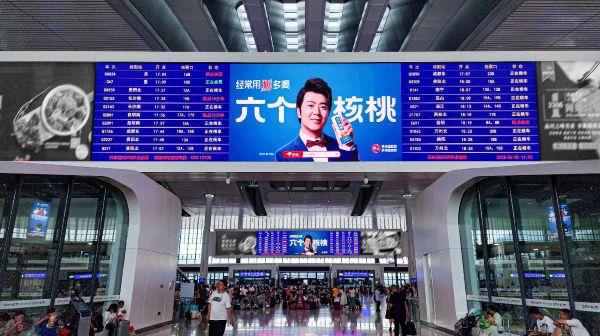
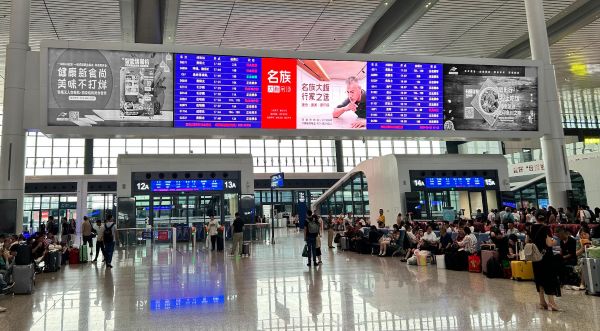
Located on the north side of the service island in the center of the lobby, the screen stands taller than surrounding seats, columns and ticket-checking signage. Travelers at the far entrance of the lobby and ticket-checking zones on both sides can clearly view the screen from a long distance. It features a 360° unobstructed transparent viewing range with no architectural barriers blocking the line of sight. All diverted passengers passing through either the north or south side of the lobby will face the large screen directly, achieving 100% coverage of all passenger flows in the waiting hall with zero omissions. This brings higher audience acceptance and less resistance to advertisements.
The waiting hall of a high-speed railway station is an enclosed exclusive travel space. Passengers usually stay for 30 to 45 minutes per waiting trip. Their attention is concentrated during idle time without distractions from online information streams and short videos. The effective visual dwell time per person exceeds 7 seconds, resulting in a far higher brand memory retention rate than ordinary outdoor media and passageway transient advertising screens. A single screen can precisely capture northbound passenger flows, while dual screens working in tandem deliver full coverage of all passenger flows across the entire lobby.
Occupying the prime visual vantage point of the waiting hall, it firmly captures all northbound passengers entering the station, waiting for trains and proceeding to ticket checks, serving as the sole core visual gateway along the northbound traffic route. The station only has two sets of symmetrical central main screens on the north and south sides, representing limited core premium advertising positions with high access thresholds. These positions boast strong exclusivity and monopolization. Compared with scattered digital display screens and ordinary light boxes inside the station, they possess irreplaceable dominance over the venue scene, and long-term ownership of such advertising assets delivers stable value preservation.
Chongqing West Station, the largest comprehensive transportation hub in western China, handles an annual passenger volume of over 42 million. Its average daily passenger arrival and departure volume on regular days ranges from 150,000 to 180,000. The single northern screen achieves an effective daily reach of more than 140,000 people. During the Spring Festival travel rush and holidays, the peak single-day exposure exceeds 250,000 visitors. Sustained massive genuine offline passenger flow throughout the year delivers consistent exposure. Its passenger groups consist of 60% interprovincial long-distance travelers, 35% business travelers and 40% tourist families, covering business crowds traveling between Chengdu-Chongqing, Yunnan-Guizhou and northwest regions nationwide.
The single screen features a specification of 5m × 8m with a display area of 40 square meters. Equipped with P4 high-density high-definition LED display modules, it delivers 4K ultra-high-definition visuals. Boasting high brightness and high color reproduction, it adapts to all-day light conditions in the station hall: no reflection under strong daylight and crisp image quality at night, creating an extremely strong visual impact. The media supports multiple advertising formats including dynamic short videos, brand promotional films, static posters and subtitle broadcasts, suitable for high-end brand image display and creative marketing campaigns of all kinds.
With its irreplicable location advantage, precise audience reach and unique policy support, it serves as a scarce platform for brands to seize high-end passenger flow resources at Chongqing high-speed railway stations. It transforms brand exposure from passive reception to active perception and significantly improves information memorability. Such precise audience matching enables far higher conversion efficiency for advertising placements compared with ordinary outdoor media.