Comprehensive Guide to Airport Advertising Placement: From Location Selection to Effect Evaluation
2026-03-09Tianci MediaViews:272
Highlights
How to operate airport advertising placement? This article breaks down the six core steps from goal setting, point selection, budget negotiation, creative production to effect review, and includes a 1.488 million yuan procurement case by the Shanxi Provincial Department of Culture and Tourism and a reference for media prices at the Postal Savings Bank boarding gate. Tianci Media is a professional airport advertising platform that helps you efficiently reach high net worth individuals!
When a brand grows to a certain stage and seeks breakthroughs and upgrades, marketing decision-makers often turn their attention to a special scenario - the airport. This is not only a transportation hub, but also a natural flow rich mine that gathers high net worth, high aspirations, and high influence people. By 2025, the passenger throughput of Beijing Capital International Airport alone will reach 70.76 million, mainly consisting of business people, high-end tourists, and corporate executives.
However, facing the complex airport environment, expensive media prices, and difficult to quantify effects, many beginners feel confused: with so many locations, which one should they choose? Can the numbers on the quotation be discounted? After the advertisement is published, how do you know if anyone has watched it?
This article will systematically break down the entire process of airport advertising placement for beginners, from the first step to the last step, explaining each step thoroughly.
1、 Step 1: Set goals first, then adjust the budget
This is the most important and easily skipped first step. Many beginners come up and ask, 'How much does the screen at Daxing Airport cost?' This question is equivalent to telling the other person: I don't know anything, you can report it at will.
The correct posture is to first think clearly about what you want.
Ask yourself three questions:
What is my core goal?
Want to increase brand awareness and let more people know that I have come to Beijing? → Select security checkpoint and departure hall
To achieve effective conversion and give those who see me the opportunity to take action? → Select arrival hall, baggage claim hall
To accurately reach a certain group of people? Business travelers choose the security checkpoint, while tourists choose the arrival hall
What is the status of my target audience at the airport?
Business travelers: rushing, anxious, and distracted
Tourist: Relaxing, open-minded, and willing to accept information
Pick up crowd: Local residents, with clear goals and a calm mindset
The same airport, different demographics, completely different advertising strategies.
Can I keep up with my offline ability?
Only brands, no stores → Security checkpoint is enough
Having stores and being able to undertake → must consider arrival hall
There are activities and promotions → waiting areas and boarding gates are more valuable
Think about these three questions clearly before moving on. Clear goals are the cornerstone of budget allocation and effectiveness evaluation.
2、 Step 2: Choose the right location to achieve twice the result with half the effort
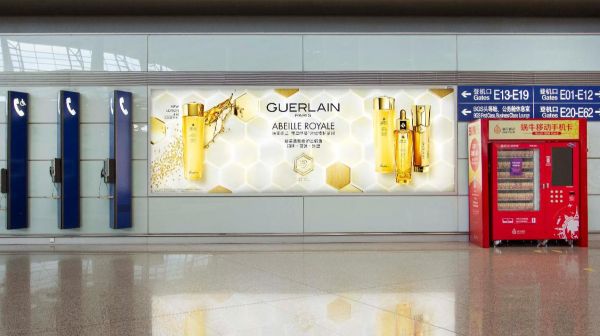
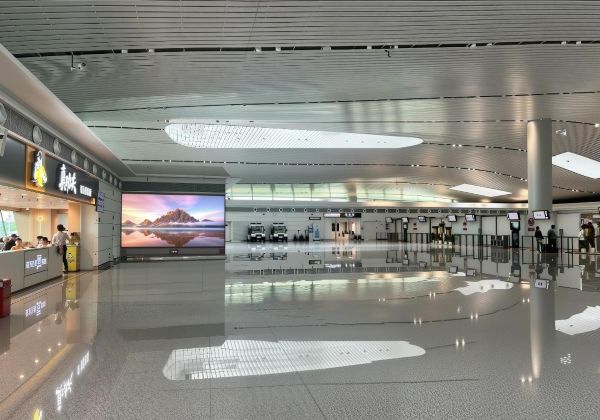
The placement of airport advertisements can be divided into three categories based on passenger flow. The key to successful advertising is to act like a director and arrange the brand's "scene" on the flow of passengers.
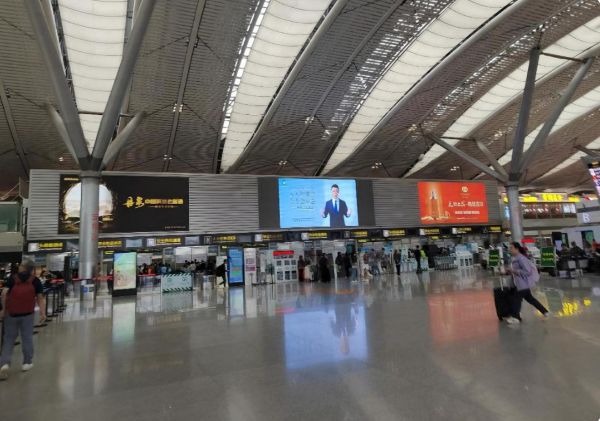
2.1 Category 1: Departure Area
Including: departure hall, check-in island airspace, security checkpoint, and post security passage.
Core characteristics: The highest passenger flow and the highest proportion of business customers, but passengers have anxious mentality and scattered attention. Suitable for large brands that require broad-spectrum exposure and establish brand awareness. The check-in hall has a spacious area, allowing passengers to have a relatively relaxed time, making it suitable for grand brand narratives to convey strength and layout.
Location selection technique: directly across from the security checkpoint>on both sides of the security checkpoint>above the check-in island; LED screens in the queue area>lightboxes in the fast lane; The position where passengers must look up>the position where they can ignore looking down at their phones.
2.2 Category 2: Waiting Area
Including: around the boarding gate, waiting hall, commercial area, and entrance of the corridor bridge.
Core features: Passengers stay for the longest time, have a relaxed mindset, and have enough time to read advertisements. Suitable for brands that require deep communication and the transmission of complex information. The waiting quarantine area is like a "living room", where passengers have longer fragmented stays and can tell brand stories and showcase product details.
Location selection technique: Directly across from the boarding gate>both sides of the waiting hall>commercial area passage; Advertisements near the rest area>hastily passing advertisements; Places with seats>places without seats (with a difference of 3 times in dwell time).
2.3 Category 3: Arrival Zone
Including: baggage claim hall, arrival channel, exit, and airport pick-up area.
Core characteristics: Passengers have the most relaxed mentality, the longest stay time (luggage waiting for 3-8 minutes), and the most smooth conversion path. Suitable for tourist destinations, hotels, and local high-end services. The baggage claim hall is the first point of contact for passengers upon arrival, filled with anticipation and relaxation. Advertisements can be associated with emotions such as "arrival," "opening," and "enjoyment.
Positioning technique: directly above/opposite the luggage carousel>both sides of the carousel>arrival channel; Directly above the exit>on both sides of the exit>outside the airport pick-up area; The natural landing point of the passenger's line of sight is a position that requires turning their head to see.
Beginner's mnemonic: Speak loudly in the departure area, communicate deeply in the waiting area, and truly transform in the arrival area.
2.4 Core Strategy Selection: International Region vs. Domestic Region
International departure/arrival area: The audience has the highest degree of globalization and top-notch consumption power, suitable for brands that already have national popularity and aim to create a global high-end image, and the prices are usually the highest.
Domestic departure/arrival area: With a larger traffic base, covering a wider range of business people and affluent classes, the cost-effectiveness is relatively higher, and the target is more focused on the domestic market.
3、 Step 3: Understand the form and scientifically combine it
There are several forms of airport advertising, each with its own advantages:
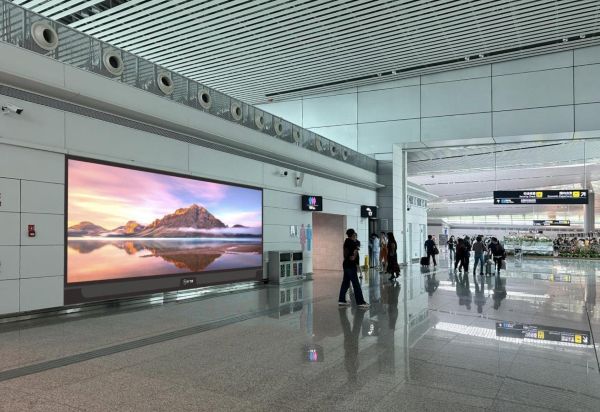
3.1 LED Large Screen
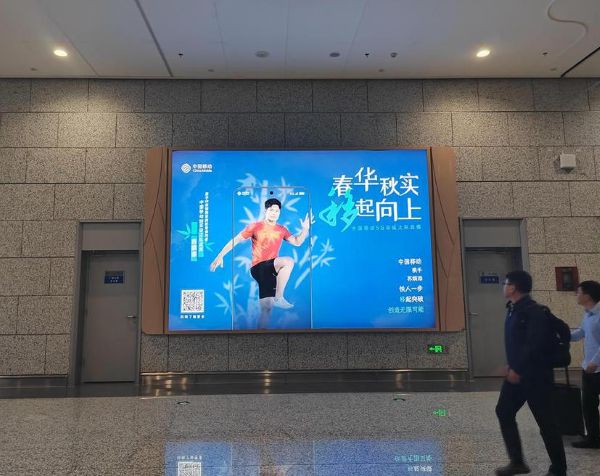
Features: Dynamic display, video playback, adjustable content. Strong visual impact, large information capacity, and real-time updates. Suitable for brand image display and short video promotion, especially in core locations such as the departure hall atrium and baggage claim area.
Cost effectiveness analysis: High budget but great conversion potential, suitable for brand image and new product promotion.
3.2 Lightbox Advertising
Features: Static display, visible for a long time. Low cost, easy maintenance, and clear brand information. Suitable for product information and brand slogan.
Cost effectiveness analysis: Suitable for small and medium-sized enterprises with limited budgets and stable ROI.
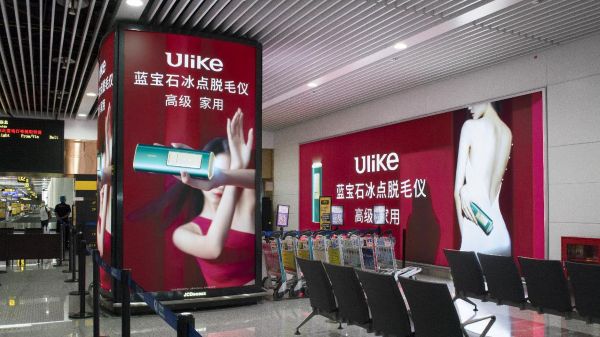
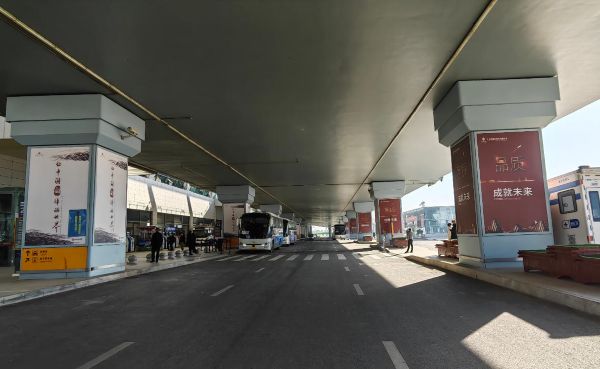
3.3 Column advertising
Features: The advertisement covers the entire column and has a 360 ° visual impact. Unique visual effect, high attention.
Cost effectiveness analysis: The advertising cost is moderate, suitable for brand visual enhancement and holiday event promotion.
3.4 Combination advertising strategy
Combination Fist "is superior to single point: The ideal strategy is to cover the complete flow of" departure (cognition) - security check (reinforcement) - waiting (resonance) ", achieving multi frequency and three-dimensional communication with the same passenger.
Focusing on the core area: When budget is limited, concentrating firepower to capture a core combination of domestic departure areas (such as large screens and security checkpoints) is far more effective than dispersed deployment in multiple secondary locations both domestically and internationally.
4、 Step 4: Understand the price and learn to negotiate
The pricing system of airport advertising is a black box to outsiders. But you don't need to be an expert, you just need to know a few core logics.
4.1 What determines the price?
Airport level: 10 million level airport vs 1 million level airport, a price difference of 3-5 times is normal. Core hub airports such as Beijing Capital and Shanghai Hongqiao naturally have the highest prices.
Location level: S-level location (security checkpoint, luggage hall) vs A-level location (passage, waiting area), with a price difference of 2-3 times.
Area size: A 30 square meter large screen vs a 10 square meter light box is not a triple relationship, it is a scarcity relationship.
Advertising cycle: Year frame vs quarter vs month, discount rates are completely different.
During peak and off peak seasons: around May Day, National Day, and Spring Festival, it is common for prices to increase by 20-30%.
4.2 Real Procurement Case Reference
Shanxi Provincial Department of Culture and Tourism Beijing Capital Airport advertising placement: In September 2025, Shanxi Provincial Department of Culture and Tourism purchased the advertising placement project for T3 terminal of Beijing Capital Airport, with a transaction amount of 1.488 million yuan and a placement period of 5 months. High definition dynamic advertisements were placed in high traffic areas of T3 terminal.
Postal Savings Bank of China Tianjin Branch Boarding Gate Media: In 2026, Postal Savings Bank of China Tianjin Branch will purchase airport T2 terminal departure area boarding gate media placement services, with advertising costs of 5000 yuan/(week/gate) and production costs of 3000 yuan/(time/gate). The estimated two-year placement is 2 million yuan.
4.3 How to negotiate?
Firstly, do not bargain with the published price. The published price is used to intimidate people. What you want to ask is: "What is the approximate recent transaction price
Secondly, clarify what is included and what is not included. Many beginners only ask about "media fees" and ignore: image production fees, replacement fees, maintenance fees, and monitoring fees. Ask clearly before signing: what is included and what is not included in this price.
Thirdly, write the commitment into the contract. We guarantee that this point will not be obstructed, and we will regularly clean the image - these verbal promises, if not included in the contract, are equivalent to nothing.
Novice advice: For the first investment, do not pursue the lowest price, but aim for "clear terms and guaranteed service".
5、 Step 5: Creative production, customized for the "airport scene"
This is the most easily underestimated step. Many beginners spend a lot of money to buy a spot, then take a screenshot from the e-commerce detail page, enlarge it, and upload it. What was the result? The advertisement was placed, but the effect was not achieved.
5.1 3-second rule
At the airport, no one will stare at your advertisement for 30 seconds. From looking up to looking down, it takes an average of 3 seconds. So, your advertisement must convey three things within 3 seconds: Who are you? What do you sell? (The brand logo should be the largest)? What does it matter to me? (The benefits should be direct enough)
5.2 Remote Design
The viewing distance for airport advertisements is usually 5-10 meters. You may feel that the font size is just right when sitting in front of the computer, but it may not be clear when placed on it. When designing, shrink the screen to the size of a mobile phone screen and place it 50 centimeters away from the eyes. What can be seen clearly, can only be seen clearly on the wall.
5.3 Consider environmental lighting
The lighting in the luggage claim hall is usually dim, and the lightbox effect is the best. The departure hall has sufficient lighting, and attention should be paid to the brightness setting of the LED screen. Outdoor areas should consider direct sunlight and rain shelter.
5.4 is designed for "scanning", not for "reading"
No one at the airport will stand and read your advertising copy. So: the title should be big enough, and the subtitle can be smaller; Put the core selling points in the title, don't expect anyone to read the main text; The QR code should be large enough and there should be a prompt next to it saying 'Why scan the code?'.
Beginner's mnemonic: Airport advertisements are not meant for you to read, they are meant for you to remember within 3 seconds.
Real case: In February 2026, the "Heitu Youpin" brand adopted a combination of LED screens and LCD electronic screens in the T2 terminal of Shanghai Hongqiao Airport, playing promotional videos of high-quality agricultural products such as Heilongjiang rice, miscellaneous grains, and fungus in a loop. In the VIP lounge of China Southern Airlines, multiple sets of LCD screens are presented synchronously, achieving a visual effect of "black soil premium products" everywhere.
6、 Step 6: Publish and monitor the broadcast, don't let the money go to waste
The advertisement has been made, the location has been selected, the contract has been signed, and finally we have waited for the day of publication. Many beginners' approach is to wait for the supplier to send photos. The correct approach is to actively monitor the broadcast.
6.1 What should be done for monitoring?
Confirm publication date: The publication date specified in the contract requires on-site photos to be obtained on the same day. If there is a delay, it should be handled according to the terms of the contract.
Confirm picture quality: Is the color correct? Is the brightness enough? Are there any wrinkles, damages, or obstructions?
Confirm if the location is correct: Sometimes when signing at point A, it is replaced with point B when it is published. If you don't monitor the broadcast, no one will proactively tell you.
Confirm the night effect: Is the LED screen daylight or dark at night? Does the lightbox not light up at night? These issues can only be discovered by looking at them at night.
Regular reporting is required: If it is a long-term deployment, suppliers are required to provide monitoring photos and simple data reports (covering person times, exposure frequency, etc.) on a monthly basis. The standard for government procurement is to submit monitoring reports every month and repair any damages within 3 days. You can also use this standard.
7、 Step 7: Evaluate the effectiveness to make the next one more accurate
The advertisement has been published and the money has been spent. The boss asked: How is the effect? Many beginners are tongue tied and can only say 'I feel pretty good'. Effect evaluation is not an additional question, but a mandatory answer sheet.
7.1 How to evaluate? Divided into three levels
Level 1: Exposure data. This is the most basic and what suppliers can provide: coverage, exposure frequency, and cost per thousand people. However, please note that exposure does not equate to effective reach. 100000 people passed by, but they were all looking down at their phones. This 100000 is an invalid exposure.
Level 2: Interactive data. If you have QR codes, search boxes, and phone numbers on your advertisement, you can track: scan volume, search volume, and phone consultation volume. This part of the data is the core basis for you to evaluate the effectiveness.
Level 3: Brand data. This part is the most difficult, but also the most important: brand search index (has Baidu index and WeChat index increased?), social media volume (how many people mentioned you on Little Red Book and Tiktok?), store flow (has the flow of customers in nearby stores changed during the launch?)
Real case: A leading mobile phone brand achieved nearly 20 million exposures with the help of Shanghai Metro, covering over 1.8 million target potential customers. Ultimately, over 250000 people watched the advertisement and entered the store, accounting for 38.92% of the total number of visitors. The potential customer action power of advertising exposure was 2.3 times that of non viewers in the same city.
Only by piecing together these three layers of data can you answer the question of 'how effective is it?'.
8、 Common Misconceptions and Avoiding Pits Guide
8.1 The 5 easiest pitfalls for beginners to step into
Pit 1: Being fooled by the "coverage of people". Our location covers 30 million people a year! "- sounds impressive. But you didn't ask: How many of these 30 million people are my target audience? How many of them see me in a valid state? Remember: Invalid exposure, no matter how large, is zero.
Pit 2: Treat 'publishing' as' completion '. Many beginners' thinking is: once the advertisement is published, the task is completed. incorrect. Publishing is just the beginning. Is it obstructed? Is the brightness enough? Is the screen damaged? Is anyone watching? These issues require your continuous attention during the advertising period.
Pit 3: Only includes media fees, not production fees. When signing the contract, I thought the price was okay, but upon making the payment, I found that the production fee, installation fee, and painting replacement fee combined were higher than the media fee. Ask clearly before signing: what is included and what is not included in this price.
Pit 4: The cycle is too short, and it will be published as soon as the face is familiar. It takes time to establish awareness of airport advertising. Only invest for 2-4 weeks, many people just noticed you and the advertisement disappeared. General recommendation: Invest for at least 8 weeks. If the budget allows, invest quarterly.
Pit 5: Without data, review based on intuition. This kind of review, such as' I feel the effect is okay 'or' It seems like no one is watching ', will not help with the next advertising campaign. From the beginning, I need to think carefully: what data should I use to evaluate the effectiveness? How to collect this data?
8.2 Other Common Misconceptions
Just look at the price, ignore the location: the difference in foot traffic is several times, and the effect is vastly different.
The advertisement content is too full: the passengers are walking fast and there are too many words to read clearly.
Temporary booking during peak season: Golden spots are usually booked 3-6 months in advance.
Not seeking formal agents: Airport advertising resources are often not directly open to small and medium-sized customers and must be connected through authorized agency companies. Easy to encounter issues such as price increases, lack of resources, and inability to publish.