Airport advertising: A brand arena for national gateways and a beginner's guide
2026-01-08Tianci MediaViews:189
Highlights
This article provides a systematic analysis for beginners on the core value, main types (covering traditional large screens, as well as targeted media such as Capital Airport trolley ads and Daxing Airport trolley ads), and the scientific four-step approach to advertising deployment. It helps you effectively reach the business traveler demographic and enhance your brand's international image. Read now for an authoritative introductory guide.
When you step into the airport and travel from one city to another, your journey goes far beyond the physical movement of space. From the moment you step into the terminal, you enter a communication scene carefully designed by top global brands. The giant screens standing in the check-in hall, the light boxes embellishing the boarding corridor, and even the handcart at your fingertips are silently conveying the brand's message. This is airport advertising - a marketing palace that engages in deep conversations with the most valuable consumer groups in a closed, high-end setting.
For first-time business or marketers, airport advertising seems high-end and full of mystery. What is its unique value? What are some unknown and efficient forms? What is the complete process of advertising? This article will simplify complexity and provide you with a comprehensive guide from cognition to practice, taking you to uncover the mystery of airport advertising.
一、 Why choose airport advertising? Three irreplaceable core values
Before formulating any plan, it is essential to understand the underlying value logic of airport advertising, which is the cornerstone of all investments.
1. Audience value: Accurately focus on high net worth individuals
Airports, especially international hubs, naturally select and gather the core consumer forces in society: business elites, corporate executives, high-income travelers, and international tourists. They have high purchasing power, decision-making power, and influence, making them an ideal customer group for the finance, automotive, technology, luxury goods, and high-end service industries.
2. Scene Value: "Golden Attention" in a Closed Environment
Passengers have a lot of fragmented waiting time during check-in, security check, waiting, and arrival. Compared to the noise of outdoor open spaces, the quarantine area after security check is a relatively enclosed and less disruptive high-quality communication environment. Here, passengers' attention is more easily captured by high-quality advertising content, achieving deep information transmission.
3. Brand Value: Authoritative Endorsement of National Gateway
Continuously appearing at national gateways such as Capital Airport and Daxing Airport is a strong certification of brand strength, industry status, and international perspective. The halo effect brought by this "national landmark" can greatly enhance the brand's authority and trust.

二、The main types of airport advertising: a diverse world beyond giant LED screens
Airport advertising is a three-dimensional media matrix, far beyond just a few large screens in the lobby. According to location and function, it can be mainly divided into the following categories:
1. Brand image level media (establishing a high level)
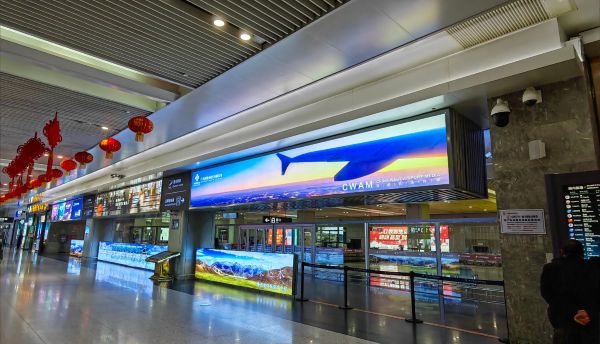
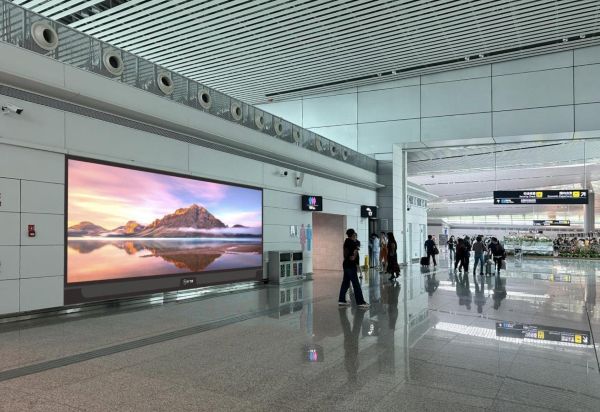
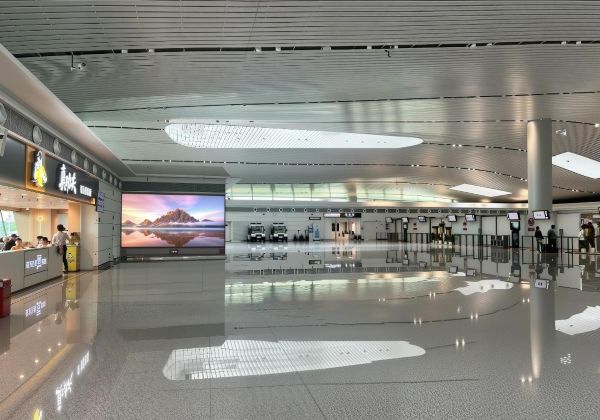
The giant LED screen in the departure hall is located at the starting point of the passenger flow, with unparalleled visual impact, used to create a stunning first impression of the brand and establish a high-end tone.
Panoramic column advertising on the corridor bridge: When passengers board the plane through the corridor bridge, they are surrounded by brand information in a panoramic manner, creating a strong sense of immersion.
2. Deep communication level media (transmitting information)
Digital screen display wall in waiting area: an area where passengers stay for a long time, suitable for playing brand feature films or in-depth product introduction videos for concept communication.
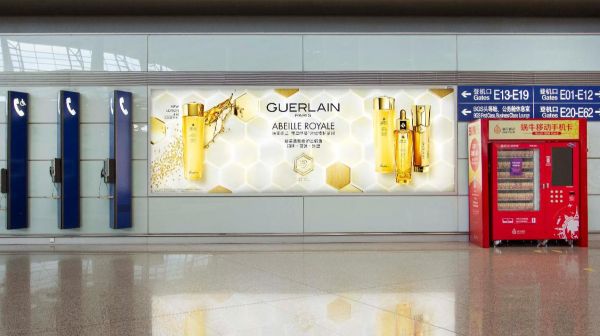
Arrival channel lightbox: the first scenery to welcome arriving passengers, suitable for promoting local high-end services, hotels, and tourist destinations.
3. Precise scene triggered media (guiding actions)
Exclusive area media: Advertisements in the first-class/business class lounge, reaching the private space of the highest net worth customer group.
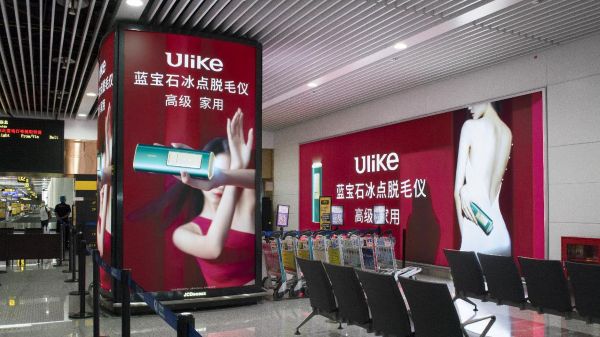
Handcart advertising: This is an often underestimated and efficient medium. For example, the advertising on hand carts at Capital Airport and Daxing Airport can accompany passengers throughout the entire process from check-in to boarding gate, especially covering the "decision-making blank period" when passengers go to the transportation center after luggage retrieval. At this time, passengers have clear demands for local transportation, hotels, and communication services, and the advertising conversion path is extremely short. It is flexible, precise, and capable of providing close companionship.
4. Digital interactive media (innovative experience)
AR interactive device/QR code experience: Using technology to turn static advertisements into experiential and interactive entrances, collecting sales leads or providing value-added services.
三、 The Four Step Delivery Method: A Scientific Path from Strategy to Execution
Step 1: Goal Setting and Strategy Selection
Firstly, clarify the core objective: to enhance international brand awareness, promote specific high-end products, or attract local service traffic? Goals determine everything. For example, luxury goods pursuing image should first choose the large screen in the departure hall; If car rental services pursue conversion, they should focus on layout of arrival channels and trolley advertisements.
Step 2: Media Evaluation and Portfolio Planning
Evaluation dimensions: Evaluate the audience fit of different media (who is watching?), scenario fit (what does he need at the time?), and cost-effectiveness.
Scientific combination: Avoid single placement. The combination of "air strike+ground infiltration" should be adopted. For example, using a large LED screen to establish brand height (aerial impact), while coordinating with handcart advertising and arrival channel lightboxes to achieve precise reach and action guidance (ground penetration).
Step 3: Creative Content: Tailored for the "Airport Mentality"
Airport advertising creativity must follow specific rules:
Vision first, 3-second principle: Use high-definition visuals with an international feel, and the core information (brand, product, proposition) must be clearly conveyed within 3 seconds.
Minimalist and dynamic information: Abandoning complex copy. A stunning image paired with a powerful slogan is far superior to a full screen of text.
Emotional connection, echoing the journey: Creativity should resonate with travel emotions such as "expectation of departure", "care of arrival", and "desire to explore".
Step 4: Execution, Monitoring, and Effectiveness Evaluation
Professional execution: Choose a reliable media agency to ensure the quality and timeliness of publication.
Effect tracking: Set measurable KPIs. For brand advertising, the brand search index during the advertising period can be monitored; For effective advertising, it is essential to use exclusive QR codes, discount codes, or appointment phone numbers to track the source of leads.

四、 Common Misconceptions and Avoiding Pits Guide
Misconception 1: Only recognizing large screens, ignoring combination and cost-effectiveness.
Correct answer: Giant LED screens are expensive in price. For many brands, combining the use of digital screens in the waiting area, arrival channel advertisements, and high-frequency trolley advertisements can often achieve more comprehensive and in-depth coverage with a more reasonable budget.
Misconception 2: Simply copying ideas without considering the uniqueness of the scene.
Correct answer: Simply compressing TV commercials or outdoor big brand materials for use in airports often fails due to differences in viewing distance, environment, and audience mentality. Creativity must be exclusively customized for airport passengers.
Misconception 3: Short term trial and expect immediate results.
Correct answer: Airport advertising is a brand asset investment that requires periodic mental precipitation. It is recommended to advertise at least quarterly in order to form a stable understanding. It is unrealistic to expect a single month explosion.
Misconception 4: Isolate airport advertising from the overall marketing strategy.
Correct answer: Airport exposure should be linked with online marketing. For example, adding social media topics to advertisements, directing offline traffic to online private domain pools, and achieving integrated conversion.
五、Conclusion
In summary, airport advertising is a systematic brand building project. It tests the brand's insight into high-end audiences, mastery of scenario marketing, and determination to make long-term strategic investments.
For beginners, do not hesitate because you feel "high-end", nor blindly immerse yourself because you don't understand the way. Starting from understanding its value and type, use scientific strategies to advance step by step.