Airport Advertising in China: A Strategic Guide for International Brands
2026-07-03Tianci MediaViews:44
Highlights
For international brands seeking to establish or expand their presence in the world’s second-largest economy, airport advertising offers an unparalleled opportunity. In 2025, China’s 270 civil transport airports handled a record 1.529 billion passenger trips. This massive scale, combined with the premium demographic profile of air travelers, makes airport advertising one of the most effective channels for brand building in China.
Why Airport Advertising Matters for International Brands
Chinese airports concentrate a uniquely valuable audience. According to industry data, China’s top ten airports carry 80% of all air passengers, with approximately 70% being business travelers—corporate executives, entrepreneurs, and decision-makers. This is precisely the audience that international brands need to reach: individuals with high purchasing power, influence, and the ability to drive both consumer and B2B purchasing decisions.
Beyond raw audience quality, airport advertising offers a “halo effect.” A prominent presence at China’s national aviation hubs signals brand strength, credibility, and long-term commitment—an intangible asset that is difficult to replicate through digital channels alone.
Which Airports Should International Brands Target?
Not all airports are equally valuable for international brand advertising. The strategic choice depends on your brand’s objectives:
Shanghai Pudong International Airport (PVG) ranks as China’s leading airport for international traffic. For brands targeting global travelers and cross-border business elites, PVG is the premier choice.
Beijing Capital International Airport (PEK) and Beijing Daxing International Airport (PKX) serve as China’s primary “national gateways,” attracting a high concentration of multinational executives and government officials.
Guangzhou Baiyun International Airport (CAN) serves as the gateway to the Greater Bay Area and a key entry point for international trade professionals.
Shenzhen Bao‘an International Airport (SZX) and Chengdu Tianfu International Airport (TFU) offer growing international connectivity with potentially more accessible entry points for brands targeting specific regional markets.
For premium positioning and maximum international exposure, prioritize Shanghai Pudong, Beijing Capital, and Guangzhou Baiyun. For cost efficiency or regional market entry, Shenzhen and Chengdu offer strong alternatives.
Key Advertising Formats
Chinese airports offer a comprehensive media mix that can be tailored to different campaign objectives:
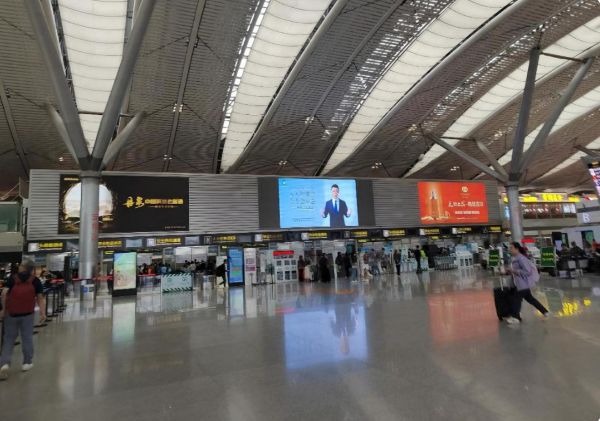
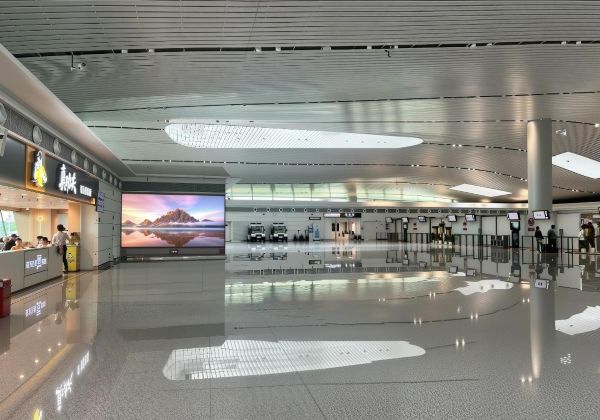
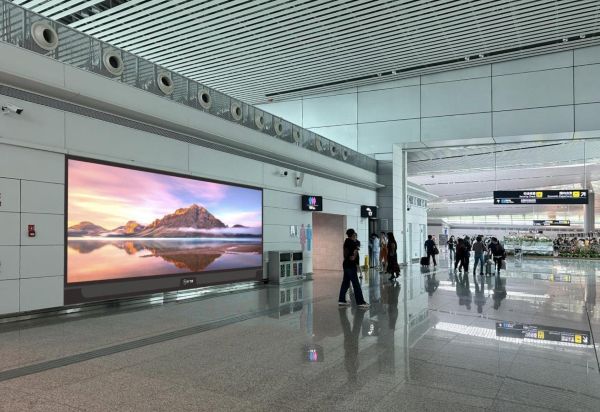
LED Mega-Screens – Monumental digital displays at check-in halls, security checkpoints, and baggage claim zones. These offer maximum visual impact and are ideal for brand storytelling. Guangzhou Baiyun Airport, for example, features the world’s largest terminal-based naked-eye 3D screen.
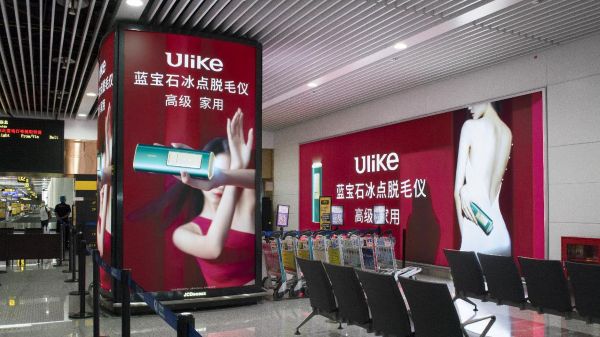
Security Checkpoint Media – Located in mandatory waiting zones where travelers spend 3–5 minutes with minimal distraction. This placement ensures near-zero ad avoidance.
Boarding Gate & Jet Bridge Displays – The last enclosed space before passengers board, offering extended dwell time and close-range exposure.
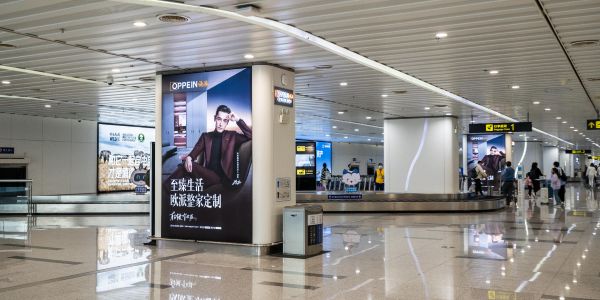
Baggage Claim Displays – Capturing arriving passengers during 15–20 minutes of relaxed waiting time, ideal for tourism, hospitality, and local service brands.
VIP Lounge Media – Precision targeting of the highest-net-worth travelers in a quiet, high-attention environment.
Digital Out-of-Home (DOOH) & Programmatic – Increasingly, Chinese airports are adopting programmatic DOOH capabilities. In 2025, 30% of Chinese companies had already deployed pDOOH domestically. This enables real-time creative optimization, audience targeting, and measurable campaign performance.
Strategic Planning and Execution
Understand the Passenger Journey
Effective campaigns follow the complete traveler flow: check-in → security → boarding → arrival → baggage claim. Each touchpoint offers different engagement opportunities. The departures area is ideal for building anticipation and brand awareness; the arrivals area is better suited for calls to action and conversion-oriented messaging.
Plan for Peak Seasons
Major travel periods—Spring Festival (January–February), summer holidays (July–August), and National Day week (October)—require booking 4–8 weeks in advance. These periods see significantly higher passenger volumes and correspondingly higher media demand.
Content Considerations for International Brands
Airport advertising content must comply with China’s Advertising Law. Key requirements include:
Truthfulness – Advertisements must not contain false or misleading claims.
Social Responsibility – Content must not violate social morals, infringe upon others‘ rights, or harm national security or public interests.
Cultural Sensitivity – For international airports serving diverse passenger populations, content should avoid cultural conflicts or inappropriate messaging.
Respect for National Symbols – Advertisements cannot misuse or disparage national symbols, flags, or emblems.
Compliance and Legal Requirements
Foreign enterprises conducting advertising in China must engage a locally registered advertising agency with appropriate qualifications. Key documentation typically includes:
Valid business license and tax registration
Product import licenses and customs documentation
Industry-specific certifications for sensitive categories (pharmaceuticals, food, alcohol)
The approval process involves content review by both the advertising agency and the airport media operator before publication.
Measuring Campaign Effectiveness
Modern airport advertising offers multiple measurement approaches:
QR codes and unique promo codes for direct attribution
Programmatic DOOH platforms providing real-time delivery and performance data
Post-campaign brand lift surveys conducted in-terminal
Geofencing with mobile attribution linking ad exposure to online actions
The Bottom Line
For international brands entering the Chinese market, airport advertising is not merely a media buy—it is a strategic investment in brand credibility and audience reach. By selecting the right airports, understanding passenger flow, and ensuring full compliance, brands can effectively engage China’s most influential travelers at the moment they are most receptive.