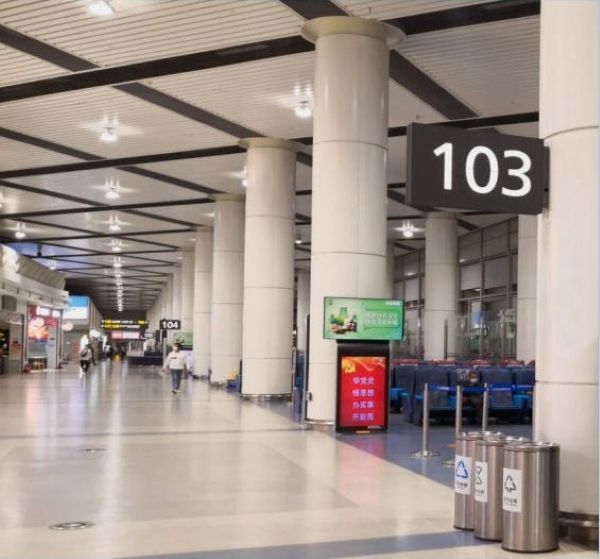

- Photos
- Specs
- Advantages
- Value
- Media Map
| Area:Taiyuan | Type:airport | Frequency:180 |
| Address:Taiyuan Wusu Airport | Format:TV | Duration:15s |
| Location:Gates T1 and T2 | Min Qty:30 | Operating Time:6-22o'clock |
| Size:55寸 | Min Period:year |
Positioned directly in front of the glass partition at boarding gates, the televisions enjoy unobstructed views with no interference and offer no option for avoidance. Information forcibly captures visual focus, achieving a reach rate close to 100%, far exceeding advertisements or audio announcements in the waiting lounge. All passengers have to stay in front of the televisions for 20–40 minutes before boarding. Within this psychological cycle of "waiting-verifying-preparing", passengers maintain high concentration. The televisions deliver dual sensory stimulation via dynamic visuals and voice announcements, greatly improving information retention.
All devices are installed close to boarding gates and waiting seats. After passengers sit down to wait, their eyes naturally level with the screens, free from obstructions by columns or walls. As short-distance media at boarding gates, these televisions enable passengers to receive information without deliberate observation. With a communication distance ranging from 3 to 8 meters, the screens deliver clear visuals and boast a far higher effective viewing rate than other media. All air passengers must enter the waiting area after security screening, enabling full coverage of departing passenger flow without omission.
High-definition vertical LCD digital signage is adopted, equipped with 55-inch high-definition display screens. A total of 30 units are arranged in a matrix layout, covering all major boarding gates in the east and west concourses of Terminal 1 and Terminal 2. There are no blind spots or visual barriers. The screens feature sharp image quality and high color reproduction, supporting playback of various materials including dynamic videos, graphic posters and scrolling captions.
The location layout covers all boarding concourses of T1 and T2 terminals, forming an in-terminal digital broadcast network. Advertisements can be precisely launched at a single location or released synchronously across all areas. Only passengers with valid boarding documents are allowed to enter this zone, which automatically filters non-relevant people such as greeters and send-offs, delivering a highly targeted audience. Passengers stay for an average of 30 to 90 minutes before boarding in a state of leisure waiting. They repeatedly view screen information at high frequency, so video advertisements deliver stronger appeal and remarkable information retention effects.
Relying on the airport's annual passenger throughput of tens of millions, this network precisely reaches all departing passengers after security check. It serves as a high-value short-distance brand communication medium at Shanxi’s provincial aviation hub. Devices are densely installed beside each domestic boarding gate and along waiting seat areas in T1 and T2 terminals. Closely matching core passenger waiting scenarios, the equipment supports both flight information display and commercial promotion with excellent scenario adaptability.
TV screen machines focus on penetrative communication featuring "high frequency and short viewing distance". While passengers queue up for procedures, their line of sight is usually level with or slightly above these screens. Whether showcasing new product launches or tourist destination promotional videos, the content played on TVs reaches audiences directly at an extremely close viewing distance. The "accompanying" viewing experience enables repeated and in-depth implantation of brand messages by making use of passengers’ fragmented waiting time.