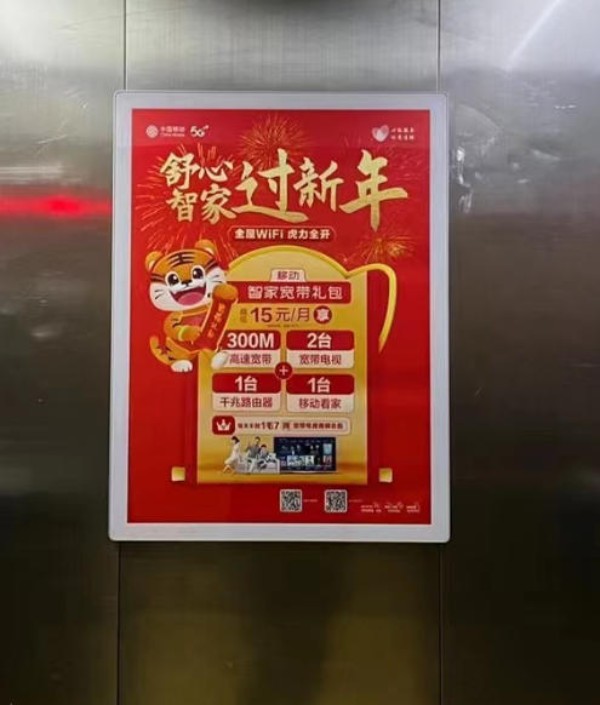

- Photos
- Specs
- Advantages
- Value
- Media Map
| Area:Guangzhou | Type:Elevator | Frequency:0 |
| Address:No. 3, Sanmalu, Zhusi Gang | Format:framework | Duration:0 |
| Location:Zhusi Gang Community | Min Qty:1 | Operating Time:0-24o'clock |
| Size:424mm×570mm | Min Period:week |
Located in the core of the Dongshan area in Yuexiu District, covering the Zhusi Gang First to Fourth Road sections, it is 365-452 meters from Dongshankou Station on Metro Lines 1 and 6, with 137 bus stops nearby. The area experiences dense daily cross-district commuter traffic, combined with a stable population of 4,616 residents, creating a high-traffic pool. It is adjacent to Dongshan Department Store and Wangfujing Department Store, and is close to top medical and educational resources such as Sun Yat-sen Medical University and Zhixin Middle School, with a strong consumer atmosphere and outstanding commercial value.
Advertising in elevator enclosed environments has a viewing rate of up to 95%, with an average dwell time of 15-30 seconds, making information transmission far more efficient than traditional media. Residents take the elevator 4-6 times daily on average, encountering advertisements 28-42 times a week, forming a complete cycle of “repeated exposure – memory reinforcement – decision influence.” In this single-media environment with no other advertising competition, attention to the ads is three times higher than in open shopping areas, with higher quality of information reception.
Elevators serve as the community’s “last 100 meters” consumer decision-making scenarios, where advertising information in enclosed spaces establishes a “mental property.” A single placement can reach multiple exposures, offering long-term returns that enable brand equity to accumulate, be inherited, and increase in value.
With its core location in Dongshan, Yuexiu District, high-net-worth government and enterprise audience, compulsory-viewing communication feature, and exceptional cost-effectiveness, its investment value is reflected in four key dimensions: precise access to household decision-makers, controllable costs, short return cycles, and accumulation of brand equity.
Static frame advertisements have a repetitive reinforcement effect, with an average daily exposure time of about 1.9 minutes, accounting for nearly a quarter of consumers' total daily ad exposure time. Brands can leverage a 'frame ad–offline store' linkage to guide residents to nearby consumption, converting community traffic into business district footfall. This is particularly suitable for local merchants such as nearby educational and training institutions, chain restaurants, and fresh food supermarkets, creating a 'last-mile' marketing loop.
With the core advantages of 'native scenes, precise targeting, and high cost performance,' it not only resolves the inefficiency of traditional ads that 'broadcast widely,' but also avoids the interference of 'information overload' in online advertising. It becomes an effective media choice for brands to establish stable recognition and drive actual consumption in old urban districts. Each advertisement, through its unique community scene value, injects lasting momentum into brand marketing.
Relying on five key strengths—prime locations in Yuexiu District, high-net-worth audiences, compulsory exposure in enclosed spaces, high-frequency visibility, and cost-effectiveness—it becomes a high-quality media choice for brands to deeply cultivate community markets and enhance terminal conversion. Its stable audience structure and efficient communication effect make it especially suitable for advertisers needing long-term brand building and precise marketing. It is one of the must-have media channels for mid-to-high-end brands to reach core consumer groups in Guangzhou.
With six major value points—precise target audience, high-frequency reach, high cost-effectiveness, geographic coverage, community trust, and asset appreciation—this repetitive reinforcement characteristic can increase brand recall by more than three times, build long-term brand equity, and achieve the compounding growth of investment value.