Beijing Bus Station Advertising Guide: A Complete Guide from Point Selection to Publication
2026-03-24Tianci MediaViews:118
Highlights
Want to advertise at Beijing bus stations but don't know where to start? This article teaches you step-by-step how to avoid pitfalls from form selection, point evaluation, creative design to effect review. Tianci Media is a professional public transportation advertising platform. Consult now for exclusive solutions!
Every day, nearly 8 million people in Beijing take buses to shuttle through this millennium old capital city. From Chang'an Avenue to the Third Ring Road, from Financial Street to Zhongguancun, bus stops have become one of the most densely populated nodes in the city. Bus stop advertisements (bus shelter lightboxes) are the best touchpoints for brands to "face" these mobile populations.
For beginners who are new to Beijing, facing thousands of bus stops, complex regional grading and pricing systems, they often don't know where to start. This article provides you with a complete guide to advertising at Beijing bus stations, taking you through every step from form selection, location evaluation, creative design to advertising execution.
1、 The Two Mainstream Forms of Advertising at Beijing Bus Stations
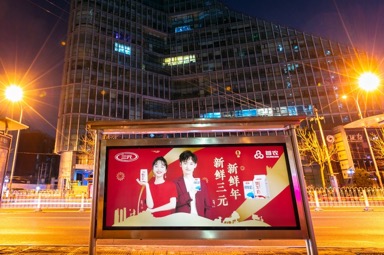
Bus shelter lightbox advertisement: located in the bus stop shelter, the screen size is usually 3.5 meters by 1.5 meters, with built-in LED lighting, visible 24 hours a day. This is the most mainstream form of advertising at Beijing bus stations, with strong visual impact and long dwell time (average waiting time of 3-5 minutes), suitable for brand image display and deep communication.
Solar powered station signs/box type station signs: distributed on streets throughout the city, with small sizes and affordable prices, suitable for wide coverage and supplementary accessibility. There are a total of 1798 solar power station signs in the city, with a release fee of about 650 yuan/block/month.
2、 Core price reference and influencing factors
The price of advertisements at Beijing bus stations is mainly determined by the regional level - the more bustling the location, the higher the price.
Core areas (Guomao, Xidan, Financial Street, Wangfujing, etc.): The published price is about 34000 yuan/month/block, and the discounted price is about 9800 yuan/month/block.
General area: Prices decrease gradually, with prices getting cheaper towards the outer ring. In some remote areas, prices can be as low as several thousand yuan.
Solar power station signs: 650 yuan/block/month, covering 152 streets in the city.
The price difference mainly comes from the following variables: administrative area and location value, station pedestrian density, advertising space visibility, advertising period (discounted for more than 3 months), and purchase quantity (bundled purchase with multiple stations is more favorable).

3、 Six Steps to Complete Advertising Placement at Beijing Bus Stations
Step 1: Clarify the target and audience portrait
Before contacting any supplier, ask yourself three questions:
Purpose of advertising: brand exposure, new product launch, event traffic or store promotion?
Target audience: Business elites in Financial Street, young consumers in Xidan, or families around the community?
Budget range: The starting threshold for advertising at bus stops is relatively low, and the monthly cost of a single lightbox is several thousand to tens of thousands of yuan. It is recommended to reserve 50000 to 200000 yuan for the first time and select 3-5 core stations for advertising for 3 months.
Step 2: Scientific screening of sites - location determines value
There are numerous bus stops in Beijing, and different areas are suitable for different targets:
Guomao/CBD region: covering white-collar and business professionals, suitable for finance, automotive, and high-end services.
Xidan/Wangfujing: Covering young consumers and tourists, suitable for fashion, beauty, catering, and entertainment.
Financial Street: Covering financial practitioners and corporate executives, suitable for private banks and high-end wealth management.
Zhongguancun: covering technology practitioners and college students, suitable for digital, education and Internet services.
Surrounding communities (such as Huilongguan and Tiantongyuan): covering family groups, suitable for education and training, home decoration, and local living services.
Suggestion: Personally go to the target site to observe and feel the traffic and crowd characteristics at different times.
Step 3: Determine the form and cycle of advertising placement
Choose the most suitable form based on budget and goals:
Limited budget (within 50000 yuan): Choose 1-2 core station shelters or expand coverage by combining solar powered station signs.
Medium budget (100000-200000 yuan): Choose 3-5 core station bus shelters and deploy them for 3 months.
Adequate budget (over 200000 yuan): Select the waiting shelters along the entire core line to create regional momentum.
Cycle recommendation: Invest for at least 3 months. Bus stop advertisements require time to accumulate effects, and residents along the route need sufficient frequency to form memories.
Step 4: Creative Design - Customize Outdoor Scenes
The viewing scene of bus stop advertisements is "waiting", where the audience has relatively sufficient time, but the advertisement still needs to quickly capture attention.
The 3-second rule: Three things must be conveyed within 3 seconds - the brand logo (should be large), the core message (should be short), and the action instructions (should be clear).
Design points:
The screen is concise, with one image, one text, and one action
Strong color contrast and clear recognition even at night
The font is large enough to be read from a distance
QR code can be added for convenient scanning and interaction
Technical requirements: Resolution not less than 150dpi, color mode CMYK, strictly designed according to the size provided by the media (3.5m × 1.5m) and safety frame requirements.
Step 5: Select a service provider and execute the advertising campaign
The advertising resources of Beijing bus stops are mainly operated by official institutions such as Beijing Bus Media Co., Ltd. (Beibu Media). Ordinary advertisers usually advertise through professional agencies.
Delivery process:
Consultation and communication to understand the quotation and schedule (it is recommended to book 1-2 weeks in advance)
Sign the contract, clarify the location, cycle, and cost details (confirm whether it is a "full package price")
Design advertising materials and output files according to technical requirements
Submit to relevant departments for review (to ensure compliance with advertising laws and urban management regulations)
Pay the fees and produce the publication
Obtain the publication monitoring report (photos with time watermark and location)
Review of the effect after the completion of the placement
The benefits of finding a professional agent: The professional platform has a city wide site database and rich advertising experience, which can provide one-stop services from demand analysis, site recommendation to creative execution and effect tracking.
Tianci Media is a professional public transportation advertising platform that has been deeply involved in Beijing's public transportation media for many years. It has lightbox resources covering core areas and community stations, and can provide customers with authentic and transparent quotes and scientific advertising recommendations.
Step 6: Effect Evaluation and Review
After the placement is completed, evaluate the effectiveness from the following dimensions:
Exposure data: touchpoints, CPM (cost per thousand people)
Interactive data: QR code scanning volume, consultation volume, visit volume (if there is a dedicated QR code)
Brand data: changes in search index, popularity research
Based on the review results, optimize the site, cycle, and creativity for the next advertising campaign.
4、 The 4 easiest pitfalls for beginners to step into
Pit 1: Only focus on price and ignore the value of the site. The cheapest site may be located in the suburbs, with sparse daily foot traffic and limited exposure effect. Although the unit price of stations in the core business district is high, the effective outreach cost may be lower. We should evaluate using 'effective cost per thousand people' instead of simply comparing prices.
Pit 2: Neglecting the cost of production and installation. The media release fee on the quotation usually does not include production costs. The production cost of the lightbox is about 2000-5000 yuan per piece, and a separate budget is required. Confirm the "all inclusive price" before signing the contract, including media fees, production fees, initial installation fees, and taxes.
Pit 3: The advertising cycle is too short. Trying to invest for a month is difficult to achieve results. Bus stop advertisements require a cumulative effect over time, with at least 3 months of investment. Due to limited budget, it is better to reduce the number of sites than to extend the cycle.
Pit four: Neglecting compliance. The setting of outdoor advertising must comply with the Special Plan for the Setting of Outdoor Advertising Facilities in Beijing. Before signing the contract, it is necessary to confirm whether the location is included in the plan to avoid the risk of "gray" locations being demolished.
5、 Conclusion
Beijing bus stop advertising is essentially about allowing brands to meet their target audience time and time again at the nodes of the city's arteries while waiting. For beginners, the key to success lies in: clear goals, scientific selection of points, creative adaptation, professional execution, and reserved cycles.
Suggest starting with small-scale testing: select 3-5 core sites, advertise for 3 months, and track the effect with a dedicated QR code. On the basis of data support, gradually scale up the scale.
Tianci Media is a professional public transportation advertising platform that provides one-stop professional services from demand analysis, location evaluation, creative execution, and effect tracking. Consult now to obtain your exclusive advertising placement plan for Beijing bus stations!