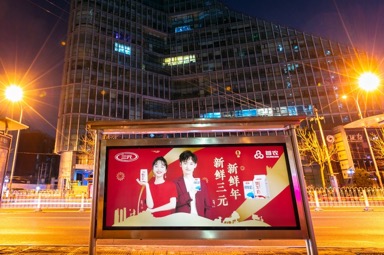
Bus Advertising Placement: Letting the Brand Pulse Along with the City's Rhythm
2026-05-28Tianci MediaViews:102
Highlights
In today's era where digital advertising costs are constantly rising and users' attention is fragmented, bus advertising placement, as a "evergreen" traditional outdoor media, is regaining the favor of brand owners by virtue of its mandatory reach, high repeated exposure, and localized coverage capabilities.Each bus, traveling along the main roads, commercial areas, and residential districts of the city, is not only a means of transportation but also a mobile display wall for the brand.
1. Why are bus advertisements still effective?
Many marketers would ask: "Everyone is using their phones. Who is still watching the bus?" The data provides a different answer: A single bus can cover approximately 10,000 to 30,000 people per day. Its routes pass through schools, hospitals, commercial districts, and office buildings, forming a natural closed-loop of daily activities. The advantages of bus advertisements lie in three points:
Highly compulsive display - During waiting at the bus stop, while waiting for the traffic light to change, or during traffic jams, passengers and passers-by will inevitably come across the vehicle's display screen.
High-frequency repetition - Buses on the same route pass through the same area multiple times each day, strengthening brand recognition.
Localized precision - Routes can be customized for specific urban areas, communities or business districts. For example, educational institutions can be targeted with routes around their campuses, and food brands can be targeted with routes along food streets.
II. Common Forms of Bus Advertisements (with Illustrations)
Advertising on buses is not limited to the "covering the entire vehicle body" method. Depending on the budget and purpose, you can choose from the following options:
Full vehicle color stickers: Covering all parts of the vehicle except the doors and windows, they offer the strongest visual impact. Suitable for new product launches or large-scale promotions.
Three-side display panels: Only attached to the sides and rear of the vehicle. Affordable, preserving the original factory paint, suitable for long-term deployment.
In-car media: This includes hand straps, seat backs, in-car TVs and voice station announcements. These forms directly reach the passengers and have a short conversion path.
Tail LED screen: Plays short text or QR codes in a scrolling manner, especially suitable for guiding online interactions (such as公众号 subscription, prize draw entry).
III. How to formulate an efficient bus advertising placement strategy?
A successful bus advertising placement is not as simple as "just choosing a route and done". It requires five steps:
Step 1: Identify the target audience and route matching
If selling children's educational products, prioritize routes that pass through primary schools, children's museums, and large communities.
If it is about local life services (such as housekeeping and decoration), choose a mixed route that combines the old city area with new residential areas.
Step 2: Creative Design - Understandable from 10 Meters Away
The reading time for bus body advertisements is usually only 3-5 seconds. Please follow the principle of "large fonts, large color blocks, large logos". Avoid filling the space with dense text or small-sized QR codes.
Step 3: Select the投放 period
Explosive type: Allocate 4 weeks for full city coverage during festivals or events.
Continuous type: More than 12 weeks. Suitable for brand image building. Calculated based on weekly average cost, it actually saves more money.
Step 4: Combined Promotion
Link the bus body, the light box of the waiting shelter, and the interior handles for joint promotion. For instance, the waiting shelter announces "The XXX brand special line is approaching the station", while the bus body enhances the visual effect, and the interior handles provide the discount code, forming a closed loop.
Step 5: Effect Monitoring and Optimization
Traditional outdoor advertising has often been criticized for being "difficult to track". Nowadays, it can be evaluated through customized URLs, exclusive QR codes, or even comparing sales in different areas. It is recommended to test different creative ideas in two separate routes within the same city and observe changes in consultation volume.
IV. Budget and Cost: Are Bus Advertisements Expensive?
Many people mistakenly believe that bus advertisements are extremely costly. In fact, when calculated based on cost per thousand impressions (CPM), bus body advertisements are often lower than local information flow advertisements. Taking domestic second-tier cities as an example:
The full-body color stickers for a single bus are placed for 4 weeks, with the cost ranging from 8,000 to 15,000 yuan. This covers approximately 500,000 people's exposure, and the CPM (cost per mille) is only 16 to 30 yuan.
In contrast, the CPM (cost per mille) for information flow advertisements in the same city is often as high as 40-60 yuan, and they also face issues such as ad blocking and user skipping.
For small and medium-sized businesses, they can also opt for the "shared ride" model - sharing the rotation schedule of a bus route with multiple brands, or only installing interior handrails (a single handrail costs only a few hundred yuan for 4 weeks).
V. Real Case: How Local Restaurants Use Bus Advertisements to Achieve Queuing at Their Stores?
A new tea-drinking brand opened three new stores in a second-tier city. They chose to place advertisements on the bodies of 10 bus routes that passed by university campuses, office buildings, and shopping centers. The creative approach involved using an oversized "Buy One Get One Free" text and cup-shaped patterns, along with the text "Get a Coupon on下车" to guide customers. After two weeks of placement
The store's customer flow has increased by 40%.
The number of coupons available for scanning and redeeming has exceeded 8,000.
The write-off rate is as high as 62%.
The brand's marketing director concluded: "The bus advertisements enable our brand to 'circulate' in the city every day. They are more proactive than the fixed big advertisements and more genuine than online advertisements."
VI. Common Mistakes in Bus Advertising Placement (Avoiding Pitfalls Guide)
Mistake 1: Too Much Information in the Picture → Many advertisers want to include addresses, phone numbers, event details, QR codes, spokespersons... The result is that the text is so small that it's impossible to read. In a word: Only present one core benefit point.
Misconception 2: Focusing on only one route → One route has a very narrow coverage area. It is recommended to have at least 3 to 5 different routes that lead in different directions to form a network.
Myth 3: Ignoring vehicle operation time → Some bus routes have few night services. If your brand focuses on the night economy, please prefer to choose the routes that operate until 23:00.
Conclusion
Bus advertising placement is not a relic from the old era; rather, it is the core component of "mobile outdoor media". When brands learn to select routes based on data, create eye-catching content, and adopt combined strategies to achieve conversions, buses can become your most reliable "roadshow stage". If you are planning your next wave of local marketing, consider starting with the bus bodies on a major urban thoroughfare - let the brand follow the heartbeat of the city and enter thousands of households.
Need to customize the advertising plan further? Please leave your industry and budget in the message, and we will provide you with line matching suggestions. Or you can directly contact us to obtain the bus advertising media quotation sheet.