Don't be fooled by the quotation! The real price of bus advertisements, this article will help you figure it out
2026-03-18Tianci MediaViews:139
Highlights
How to calculate the quotation for bus advertising? The prices of car bodies, bus shelters, and in car televisions vary greatly. This article helps you clarify the pricing logic from three dimensions: form, city, and route. Tianci Media is a professional public transportation advertising platform that provides authentic and transparent pricing solutions.
I want to advertise on buses, but I'm confused about the price list - some advertise on the bus body, some advertise for thousands, while others advertise for tens of thousands. What's the difference
This is the real confusion that many beginners face when it comes to bus advertising pricing. Bus advertising comes in various forms and has a complex pricing system. Without a clear understanding of the logic behind the pricing, it is easy to spend more money unnecessarily.
This article will help you thoroughly understand the pricing structure of bus advertising from four dimensions: advertising form, city level, route value, and advertising cycle, so that you can understand the quotation and calculate the cost-effectiveness from the first time you advertise.
1、 The core components of bus advertising pricing
The quotation for bus advertising consists of two main parts.
The media publishing fee is the main cost on the quotation, calculated based on the advertising form, city level, route value, and advertising period, which determines the basic exposure value of the advertisement.
The production and installation fee refers to the cost of creating advertising visuals and installing them for publication, which usually requires a separate budget. The production cost for a full car advertisement is about 3000 to 8000 yuan per vehicle, and for a half car advertisement it is 1500 to 4000 yuan per vehicle.
2、 Price difference based on advertising format
Vehicle advertising has the strongest visual impact. Full vehicle advertising covers both sides of the vehicle, the rear, and some of the front of the vehicle. The cost for core routes in first tier cities is about 30000 to 80000 yuan per vehicle per month, and 10000 to 30000 yuan per vehicle per month in second - and third tier cities.
Half pack advertisements cover the main areas on both sides of the vehicle, offering high cost-effectiveness. First tier cities charge 15000 to 40000 yuan per vehicle per month, while second - and third tier cities charge 5000 to 15000 yuan per vehicle per month.
Advertisements on both sides of the vehicle cover specific areas, resulting in lower costs. First tier cities charge 8000 to 20000 yuan per vehicle per month, while second - and third tier cities charge 3000 to 8000 yuan per vehicle per month.
The advertising area at the rear of the car is small, targeting vehicles and pedestrians behind. First tier cities charge 5000 to 12000 yuan per vehicle per month, while second - and third tier cities charge 2000 to 5000 yuan per vehicle per month.
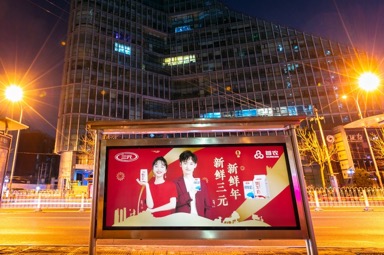
The price of lightbox advertisements in bus shelters varies by city. The published price in the core area of Beijing is about 34000 yuan per month, with a discounted price of about 9800 yuan per month. The core site in Dongguan costs about 8000 yuan per piece per month. Beijing solar power station signs cost about 650 yuan per piece per month.
There are various forms of media in the car. In terms of on-board televisions for buses, the procurement case of Gansu CDC shows that the price of package eight is 7000 yuan per week. The seat advertisement costs about 1800 yuan per vehicle per month, and the in car lightbox costs about 2000 yuan per vehicle per month.

3、 Price gradient by city level
First tier cities (Beijing, Shanghai, Guangzhou, Shenzhen) have the highest prices, with full vehicle advertising on core routes costing 30000 to 80000 yuan per month.
The prices in new first tier and second tier cities (such as Chengdu, Hangzhou, Wuhan, Nanjing, etc.) are about 60% to 70% of those in first tier cities.
Third - and fourth tier cities account for approximately 30% to 50% of first tier cities. The advertising on Chongqing's bus billboards costs only 580 yuan per side, while the banner advertising costs 1600 yuan per vehicle per month.
4、 Price classification based on line value
Within the same city, the quotes for different routes may vary several times. Taking Changsha as an example, the price of A++level gold lines is 20000 yuan per unit per month, A+level lines are 19000 yuan per unit per month, and A+level regular lines are 18000 yuan per unit per month.
The routes passing through core business districts, urban main roads, government agencies, and key office buildings have much higher exposure value and prices than ordinary routes.
5、 Viewing discount patterns based on advertising cycles
Bus advertisements are usually placed on a monthly basis, and the longer the period, the greater the discount.
The highest price for one month of advertising is difficult to obtain discounts. The unit price usually decreases by 10% to 15% after being placed for more than 3 months. Discounts of up to 20% to 30% can be obtained after 6 months or 1 year of advertising, and value-added services such as priority line selection and free picture exchange can also be obtained.
6、 How to understand the quotation and make scientific decisions
The first step is to clarify goals and budget. Ask yourself three questions: Who are the target customers? Where did they appear? What is the budget?
The second step is to determine the advertising format. Due to limited budget, a combination of car tail stickers and bus shelters can be selected. Medium budget options include half package or full vehicle advertising focusing on 3 to 5 golden routes. With sufficient budget, multiple advertising routes can be selected for the entire vehicle to form a network coverage.
Step three, filter matching routes. Financial brands prioritize the CBD ring road, educational institutions focus on school district routes, fast-moving consumer goods focus on community life circles, and home building materials choose routes that pass through large residential areas.
Step four, calculate the actual cost. The total cost is equal to the media publishing fee plus production and installation fee plus taxes. Before signing the contract, it is necessary to confirm whether the quotation includes production and installation costs. The production cost usually accounts for 15% to 35% of the total cost.
Step five, evaluate cost-effectiveness. Calculate CPM, which is the cost per thousand people. The formula is the monthly fee per point divided by the average daily flow multiplied by 30 divided by 1000. The CPM advantage of bus advertising is obvious, with data showing only 1.19 yuan.
7、 The 4 easiest pitfalls for beginners to step into
The first pitfall is to only consider the price and not the value of the route. The cheapest route may pass through remote areas with sparse passenger flow. The method of avoiding pitfalls is to evaluate "effective traffic" rather than absolute price, using CPM for horizontal comparison.
The second pit, ignoring the production and installation costs. The media release fee on the quotation usually does not include production costs. The method of avoiding pitfalls is to confirm whether the media fees, production fees, installation fees, and taxes are fully covered before signing the contract.
The third pit is designed to be too complex. The bus is moving, the audience is also moving, and the complex details are meaningless. The method of avoiding pitfalls is to adhere to the "three second principle", with a large brand logo, a short core slogan, and strong color contrast.
The fourth pitfall is that the advertising cycle is too short. Trying to invest for a month is difficult to achieve results. The method of avoiding pitfalls is to invest for at least 3 months. If the budget is limited, the number of lines can be reduced and the cycle can be extended.
8、 Conclusion
Bus advertising quotations may seem complex, but as long as you master the four dimensions of form, city, route, and cycle, you can understand the logic behind the quotation.
For beginners, it is recommended to start with small-scale testing: select 2 to 3 core routes, deploy them for 3 months, verify their effectiveness, and then gradually scale them up.
If you find these analyses too complex, finding a professional advertising platform is a more efficient choice. Tianci Media is a professional public transportation advertising platform that has been deeply involved in national public transportation media for many years. It has a route database covering major cities and rich advertising experience. We will provide authentic and transparent quotes and scientific advertising recommendations based on your budget and goals, helping you avoid various pitfalls and ensure that every penny is spent wisely. Consult now for your exclusive bus advertising placement plan!