Are you afraid of being scammed when placing elevator advertisements? Explain all cost components and price traps in one article
2026-01-29Tianci MediaViews:149
Highlights
Simply put, elevator advertising does not have a fixed price, and its cost is a complex formula determined by four variables: advertising form, urban location, building quality, and advertising strategy.
1. Two mainstream billing models and price ranges
There are currently two main forms of advertising in the market, with completely different billing logic:
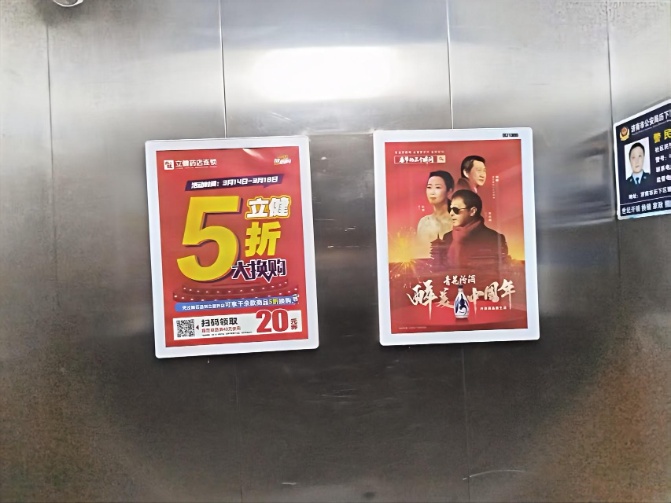
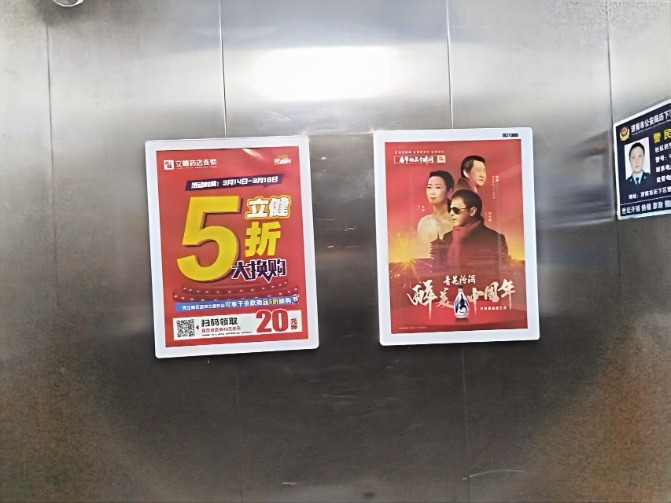
Elevator frame advertisement (static poster)
Billing model: The core is "rental location". Calculate based on the weekly or monthly usage fee for a single advertising box.
2026 price range: This is the form with the largest price difference.
In third - and fourth tier cities or old residential areas, the monthly cost of an advertising box may be as low as tens of yuan.
In ordinary residential or office buildings in second tier cities, the mainstream price is usually between 200 yuan and 600 yuan per month. For example, according to the open bidding price limit for elevator advertising spaces in some cities, the tax inclusive price limit in Xuchang, Henan is about 200 yuan/block/month, while the tax exclusive price limit in Luoyang, Henan is about 94.3 yuan/block/month, reflecting the basic cost of bulk procurement.
In high-end communities and core commercial districts of first tier or new first tier cities, prices can easily exceed a thousand yuan per month.
Elevator digital screen advertisement (dynamic video)
Billing model: The core is "buying data". Usually sold according to CPM (cost per thousand impressions) or packaged as a package that covers XX people.
2026 price range: This is currently the fastest growing form, and due to its technological content and better dynamic display effect, its unit price is usually higher than that of static frameworks.
The monthly fee for regular locations may be in the hundreds of yuan.
In high-quality commercial districts or landmark office buildings, the monthly cost of a single digital screen can reach thousands of yuan, usually several times the price of a static frame.
2. The four key factors that determine the price level
Why is the price range so large? Mainly focus on the following four points:
City and location: These are the primary determining factors. The price of elevator advertisements in Beijing Guomao office buildings may be dozens of times higher than that of a residential area in a certain county. The core resources of first tier cities are always scarce and expensive.
Building quality and audience: Residents of high-end commercial housing and Grade A office buildings have strong purchasing power, making them a must compete area for brands such as automobiles, finance, luxury goods, etc. Therefore, media prices have also skyrocketed. On the contrary, ordinary or old communities have lower traffic value and more affordable prices.
Scale and cycle of advertising: Media companies prefer long-term, large-scale orders. If you can package multiple elevators within a single area or sign quarterly or annual contracts, you can usually receive significant discounts, thereby significantly reducing the average cost of a single location.
Media company brand: Top media companies (such as Focus, New Tide, etc.) usually offer higher prices than regional small media companies due to their wide network coverage, strong technical capabilities, and more complete effect monitoring systems, but their service standardization and reliability are also higher.
Market Trends in 2026 and Your Response Strategies
Understanding industry trends can help you make wiser budget decisions:
Intelligence and digitization are the absolute mainstream: by 2026, the proportion of digital intelligent screens in elevators has significantly increased, expected to account for over 35% of the total market. Its advantages lie in the ability to remotely change images with one click, dynamically update content, and carry interactive functions. The advertising effect and flexibility far exceed static frameworks.
The measurement of effectiveness has shifted from "exposure" to "mentality": Industry evaluation standards are shifting from simply "how many times have they been played" (CPM) to focusing on the improvement of brand awareness and favorability through advertising, that is, the establishment of "intellectual property rights" (CPE).
Scene based precise advertising has become possible: Through technology, customized advertising content can be played for different buildings during different time periods (such as morning and evening rush hours) to achieve more accurate reach.
📝 2026 Action Guidelines and Cost Self Inspection Checklist
When you are ready to advertise, you can follow these steps:
Clarify your own needs: First, think about who your brand wants to reach (housewives? Young white-collar workers?), what areas it will focus on, and whether its core goal is to increase visibility or promote sales and attract traffic.
Obtaining Transparent Quotations: When contacting media companies, it is essential to request a "detailed quotation" that includes specific property names, estimated daily foot traffic, advertising formats, unit prices and total prices for individual locations, rather than just a vague "package price".
Pay attention to contract details: Confirm whether the quotation includes advertising image design and production fees, publication installation fees, and post production monitoring report fees (such as digital screen playback proof, framework publication photos).
Set up effect tracking method: Design effect verification methods before advertising, such as using dedicated discount codes, QR codes, or monitoring the brand's search popularity changes in the target area during advertising.
In summary, in 2026, the core of elevator advertising budget planning is to pursue "precise matching" rather than "casting a wide net". Concentrating limited budget on "high-quality buildings" and "digital smart screens" that highly overlap with your target customer profile will result in a much higher return on investment than blindly pursuing coverage.
If you could provide me with an approximate target city, industry, and budget range, I can offer you more targeted analysis and channel recommendations.