

Beijing Elevator Advertising Price Perspective: Precise Budget and Placement Guide for 2026
2026-01-27Tianci MediaViews:134
Highlights
Do you want to know the specific price of elevator advertising in Beijing? This article provides a detailed explanation of the pricing methods, price ranges, influencing factors, and negotiation skills for elevator advertising in Beijing's communities and office buildings in 2026, to help you accurately formulate budgets and achieve efficient advertising. Get accurate quote estimation immediately!
When you are considering finding a stable and high-frequency offline traffic entrance for your brand in Beijing, elevator advertising is almost a must-have option. However, faced with market quotes ranging from a few thousand yuan to hundreds of thousands of yuan, many market leaders are confused: "How much does it cost to advertise in elevators in Beijing? Why is the price difference so huge
Directly asking "how much does it cost per square meter" or "how much does an elevator cost" is like asking "how much does it cost to buy a house in Beijing", and cannot get an effective answer. The price of elevator advertising in Beijing is a complex function determined by multiple variables such as location, form, duration, and quantity. This article will break down this function for you, transforming you from a "novice" to an "expert" who can accurately budget and negotiate.
Understanding the core of price: not 'buying location', but 'buying attention'
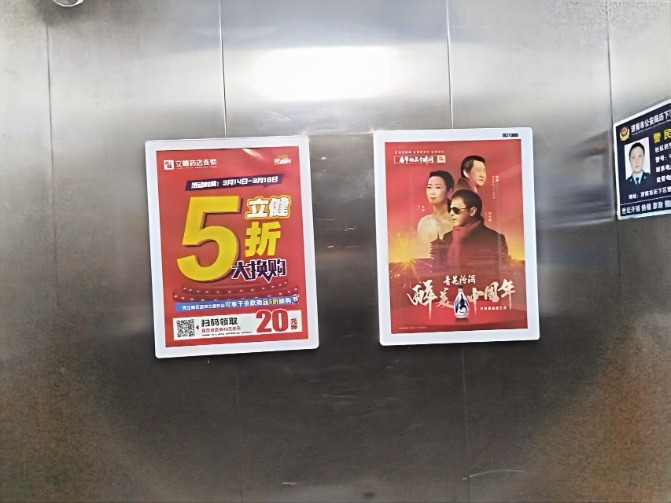
Firstly, a fundamental understanding must be corrected: what you are paying is not the physical space rent for that advertising space, but rather the attention span and exposure frequency of the target audience. Therefore, all pricing logic revolves around this.
The two basic components of price
1. Media release fee
This is the main cost, which is the fee paid to media companies such as Focus Media, New Wave Media, or regional media agents to publish advertisements in designated elevators. There are mainly two pricing methods:
Pricing by week/month: mainstream method. For example, in the high-end community around Guomao in Chaoyang District, Beijing, a frame advertising space for an elevator costs about XXX yuan per month.
Package pricing based on "frame number" or "point number": for example, "100000 yuan package, including 500 elevator frame advertising spaces in 50 communities in Haidian District, with a placement period of 4 weeks".
2. Advertising screen production and installation fees
This part is often overlooked by first-time advertisers.
Production cost: Depending on the material (such as high-definition printing, soft film), size, and complexity of the process, the production cost of a single frame image ranges from tens to hundreds of yuan.
Installation and maintenance fees: Media companies are usually responsible for the initial installation, but may charge fees. The contract should specify the responsibility and cost for subsequent screen replacement and damage maintenance.
Five key variables that affect prices
It is the combination of the following variables that leads to significant differences in prices.
Variable 1: Regional Value - The 'Geographic Ladder' from the Second Ring Road to Beyond the Sixth Ring Road
The advertising prices of elevators in Beijing show a clear concentric circle distribution. The core business district and high-end residential area have the highest prices.
Top commercial districts (Guomao, Financial Street, Zhongguancun, etc.): The price of office building elevators can reach several times that of the community, and the monthly cost of a single elevator may be as high as thousands to tens of thousands of yuan.
Core urban areas (Dongcheng, Xicheng, Chaoyang, Haidian hotspots): Mature high-end communities and Grade A office buildings are high priced.
Emerging urban areas and large residential areas (such as Wangjing, Tongzhou, Changping Huilongguan, etc.): densely populated and relatively cost-effective, they are the focus of saturation attacks by many brands.
Suburban districts and counties: The lowest price, but it needs to be evaluated for compatibility with the target customer group.
Variable 2: Real estate/building quality - the direct measure of "value"
Within the same area, the quality of the building itself is the pricing core.
Community: The core evaluation indicators include the level of property fees, household density, average housing prices of homeowners, and vehicle prices. A community with a property fee of 10 yuan per square meter per month is much more expensive than a community with a fee of 2 yuan per square meter per month.
Office buildings: divided into Class A, 5A, Class B, etc. The industry and scale of the companies inside the building (Fortune Global 500, density of listed companies) directly affect the audience value and foot traffic, thereby determining the price.
Variable 3: Advertising Form and Position - Attention Battle
The ability to capture attention varies in different positions inside and outside the elevator, and the price also varies (usually in descending order of premium ratio):
Intelligent screen (video) inside the elevator car: forced viewing, combining sound and image, with the strongest effect and the highest unit price.
Elevator door stickers (inside and outside): The action of opening and closing doors brings natural attention, especially the outer door stickers.
Elevator waiting hall intelligent screen (video): the focus of attention during waiting.
Elevator car frame (static poster): Classic form, high cost performance, divided into horizontal and vertical versions.
Elevator car door frame sticker: The visual area is relatively small.
Variable 4: Advertising Scale and Duration - Discount on Quantity
Media procurement follows the principle of 'quantity is preferred'.
Scale effect: The average price of a single elevator with 100 units deployed is much lower than the average price of only 10 elevators deployed. Media companies are willing to offer discounts for packaged purchases.
Duration effect: Signing long-term contracts for 3 months, 6 months, or 1 year typically results in additional discounts and cost lock-in compared to investing only for 1 month.
Variable 5: Agency Level and Negotiation Timing
There may be differences in price and flexibility when working directly with media headquarters, local branches, or third-party agencies. In addition, at the end of the year or quarter, media companies often have greater negotiation space when striving for performance.
Four steps to develop your precise budget plan
Step 1: Clarify the target and audience portrait
This is the starting point for all decisions. Does your brand want to reach financial elites, Internet upstarts, young families or community treasure mothers? A clear portrait of the crowd will directly guide you in choosing which area and quality of the property.
Step 2: Set the core parameters for advertising placement
Form selection: Choose intelligent screens for strong impact, choose frame posters for wide coverage and controllable cost, and combine them for better advertising effects.
Regional delineation: Define 1-3 core target areas on the map. For example, Internet education products may focus on the school district housing community in Haidian and the Internet enterprise cluster in Shangdi and Xierqi.
Scale estimation: Based on the budget and regional property density, estimate a preliminary range of elevator quantities (such as "50-80 mid to high end community elevators around Chaoyang CBD").
Step 3: Obtain and analyze the quotation
Submit clear requirements (region, property grade, form, quantity, period) to the media or agents, and obtain a detailed quotation. The key is not to look at the total price, but to analyze the cost per point (CPP) and cost per thousand people (CPM).
Learn to ask: "What is the average occupancy rate of this property?" "What is the average daily passenger flow of an elevator?" "What is the distribution ratio of each area and property type in this package
Step 4: Negotiation and Optimization
Resource exchange: Inquire if it is possible to exchange a portion of the budget for other media resources (such as ad giveaways on social media).
Point optimization: While keeping the total budget unchanged, request to replace the points in the quotation that may not perform well with better options at the same price.
Strive for additional services, such as providing a free screen replacement or a more detailed effect closure report.
Three price traps that must be avoided
Trap 1: Only focus on low prices and ignore audience quality
Behind the phrase 'extremely low unit price in a certain area' may be properties with low occupancy rates, sparse foot traffic, or a completely mismatched audience with your brand. Low quality exposure is equivalent to wasting all budget.
Trap 2: Confusing "publication price" and "transaction price"
The official pricing provided by the media usually has a significant discount margin. Do not be intimidated by the publication price, negotiations should be based on this. At the same time, we should also be wary of certain agents offering "phishing prices" far below the market, which may increase various fees or switch locations in the later stages of execution.

Trap 3: Neglecting contract details leads to hidden costs
Before signing the contract, it is necessary to clarify:
Does the price include tax? Does it include production and installation costs?
What is the cost and process of screen replacement?
Are there clear terms for broadcasting or refunding in the event of elevator maintenance, power outages, or other situations where the display cannot function properly?
Conclusion: Practical recommendations for different budget brands
To get the final answer to 'Beijing Elevator Advertising Prices', you must first answer a few questions of your own. The following are direct paths provided for brands at different stages:
For brands with limited budgets (such as 50000 to 100000) and a desire to test their performance:
Suggest targeting one core area (such as a large residential area) and selecting 50-100 elevator frame advertisements for one month of concentrated advertising. Focusing is necessary to generate memory points and collect preliminary market feedback data.
For brands with mature budgets (such as 300000 to 1 million) and a desire to enhance brand awareness:
Suggest adopting a combination strategy of "core area intelligent screen+radiation area framework poster". For example, the influence of intelligent screen manufacturing can be deployed in office buildings and high-end communities in Guomao and Zhongguancun, while frame posters can be spread out in quality communities within 3-5 kilometers for saturation coverage, with a suitable cycle of 2-3 months.
For leadership brands with sufficient budget (over one million) and seeking strategic positioning:
Consider signing an annual framework agreement with the media to lock in high net worth points in multiple core business districts and conduct long-term, rhythmic creative content broadcasts, turning elevator media into a stable brand's own traffic pool.
Ultimately, advertising elevators in Beijing is a competition about precision. The correct price is not the lowest or highest price, but the "value price" that best matches your brand goals, audience profile, and expected results. Through the framework of this article, you have mastered the key to self-assessment and decision-making.


