Airport Advertising Guide: Premium Audience Value, Buying Strategy & Measurement
2026-08-15Tianci MediaViews:38
Highlights
Few advertising environments carry the built-in prestige of an airport terminal. Every person in the building has purchased a plane ticket, and that single fact filters the audience toward higher income, higher education, and higher decision-making authority than almost any other public space. But prestige alone does not justify a media buy. This guide breaks down airport advertising from the advertiser's perspective: the genuine advantages of the channel, a realistic profile of who you are actually reaching, how experienced buyers structure terminal campaigns, and the measurement techniques that prove - or disprove - the investment.
1. What Makes Airport Advertising Different
A pre-qualified audience. Air travel self-selects for spending power. Frequent flyers skew heavily toward management, business owners, and affluent households - exactly the profiles that luxury, automotive, finance, and premium consumer brands pay premiums to reach elsewhere.
Dwell time, not just footfall. Unlike a street billboard glimpsed for two seconds, the airport holds passengers captive for one to three hours: checking in, clearing security, waiting at gates, standing at baggage carousels. Attention supply is unusually abundant.
A trust halo. Airports are tightly governed environments. Brands displayed there inherit an implicit vetting - the "this company is established" inference that follows travelers off the plane and into their purchase decisions.
A sequential journey, not a single touchpoint. The terminal offers a natural funnel: arrival and check-in for broad awareness, security and corridors for deeper engagement, gates and baggage claim for considered messaging, and ground transportation for the final reminder. Few media allow an advertiser to accompany one consumer through four distinct mindsets within a single visit.
2. Understanding the Airport Audience
Business travelers travel weekly, alone, on corporate budgets. They decide on hotels, airlines, credit cards, SaaS tools, and professional services - often from the airport itself. They over-index in lounges, priority lanes, and weekday morning departures.
Affluent leisure travelers fly several times a year for holidays and shopping. Luxury retail, destinations, insurance, and premium automobiles resonate; they respond to aspiration rather than utility.
Family and seasonal travelers concentrate in holiday windows. Education, entertainment, and value-oriented retail messages perform during these peaks.
International arrivals are a distinct segment: currency, connectivity, ground transport, hotels, and duty-free dominate their immediate needs, making arrival-zone media unusually actionable.
Beyond demographics, mindset matters: departing travelers are goal-focused and time-stressed early, then progressively idle; arriving travelers are disoriented and information-hungry. Matching message intent to journey stage - reassurance early, engagement mid-journey, action prompts at claim and exit - consistently outperforms uniform campaigns.
3. Structuring an Airport Campaign
Choose the airport by route mix, not by city size. A secondary airport dominated by low-cost carriers serves a fundamentally different audience than a hub with dense long-haul and premium cabins. Request route-level passenger data before comparing rates.
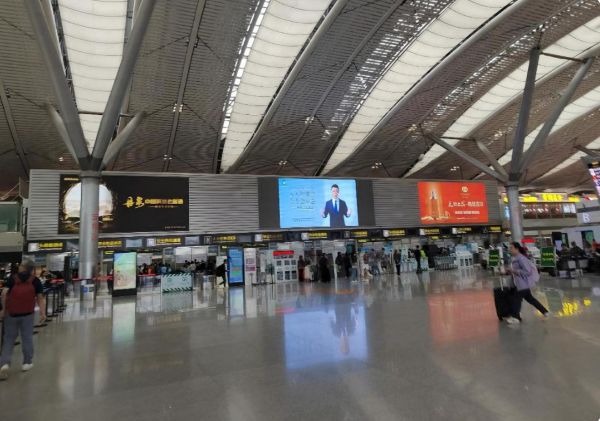
Buy the journey, not the billboard. Strong campaigns combine: one high-visibility anchor in the departure hall for brand stature; support formats along the security-to-gate corridor where attention peaks; and a conversion layer at baggage claim or ground transport carrying a QR code, vanity URL, or promotional code. This mirrors the awareness-consideration-action funnel physically.
Exploit timing. Align flighting with seasonal peaks (golden weeks, summer holidays, year-end) for consumer brands, or with conference and trade-fair calendars for B2B. Daypart pricing can also align creative with morning business departures versus evening leisure flights.
Design for the environment. Travelers are distracted and often luggage-laden. Creative must be legible at a distance, simple in message, and premium in aesthetic - cluttered or discount-style creative actively damages brand equity in this context. Include one effortless response mechanism: a short URL or QR that survives a busy terminal.
Negotiate smartly. Airport inventory is often underutilized outside peak seasons. Multi-month commitments, off-peak windows, and new-inventory launches are all legitimate leverage points for better effective rates.
4. Measuring Airport Campaign Effectiveness
Audience verification. Confirm delivered impressions against audited passenger data, broken down by route, cabin class, and month - this is your true "who did we reach" baseline.
Brand and consideration lift. Intercept surveys or online panels of recent travelers (exposed versus unexposed routes) measure awareness, image shift, and purchase intent - the core evidence for a channel whose job is prestige and priming.
Digital response tracking. Unique short links, QR codes, and search phrases on airport creative produce directly attributable visits and leads; premium products with considered purchase cycles often see response lagging weeks behind exposure, so evaluate over 60-90 day windows.
Commercial correlation. For duty-free partnerships, lounge enrollment, co-branded cards, or hotel bookings tied to arrival media, compare exposed-route versus control-route performance across the same period.
Report at least two layers together - verified reach plus lift or response - and resist evaluating airport media on CPM alone; the metric that matters is cost per high-value contact, not cost per thousand random impressions.
FAQ
Q: Is airport advertising only for luxury brands? No. Education, real estate, B2B services, and travel brands perform well; the common thread is a customer whose value justifies premium reach.
Q: Which terminal areas give the best value? Post-security corridors and baggage claim typically deliver the best attention-per-dollar; departure-hall anchors are stature plays.
Q: How long should a first campaign run? Eight to twelve weeks, one airport, one route segment - long enough to accumulate frequency on a low-repetition audience.
Conclusion
Airport advertising is not a media buy; it is an audience investment. The terminal gathers a pre-qualified, high-value, captive audience and arranges them along a predictable journey that smart advertisers can sequence from awareness to action. Choose airports by route mix, buy the passenger journey rather than isolated billboards, design to the environment's premium standard, and measure through verified reach plus lift and response data. Do this, and the airport's premium rates resolve into one of the most defensible line items in your media plan.