China Aircraft Advertising Market 2026: A Comprehensive Guide for Brands
2026-07-19Tianci MediaViews:5
Highlights
China's aircraft advertising market is experiencing a robust recovery and transformation in 2026. As the world's second-largest aviation market rebounds to pre-pandemic levels, aircraft advertising—spanning airport media, inflight content, and aircraft livery—has emerged as a premier channel for brands seeking to connect with high-net-worth travelers. With passenger throughput surpassing 1.46 billion in 2024 and growing at 15.9% year-over-year, the advertising opportunities within China's aviation ecosystem have never been more compelling.
Market Size and Growth Trajectory
The numbers tell a compelling story. China's airport advertising revenue reached RMB 9.57 billion (approximately US$1.3 billion) in 2024, with projections indicating a rebound to RMB 10.45 billion in 2025. Looking further ahead, the market is forecast to reach RMB 28.7 billion by 2026, representing a compound annual growth rate (CAGR) of 9.2%. On a global scale, China's inflight retail and advertising market is projected to reach US$935 million by 2030, growing at a CAGR of 7.3%.
In 2025 alone, total airport media投放 reached RMB 21.06 billion, with video media accounting for RMB 10.91 billion (52%) and print media contributing RMB 10.55 billion (48%). The market attracted 1,278 active brands, demonstrating sustained advertiser confidence in aviation media's unique value proposition.
Key Advertising Channels in Chinese Aviation
Airport Advertising
Airport advertising remains the dominant segment, leveraging the high-traffic, high-dwell-time environment of China's major hubs. Advertising formats include LED displays, large-format billboards, terminal wall ads, luggage trolley advertising, and digital interactive screens. The top five spending categories in 2025 were alcoholic beverages, apparel, software/IT, entertainment & leisure, and transportation—together accounting for 59% of total airport ad spend.
A notable trend in 2025-2026 has been the surge in AI and cloud computing advertising at airports. Leading tech giants including Alibaba Cloud, Baidu Cloud, Huawei Cloud, and Tencent have made significant investments in premium airport placements, with Alibaba Cloud reportedly spending over RMB 100 million on a single campaign. IT and internet advertising now accounts for 20% of ad revenue at hubs like Hangzhou Xiaoshan Airport, second only to food and beverage.
Inflight Advertising
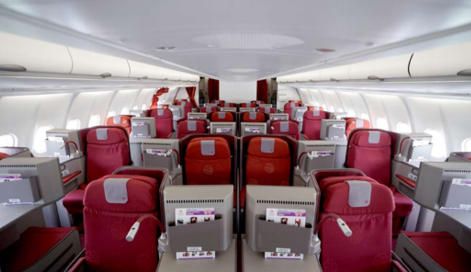
Inflight advertising offers brands a unique advantage: access to a captive, relaxed audience free from digital distractions. Key platforms include:
Inflight magazines – Distributed on major carriers including Air China, China Eastern, and China Southern, reaching business travelers and luxury consumers
Inflight Entertainment (IFE) video – Full-motion video campaigns on seatback screens with unskippable exposure
Boarding pass advertising – Back-of-boarding-pass placements
Seatback tray table and overhead bin advertising
China leads the Asia-Pacific inflight advertising market, driven by its large population, rapidly growing aviation sector, and strong domestic demand.
Aircraft Livery and Fuselage Advertising
Aircraft livery advertising transforms airplanes into "flying billboards". Chinese airlines have embraced this format through partnerships with major brands. Notable examples include:
China Southern × GAC Trumpchi – A full-body livery campaign
China Southern × Moutai – The "China Moutai" themed aircraft featuring the iconic red-white-blue color scheme
China Eastern × Pop Mart – A DIMOO-themed aircraft
China Eastern × Starbucks – "Yunnan Coffee Theme Flight"
A full-body aircraft livery typically costs around RMB 14 million (approximately US$2 million) for a one-year contract.
Why China's Aircraft Advertising Matters
High-Value Audience
China's top ten airports—including Beijing Capital, Shanghai Pudong, and Chengdu Shuangliu—handle 80% of the nation's air passengers, with business travelers accounting for approximately 70% of this traffic. Airport audiences are predominantly aged 25-50, representing the core demographic with independent purchasing power, stable incomes, and mature consumption habits.
Superior Engagement
Research indicates that 82% of frequent travelers actively notice airport advertising content, 61% can clearly recall advertised brands, and 57% take follow-up actions such as searching for the brand, making purchases, or scanning interactive codes. The average airport dwell time of 90-180 minutes provides extended exposure that digital channels cannot replicate.
Premium Brand Association
Airport environments convey prestige, quality, and authority. Brands advertising in this space benefit from an automatic association with premium positioning—a quality that is difficult to achieve through crowded digital channels.
Trends Shaping the Future
Digital Transformation
Digital advertising screens are proliferating across Chinese airports. By 2026, it is projected that over 80% of digital ad screens at major airports will be digital. AI-powered content generation, augmented reality (AR) interactive experiences, and programmatic ad buying are being deployed at hubs like Shanghai Pudong, where dynamic contextual advertising has boosted engagement rates by 47.3%.
Domestic Brand Dominance
Chinese domestic brands now account for 83% of airport media投放, up significantly from previous years, while international brand share has contracted from 19% to 8%. This shift reflects both the rise of Chinese brands and the increasing attractiveness of the domestic market.
Sustainability and Compliance
Regulatory frameworks including the Advertising Law, Personal Information Protection Law, and Data Security Law shape advertising practices. Sustainability is also gaining importance, with green requirements pushing LED adoption and recyclable material usage to over 70%.
Integration with Tourism and Retail
Airlines are increasingly partnering with tourism boards, luxury brands, and retailers to create integrated travel experiences. This "aviation +文旅" (aviation + culture/tourism) trend is creating new advertising opportunities across the passenger journey.
Conclusion
China's aircraft advertising market in 2026 presents a compelling opportunity for brands targeting affluent, engaged consumers in a premium environment. With robust market growth, technological innovation, and an increasingly sophisticated advertising ecosystem, the sector offers reach and impact that few other media channels can match. For brands seeking to establish premium positioning in the world's second-largest economy, aircraft advertising deserves serious consideration as a cornerstone of their marketing strategy.