

7 key points you must know about elevator advertising placement - how to achieve maximum exposure with minimal budget?
2025-12-05Tianci MediaViews:356
Highlights
Elevator advertising has become an important reach channel for urban brands and local businesses due to its high frequency, low cost, and precise reach. But many beginners often don't know where to start when it comes to the advertising process, budget, and effectiveness evaluation. This guide gradually breaks down the planning, execution, and optimization of elevator advertising from a practical perspective, helping you achieve maximum communication benefits with a limited budget.
Elevator advertising has become an important reach channel for urban brands and local businesses due to its high frequency, low cost, and precise reach. But many beginners often don't know where to start when it comes to the advertising process, budget, and effectiveness evaluation. This guide gradually breaks down the planning, execution, and optimization of elevator advertising from a practical perspective, helping you achieve maximum communication benefits with a limited budget.
一、 Basic Cognition of Elevator Advertising (What is Elevator Advertising? Advantages and Applicable Scenarios)
Definition and Common Forms of Elevator Advertising
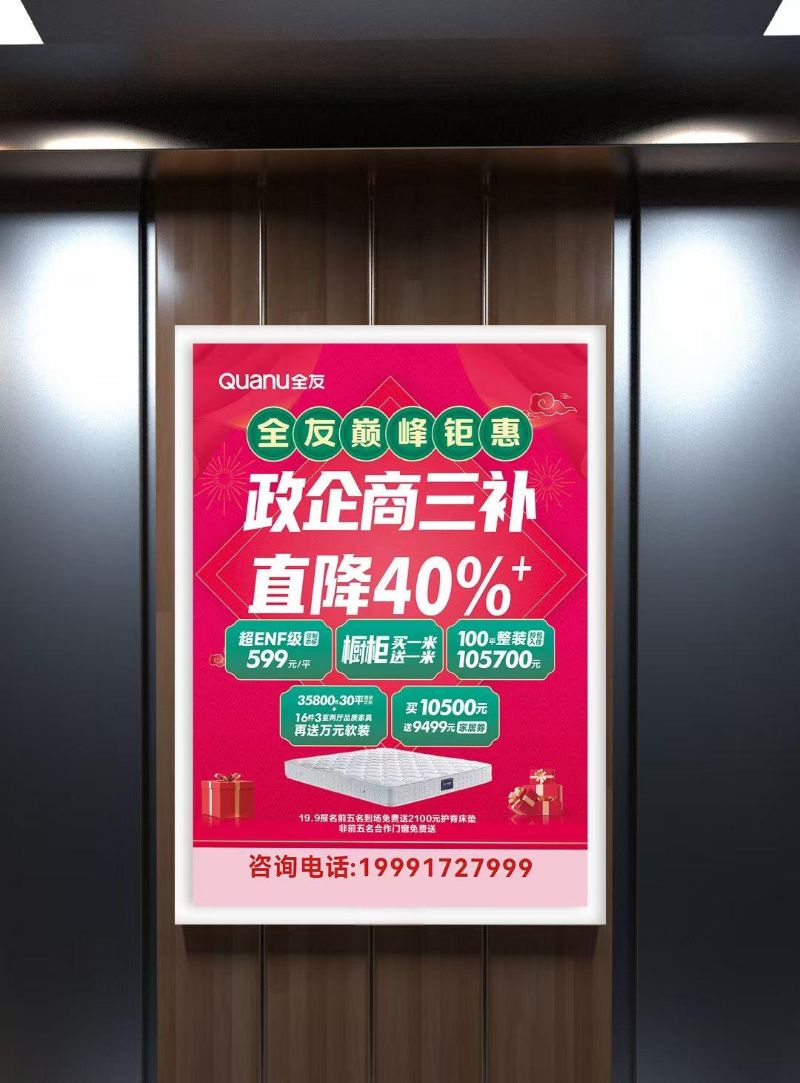
Definition: Advertisements placed on elevators and their surrounding areas in residential buildings, office buildings, shopping malls, or subways, including forms such as door stickers, car posters, floor advertisements, car LCD screens, and car push boards.
Common forms (quick list): car posters, door cover stickers, door handle advertisements, lighting light boxes, car screens (video/graphic).
The core advantages of elevator advertising
High reach frequency: The same group rides the elevator multiple times a day, resulting in high advertising exposure density.
Attention focused: When riding an elevator, the audience stays for a short time but their attention is focused, making it suitable for conveying a single and clear message.
Accurate targeting by region and audience: It can be targeted by building, floor, and audience attributes, suitable for localized marketing (such as catering, housekeeping, education, etc.).
Relatively controllable cost: Compared with outdoor large screens and televisions, the budget threshold is low, making it suitable for small and medium-sized enterprises to test the waters.
二、 Preparation before advertising (strategy and goal setting)
1: Clear target for advertising (mandatory)
Brand awareness: Enhance brand/store awareness (focusing on exposure and coverage).
Traffic guidance: guide offline to store or online ordering (focusing on conversion and action).
Event promotion: short-term promotions, member recruitment, etc. (with a focus on time sensitivity).
2: Determine the target audience and geographical scope
Select by building type: office buildings (white-collar workers)/residential buildings (housewives, students)/shopping malls (consumer groups).
Select coverage range based on radius and circle: community level, commercial district level, or city level.
3: Budget and KPI Setting
Develop a total budget, advertising cycle, KPI (exposure, in store rate, scanning frequency, etc.).
Estimate CPM (cost per thousand exposures) or CPC (cost per click/scan) within the budget for subsequent evaluation.
三、 How to develop creativity and copywriting (focusing on short, flat, and fast)
Key points of advertising creativity (best practices in elevator scenes)
(1) Information concentration: 1-2 core selling points to avoid information congestion.
(2) Large font size+strong contrast: The elevator ride time is short, and the title needs to be readable at a glance.
(3) Clear CTA: guide to the store, scan the code, make a phone call or mini program.
(4) Visual Focus: Use brand colors or large images to attract attention.
(5) Scenario based expression: Linking products/services with daily scenarios of residents/office workers.

四、 Elevator advertising placement process
1: Choose partner (platform vs agent)
Direct cooperation with media platforms: transparent cost, stable coverage, suitable for large-scale advertising.
Through local agents/advertising companies: Service support (design, negotiation) can be obtained, but attention should be paid to pricing and commissions.
2: Negotiation and Signing (Key Terms)
Duration of advertising placement, frequency of exposure, number of starting buildings, and specific location of advertising spaces.
Review process: creative review time, number of revisions, and cost.
Compensation terms: How to compensate for advertising space malfunction and failure to meet the agreed exposure.
Settlement method: Periodic settlement or one-time prepayment.
3: Production and installation
Size and material confirmation: common size standards, wear and moisture resistance requirements.
Color and print quality: color difference control, resolution (recommended 300 dpi).
Installation time window and on-site coordination: Elevator advertisements need to be communicated with the property management to avoid unauthorized installation.
4: Delivery monitoring and data tracking
Offline conversion tracking: scanning codes, coupon codes, appointment phone numbers, in store verification, etc.
Exposure/playback monitoring: If it is a video screen, it is required to provide playback logs or monitoring reports.
Periodic optimization: Adjust creative ideas, building combinations, or advertising frequency based on data.
五、 Budget and pricing (including elevator advertising fee standards)
1. Common charging models
Charged by location/building: commonly seen in posters and door stickers, priced per elevator or per building.
Billing by Cycle: Usually settled on a weekly or monthly basis.
Per screen/per playback count: commonly used for car LCD screens or video advertisements, charged by playback frequency or per thousand impressions (CPM).
Fee Standards for Elevator Advertising Placement (Example Explanation)
Note: The following is an exemplary structure, and the actual price is greatly affected by the city, building grade, coverage, and season. Before launching, the media should be requested to provide a detailed quotation.
Community housing (ordinary residential area): Monthly budget range for each elevator (example) ¥ 300-¥ 1200
High end office building: Monthly budget range for each elevator (example) ¥ 800- ¥ 3500
Car LCD screen (playback type): CPM billing or monthly subscription ranging from ¥ 1500 to ¥ 10000 (depending on playback frequency and coverage)
Door sealing stickers/floor stickers: billed by set or by building, ranging from hundreds to thousands per building per month
(Once again, it should be emphasized that the above values are for reference only and are subject to media quotes.)
六、 Effect evaluation and optimization (how to determine successful advertising)
1. Common KPI indicators
Impressions: Basic indicator.
Conversion rate to store: calculated by coupon code/scan code.
Scan rate/click through rate (if with QR code/short link).
Cost per Customer Acquisition (CPA): Total advertising cost ÷ Number of transactions.
Brand Memory Indicator: Conduct research to understand advertising memory.
2. Optimization strategy (iterating based on data)
Building replacement: Replace low conversion buildings with high potential buildings.
Creative iteration: Compare scan rates after changing the title or CTA.
Time/cycle optimization: Adjust the focus of advertising during holidays or working days.
Linking with other channels: Linking with social media and mini program advertising to improve the conversion loop.
七、 Common misconceptions and risk warnings (avoid pitfalls)
1. Common Misconceptions
Believing that wider coverage is better: blindly pursuing the number of buildings can lead to budget dispersion, prioritizing the selection of core buildings that match the target users is more effective.
Creative message stuffing: putting all the selling points on a poster, resulting in too much information and no clear CTA.
Only focus on exposure, not conversion: Exposure is the foundation, and the true measure of investment return is conversion and actual customer acquisition costs.
Neglecting property/compliance issues: Unauthorized installation may result in demolition or fines.
2. Risk and compliance recommendations
Sign a clear agreement with the property management to ensure legal installation and maintenance.
Advertising content must comply with advertising laws and industry norms (prohibition of false advertising, protection of minors, etc.).
Request the media to provide fault and compensation mechanisms to reduce investment risks.
八、 Practical novices quickly get started (3-week action plan)
1. Research and positioning
Clear goals (exposure/in store/promotion), select 3-5 target buildings.
Prepare materials and copy (concise and clear).
2. Negotiation and installation
Sign contracts with media or agents to confirm the delivery cycle and return indicators.
Complete material production and installation.
3 Monitoring and optimization
On the 7th and 14th days, review the data (scan code, visit store, feedback) and make a minor revision or building replacement.
Determine whether to expand advertising or conduct A/B testing based on cost and effectiveness.


