Shanghai Airport Advertising: Pudong vs Hongqiao – A Complete Strategy Guide
2026-06-09Tianci MediaViews:71
Highlights
For brands aiming to reach affluent travelers, business elites, and global luxury consumers, few locations rival the strategic power of Shanghai airport advertising. As China‘s most dynamic aviation hub, Shanghai operates two distinct airports—Pudong International (PVG) and Hongqiao International (SHA)—each offering unique audience profiles and advertising advantages.
Why Advertise at Shanghai Airports
Shanghai‘s two airports serve as a “super brand showroom” where global capital, top-tier talent, and high spending power converge. In the 62‑day summer travel season of 2025 alone, the two airports handled a combined 147,000 flights and 24.18 million passengers, averaging 390,000 travelers per day—a 5 % year‑on‑year increase. During the 2025 National Day holiday, they processed 3.25 million passenger trips, with the daily average rising 9.3 % to 406,000 trips, another record.
Beyond raw scale, airport environments offer extended dwell time, a premium and captive mindset, and low ad avoidance—ideal conditions for high‑impact brand messaging.
Pudong (PVG) vs Hongqiao (SHA): Know the Difference
Choosing between the two airports is not a matter of budget alone—it is a direct reflection of brand strategy.
Shanghai Pudong International Airport (PVG) serves as China‘s primary international gateway. Its passenger base consists of international travelers, long‑haul business passengers, and high‑spending tourists. Advertising here is about global brand building and establishing international trust. The most valuable placements lie along international departure and arrival routes.
Shanghai Hongqiao International Airport (SHA) is China’s premier domestic business aviation hub. Its passengers are corporate executives, private equity principals, technology founders, and senior government officials moving between Shanghai, Beijing, Guangzhou, Shenzhen, and other commercial capitals. SHA reaches the people who run the world‘s second‑largest economy—not “passengers” passing through, but decision‑makers. Domestic capacity utilization is among the highest of any Chinese airport.
Premium Advertising Formats in Shanghai Airports
Shanghai offers a diverse media matrix, from monumental displays to precision digital placements:
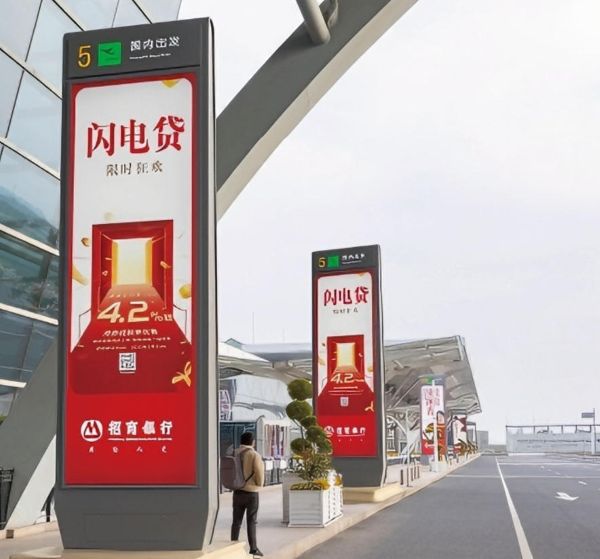
LED Digital Mega‑Screens – Located at check‑in halls and international arrival corridors. One notable example is a 178 sq. meter LED board in Pudong’s international departure hall, using 300 LED cabinets to achieve 11K resolution. At Hongqiao, an 18m × 6m main screen paired with a 12m × 4m auxiliary screen supports 8K content playback.
Airport Domination (Takeovers) – Premium brands often claim multiple touchpoints. Prada unveiled a 4,000 sq. meter billboard atop the Fixed Base Operator at Hongqiao Airport in 2026, positioned to be viewed from arriving private jets against Shanghai‘s skyline. Louis Vuitton also debuted its “Towards a Dream” campaign at Hongqiao’s Terminal 2 concourse.
Jet Bridge Ads – The last enclosed space before passengers board; ideal for deeper product messaging with high attention.
Baggage Claim Carousel Wraps – Travelers wait with focused attention, making this a high‑conversion zone for destination services or retail offers.
DOOH & Programmatic Screens – Digital out‑of‑home now accounts for 45 % of Shanghai‘s total airport advertising revenue, with media digitalization reaching 35.6 % across both airports (over 90 % at Pudong’s satellite terminal). In 2024, Vistar Media partnered with VIOOH to open access to 864 premium DOOH screens in Beijing and Shanghai, including inventory at both airports.
Smart IoT Media Management – Shanghai operates the first airport‑developed IoT management platform in China, with remote power control across 661 digital media points and RFID‑equipped luggage carts to analyze passenger flow and ad exposure data.
Measuring Effectiveness
Brands can track performance through:
Unique QR codes or short URLs embedded in each creative
Geo‑fencing paired with mobile attribution (via programmatic DOOH platforms)
Dedicated promo codes (e.g., “SHAFLY10”)
Post‑campaign surveys with travelers at departure gates
Cost and Key Considerations
Pricing depends on airport, location within terminal (international > domestic), media format (LED > jet bridge > carousel), seasonality, and contract duration. Expect significant premiums for peak business travel periods such as March–June and September–November. Long‑term annual contracts offer substantial discounts.
The Bottom Line
Shanghai airport advertising delivers access to one of the world‘s most valuable travel audiences. Brands pursuing global prestige should prioritize Pudong’s international corridors; those targeting China‘s corporate elite will find unmatched efficiency at Hongqiao. With digital transformation and programmatic DOOH now fully operational, measurable campaigns are not just possible—they are the new standard.