New Trends in Airport Advertising in 2026: How Digitalization and Scenario-based Marketing Triple Brand Exposure ROI
2026-05-31Tianci MediaViews:730
Highlights
A decade ago, airport advertisements were merely billboards for big brands to showcase their strength. Today, with the maturity of the Internet of Things, AI recognition and programmatic buying technologies, airport advertising has evolved into a precise marketing platform featuring quantifiable results, continuous optimization and interactive capabilities. Data from the first half of 2026 shows that brands adopting digital airport advertising packages have seen their average ROI rise by 187% compared with traditional fixed light box ads, and the figure even exceeds three times for some FMCG brands. So what exactly has changed with airport advertising in 2026? How can brands achieve higher genuine conversions with a smaller budget? This article analyzes three major technological transformations and four practical industry strategies, and provides a ready-to-use advertising placement checklist.
I. Three Major Digital Transformations of Airport Advertising in 2026
1. From "fixed carousel" to "programmatic real-time bidding"
In the past, LED screens at airports played content according to a fixed schedule, showing the same material to every passer-by, whether business elites or tourist groups. Nowadays, programmatic digital out-of-home (pDOOH) advertising has become prevalent in major airports.
- Identify crowd density, gender and age range, and dwell time via desensitized camera data.
• Connect to ADX (Ad Exchange) in real time. Brands can place bids as needed and only purchase time slots when high-value crowds are present.
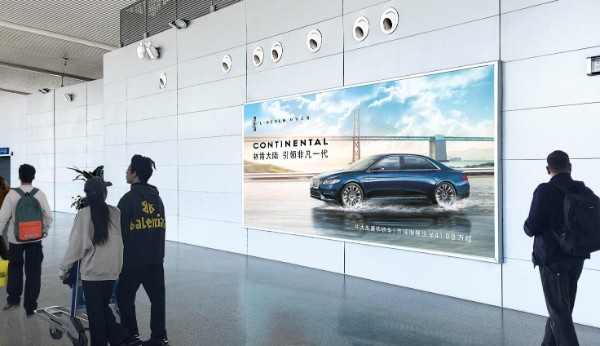
• Example: At boarding gates of business express routes from 7:00 to 9:00 on workdays, advertisements for high-end vehicles are automatically displayed. During the peak hours of family trips from 15:00 to 17:00 in the afternoon, the content is switched to parent-child travel products.
Data evidence: For airport ad campaigns using pDOOH, the cost per thousand impressions (CPM) has decreased by 22%, while the lead validity rate has increased by 41% (Source: 2026 Global Digital Out-of-Home Advertising White Paper).
2. Interactive screens combined with AI voice and vision technology turn casual passers-by into potential leads
In 2026, AI-powered interactive advertising screens have been installed in the main waiting areas of China's top 20 airports. Passengers can interact with the advertisements via gestures, voice commands or QR code scanning:
- Voice Activation: Say "I want a test drive" to the screen to book an exclusive test drive service at the airport, with flight information synchronized automatically.
• Facial Age Recognition: Beauty brands recommend different product lines based on the recognition results and print out vouchers for free samples.
• Motion-Sensing Games: Sports brands launch basketball shooting or running games, and winners can receive discount codes for duty-free shops.
A new energy brand launched AI interactive screens at Hongqiao Airport Terminal 2. Within 30 days, it obtained 2,147 test drive leads at a cost of merely 68 yuan per lead, which is one-third of the cost of online feed ads.
3. Full-link data integration: From airport exposure to online transactions
The standard configuration for airport advertising in 2026 is unique device ID tracking (anonymized in compliance with privacy regulations):
- When passengers connect to the airport's free Wi-Fi or Bluetooth beacons, the advertising system records exposure IDs.
• If the ID is used to visit the brand's official website, mini-programs or physical stores within 72 hours, the conversion will be attributed to airport advertisements.
• Combined with the "homologous sample" models of e-commerce platforms such as JD.com and Tmall, the actual sales conversion can be estimated.
Case: A high-end skincare brand placed advertisements with the slogan "Scan the QR code to get free samples" on light boxes in the arrival hall of the Capital Airport, while tracking subsequent user behaviors via Wi-Fi MAC addresses. The results showed that customers who viewed the ads and scanned the QR codes had an average order value of 1,480 yuan within 30 days, which was 67% higher than that of regular new customers.
II. Airport Advertising Placement Strategies for Four High-Conversion Industries (2026 Edition)
Users across different industries have vastly different decision cycles and touchpoint preferences. Below are proven combined solutions.
Industry 1: New Energy Vehicles
Pain Points:High costs for test drives and inconsistent quality of online leads
Airport Strategy:
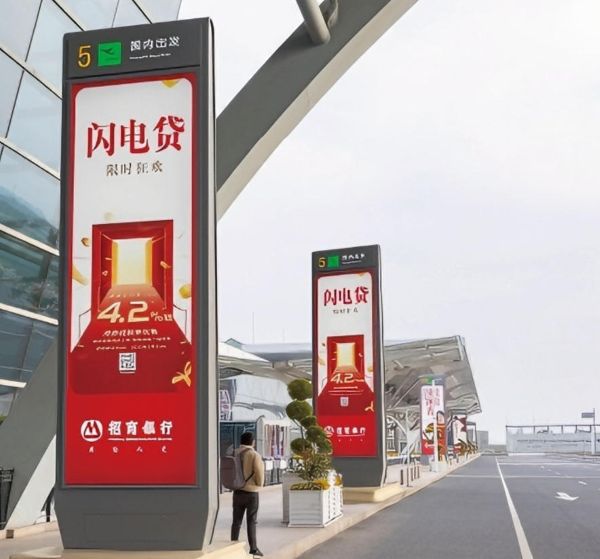
- Location selection: Near the VIP passage on the departure floor + Columns at the ride-hailing pickup area
◦ Form: LED large screen (brand story) + Interactive screen (Scan the QR code to book an airport test drive with one click and enjoy fast vehicle pickup)
◦ Creative slogan: "Take a test drive and head straight home right after landing"
- Location selection: Near the VIP passage on the departure floor + Columns at the ride-hailing pickup area
Performance Indicators: Cost per test drive < 80 yuan, Test drive conversion rate > 18%
Industry 2: Cosmetics & Perfume
Pain points: High requirements for user experience and fierce competition among airport duty-free shops
Airport Strategy:
- Selected locations: International Departure Lounge, Baggage Carousel
◦ Format: Interactive screens (AR virtual makeup try-on) + exclusive QR codes for nearby duty-free shops (10% discount)
◦ Creative slogan: "Try on shades before boarding, grab your picks directly at duty-free shops"
- Selected locations: International Departure Lounge, Baggage Carousel
Effect indicators: The coupon redemption rate via scanning QR codes exceeds 22%, and the redemption rate at duty-free shops is 2.1 times higher than that of regular advertisements.
Industry 3: High-end Finance / Credit Card
Pain points: High barriers to trust and a need for situational resonance
Airport Strategy:
- Selection of locations: VIP lounges, first-class security check lanes
- Form: Immersive projection (displaying global business travel privileges) + Embedded NFC (tap with mobile phone to access card application link)
- Core creative slogan: "One card makes every airport lounge around the world yours"
- Selection of locations: VIP lounges, first-class security check lanes
Performance Indicator: The application conversion rate of Platinum Card increased by 0.8 percentage points (Baseline: 0.5% → 1.3%)
Industry 4: Tourist Destinations / Airlines
Pain points: Long decision-making cycles and distinct seasonality
Airport Strategy:
- Spot selection: Arrive at the baggage carousel (capture the excitement right after landing)
◦ Format: Light box + interactive screen themed "Light Up Your Next Destination" (tap to generate travel posters)
◦ Core creative slogan: "Just landed, already planning the next takeoff"
- Spot selection: Arrive at the baggage carousel (capture the excitement right after landing)
Performance Indicators: Destination search volume increased by 210%, and the dwell time on the event page tripled.
III. 2026 Airport Advertising ROI Calculation Model (With Formulas)
Many brands mistakenly believe that airport advertising only delivers exposure and cannot be measured for returns. In fact, with well-established tracking links, the return on ad spend can be calculated accurately.
Basic Formula:
Airport Advertising ROI = (Direct Conversion Sales Revenue + Incremental Brand Search Value) / Total Advertising Cost × 100%
Among them:
- Direct converted sales = Total transaction volume generated by exclusive QR codes/short links (including online and offline)
• Incremental value of brand search = (Increment of Baidu Index after launch × Industry average CPC) × 0.6 (conservative coefficient)
Simple Template (taking a 30-day launch cycle as an example):
| Project | Sample data |
|---|---|
| Total advertising cost | 120,000 Yuan (including commission fees, production and interactive technology) |
| Exclusive Code Transaction Volume | 245,000 yuan |
| Average daily search volume before launch | 380 times |
| Average daily search volume after launch | 620 times |
| Increment (240 times/day × 30 days) | 7200 times |
| Industry Average CPC | 2.5 Yuan |
| Search Incremental Value | 7200 × 2.5 × 0.6 = 10,800 yuan |
| Total revenue | 24.5 + 1.08 = 25.58 ten thousand yuan |
| ROI | (25.58 - 12)/ 12 × 100% = 113% |
This ROI has outperformed most feed ads, and the brand trust value generated by airport ads yields long-term compound returns.
IV. 2026 Airport Advertising Implementation Checklist (Directly Savable)
Please check each item one by one before your next launch.
- Have you selected an airport media supplier with pDOOH capabilities?
• Have you embedded independently trackable QR codes, short links or passcodes in the advertising materials?
• Have you prepared at least two sets of creative content based on flight time periods (morning, evening and weekends)?
• Have you signed a compliance tracking agreement with the provider of airport Wi-Fi or Bluetooth beacon data?
• Have you set up A/B test groups (e.g., comparing the performance of left light boxes versus right LED screens)?
• Do you record brand search index and social media mentions before, during and after the ad campaign?
• Have you reserved 5%-10% of the budget for real-time optimization (e.g., switching placements immediately if a certain location delivers low ROI)?
V. Trend Forecast for the Next Year: Airport Advertising Will Become an "Offline Performance Media"
By 2027, it is projected that 80% of premium advertising spaces at major airports will support programmatic buying and real-time performance tracking. Airports will evolve from "brand image media" into attributable offline performance media.
For brands, now is the perfect time to seize the dividends of digitalized airport advertising. There is no need for a multi-million budget; a monthly average of 80,000 to 150,000 yuan is enough to launch programmatic advertising trials at provincial capital airports. The key is to replace experience-based thinking with data-driven thinking, and manage airport advertising in the same way as online advertising.
If you are looking for a low-cost and high-trust customer acquisition channel for high-end products, we recommend contacting airport media service providers with data capabilities right away to obtain the crowd heat maps and historical transaction cases of your target airports.
Action Suggestion: Compare the ROI calculation model and industry strategies in this article with your company's target audience and product unit price. This will help you quickly assess whether airport advertising is a good fit for your business. Feel free to leave a message if you have any specific requirements.