
- Photos
- Specs
- Advantages
- Value
- Media Map
| Area:Guangzhou | Type:high-speed railway | Frequency:120 |
| Address:No. 133, South Station South Road, Shibi Street, Panyu District | Format:led | Duration:10s |
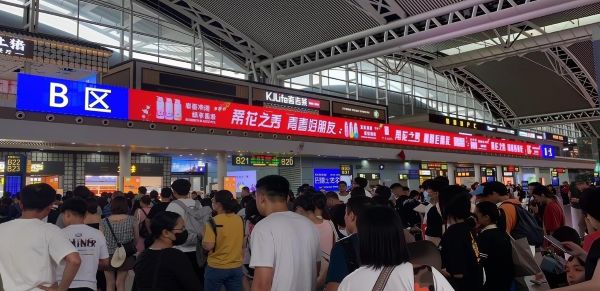
| Location:Above the ticket checkpoint in the South Station waiting hall | Min Qty:4 | Operating Time:6-24o'clock |
| Size:1.75m*70m | Min Period:month |
The media is located directly above the main line where passengers queue for ticket checking, which is a path that every passenger must pass when entering the gates. The screen offers clear and vibrant visuals with no obstructions. Since passengers naturally look up here to check train information, the ads are highly effective and hard to miss. With close-range, long-duration, and high-frequency repeated exposure, brand recall is greatly enhanced, and information reception far exceeds that of regular outdoor media.
All units use high-definition, high-refresh LED screens with delicate colors, transparent image quality, and smooth dynamic effects. Passengers looking up while queuing to check tickets can see the screens unobstructed by columns or shops. The average wait time for passengers is 5–25 minutes, allowing repeated close-up viewing of dynamic LED content. Compared with static lightboxes, dynamic videos grab more attention. With up to 120 cycles of playback per day, brand memory is reinforced, making it perfect for fully telling brand stories, promotions, or product highlights.
The audience is mainly young and middle-aged consumers aged 18–55, with over 65% being high-income, high-spending groups. It covers four core premium segments: business elites in the Greater Bay Area, cross-border commuters between Hong Kong and Macau, families traveling for culture and tourism across provinces, and young trend-focused consumers. These groups have both decision-making power and purchasing intent, making them a perfect match for diverse campaign needs like business, cultural tourism, home products, and gifts. Compared to ordinary outdoor media, this audience is higher quality and the advertising conversion potential is stronger.
Through close-range, long-duration, and high-frequency immersive exposure, brand recall and information reception far exceed conventional outdoor media. At the same time, high-definition dynamic LED screens can play promotional videos, drive activity traffic, showcase products, and other various content, accurately matching travelers' pre-consumption decision-making scenarios. This enables full-chain marketing from exposure to interest to conversion, and advertisers can see tangible, perceptible results, with high renewal rates and much higher monetization efficiency than ordinary in-station media.
Close-up, high-visual screens are 3–8 meters away from travelers, with clear visuals, unobstructed sightlines, and high attention. Multi-screen synchronized playback forms a panoramic brand network, supporting videos, GIFs, and multilingual content. Dynamic displays replace traditional lightboxes, offering stronger visual impact and higher memorability, efficiently reaching travelers with long dwell times and mandatory viewing. Effective attention time is 3–5 times that of regular media.
Ticketing and waiting areas are key pre-consumption windows for users' travel decisions. Travelers are in the planning stage for tourism, car purchases, gifting, and cross-border shopping. The quiet, low-distraction waiting environment is perfect for soft branding, traffic-driving activities, and regional promotions. It allows precise integration of consumer awareness and guides offline conversion, achieving a full marketing loop from 'brand exposure – user interest – consumer conversion.' The marketing impact here outperforms post-travel or outdoor media placements.